One Amsterdam Vertical Farm, 1,100 Dutch Supermarkets, Normal Prices
How Growy put one Amsterdam vertical farm into about 1,100 Dutch supermarkets at normal prices, and what Philadelphia should ask before funding one.
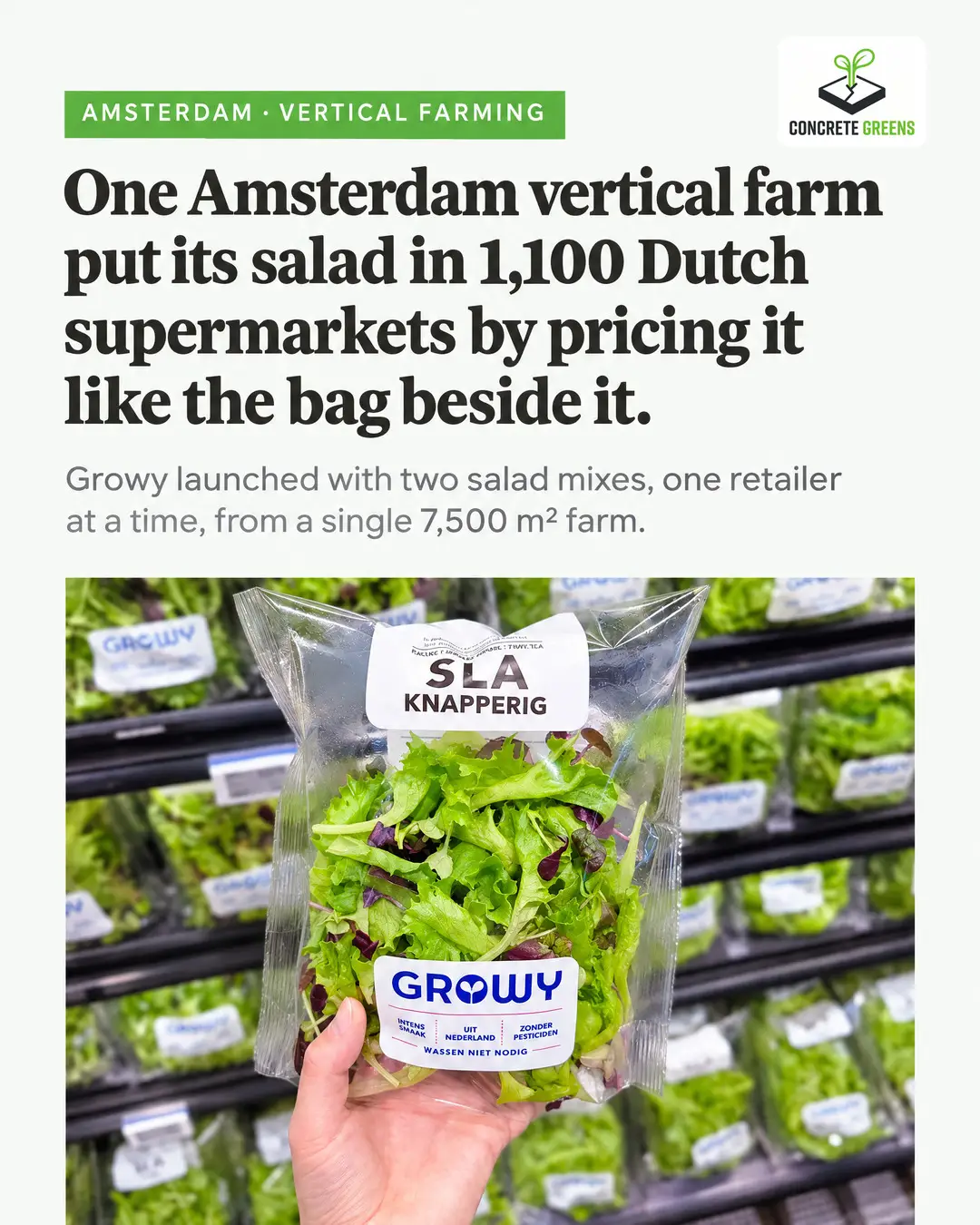
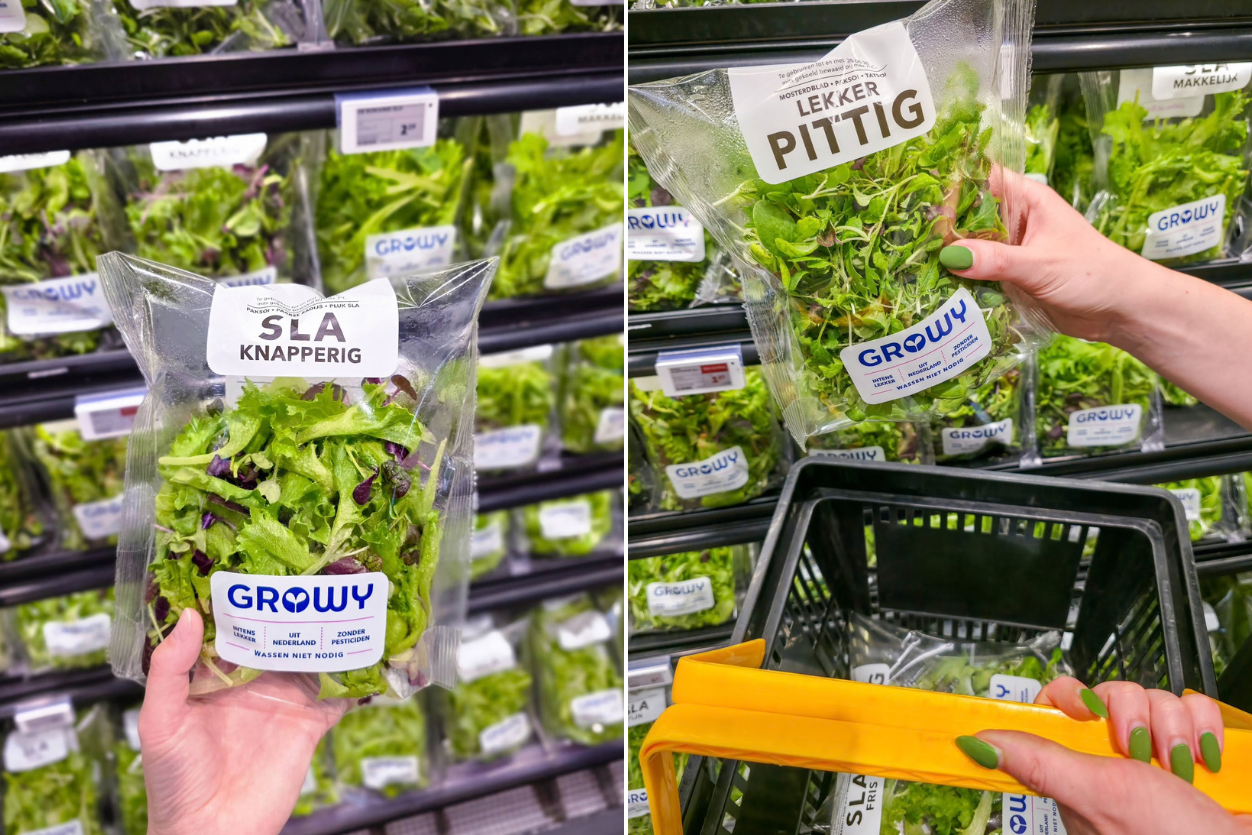
A hand holds a clear bag of salad up against a supermarket shelf. The label on top says Knapperige Sla, crispy lettuce, and the sticker on the front says Growy. Behind it, row after row of the same bags. That is a photograph Growy published of its own salad in a Dutch supermarket, and I keep coming back to it because nothing in it looks futuristic. It looks like lettuce. It sits where lettuce sits. And according to VerticalFarmDaily’s report of 5 November 2026, that ordinary bag is now in around 1,100 stores across the Netherlands: at least 600 Jumbo stores, 400 PLUS stores and 100 DekaMarkt stores, all supplied from one farm in Amsterdam. I think the most radical thing a vertical farm did this year was charge the normal price. Here is how Growy got there, what it cost them, and what I would ask before Philadelphia puts public or foundation money into an indoor farm of its own.
What Growy Actually Sells, and Where
Growy grows salad mixes and herbs indoors, in stacked layers under lights, close to the city. Its own story page puts it plainly: no open field, no tractor, plants given light, water, nutrients and air in a room where every one of those can be tuned. The farm in Amsterdam covers 7,500 square meters, and it is the farm that supplies Growy’s bags on Dutch shelves, as VerticalFarmDaily reported in its April interview with co founder Laura van de Kreeke.
The detail I care about most is the shelf. Growy sells under its own name in the regular produce section, next to lettuce grown the conventional way, and the April interview says its products are priced in line with the greenhouse grown and imported alternatives already on Jumbo shelves. Not a premium cooler by the door. Not a specialty line with a story printed on the bag and a price to match. The same aisle at roughly the same price.
Van de Kreeke said it directly: “From day one, we’ve been clear that vertical farming only works if it’s affordable. We didn’t want to launch as a premium niche; we wanted to compete head-on with conventional produce.” That sentence sounds like a grocer wrote it.
From 20 Pilot Stores to 1,100, One Retailer at a Time
The sequence matters as much as the price. The November report says the rollout began with 20 pilot stores. For about a year Growy supplied a limited number of stores, mostly in the Amsterdam region, and the company says that pilot proved two things to retailers: people wanted it, and the farm could deliver it reliably. “Once we supplied all the Jumbo stores in the Amsterdam area consistently, we knew we were ready for the next step,” van de Kreeke told VerticalFarmDaily.
The next step came on 11 April 2026, when Growy lettuce went into 500 Jumbo stores across the Netherlands, just days after the company’s seventh anniversary. It launched nationally with two salad mixes, the spicy Lekker Pittig and the crispy Knapperige Sla. Two. Capacity was finite, so the company chose reliable supply over a long product list.
It also chose one retailer. “Our full focus right now is on making Jumbo a success,” van de Kreeke said in April. “We’ve seen that if you scale too fast across retailers, you risk losing control of quality and execution.” By September, Growy was in more than 600 Jumbo locations with a third mix, Frisse Sla, and two products on Jumbo’s online store. Only after that did PLUS and DekaMarkt come in. PLUS carries two of the salads, with shelf space limited to two products until next year, and DekaMarkt also stocks five Growy herbs. Growy’s own store page now tells shoppers they can find the lettuce at Jumbo across the country.
The company says it reached shoppers without large marketing campaigns or big launch events, and van de Kreeke points to repeat purchases as the proof that counts. “People tried them, sent us messages and started asking where they could find us. And most important of all: they came back for more.”
Count it out. One farm. Twenty stores. Two products. One retailer. Then 500 stores, then 600, then three retailers and about 1,100 stores. Each step waited on the one before it.
What It Cost Them
I do not want to tell this as a fairy tale, because it is not one. In November 2025, Growy Singapore went into provisional liquidation. That company ran a farm Growy had taken over in 2023 from Kalera International, an American vertical farming company that had filed for bankruptcy. HortiDaily reported that a notice in Singapore’s Government Gazette on 4 November confirmed it, less than a year after the 8,000 square meter farm near Changi Airport officially opened in November 2024, and that the farm had been developed with support from a Singapore Food Agency grant program aimed at producing 30 percent of the country’s food locally by 2030. The Straits Times, as carried by The Star, reported that the company’s losses rose from S$2.17 million in 2023 to S$5.5 million in 2024.
Growy’s own explanation was that it had tried to run the Singapore farm with the technology already in place and kept facing high costs and inefficiency. Van de Kreeke drew the line between the two farms in April: Amsterdam is “fully in-house developed, designed for efficiency, and built with cost price as a starting point, not an afterthought.”
That sentence is the whole lesson for me. The same company, the same people, two buildings. The one designed around what the bag has to sell for is the one that survived.
And Amsterdam has its own limit. In April the plan included a second Dutch farm. By November van de Kreeke said it “was sadly way more complicated than expected,” and the company is putting its effort into international projects instead. So the Amsterdam farm is running at full capacity and almost completely selling out. Growth now waits on new buildings, not on new customers. I would rather have that problem than the opposite one.
Why the Boring Version Is the Radical One
Here is where I get a little worked up. For years the indoor farming conversation in this country has been about the building: the square footage, the robots, the lights, the funding round. I wrote in September about 80 Acres Farms, which reached 18,000 stores and still could not find the capital to keep going. Shelf space alone did not save it. Stores are not the answer by themselves. The order is.
Growy flipped the order. Price first. Buyer second. Range third. Building size last. And before somebody tells me the Netherlands is a different market with different energy prices and different grocery chains, yes, it is. I am not asking Philadelphia to copy a Dutch farm. I am asking us to copy the questions.
This is also exactly the model I want for Concrete Greens. Indoor growing should complement the farms we already have, not pretend to replace them. Local greens all year, at a price the shelf already accepts, with revenue that covers the costs and the surplus going to neighbors who need it. None of that works if the bag costs twice what the bag beside it costs.
The Four Things I Would Ask Before Philadelphia Funds an Indoor Farm
Philadelphia is already asking a version of this question from the other side. In October, City Council approved hearings on a city supported grocery store, and I wrote about what Atlanta’s experience means for that hearing in Atlanta’s Azalea Fresh Market and Philadelphia’s Grocery Question. A neighborhood grocer is the demand side. Someone also has to fill the salad shelf, at a price that neighborhood can pay. That is the supply side, and it is where an indoor farm either earns its place or does not.
So if a grower, a city program or a foundation here is about to put money into an indoor farm, these are the four things I would want on the table first.
First, a signed retail buyer. Not interest, not a letter of support. A grocer that has agreed to put the product on its shelf, the way Growy had Jumbo stores in Amsterdam before it went national.
Second, a price at parity with the bag already on that shelf. If the plan needs shoppers to pay a premium for the story, the plan is a gamble on goodwill, and goodwill does not restock a cooler.
Third, a capped product range. Growy went national with two salad mixes. A new farm that promises fifteen products on day one is promising something its first year cannot prove.
Fourth, a pilot sized like Growy’s: about 20 stores, long enough to show consistent supply before anyone asks for a bigger building.
None of these four requires new technology. They require patience and a grocer at the table. Bring them to the next pitch you hear, and to the Council hearing when it comes. Ask who is buying, and at what price, before you ask how big the building is.
About the Author
Harry Hayman is a Philadelphia-based entrepreneur, music producer, and cultural advocate. Through his work with the Feed Philly Coalition, he explores and documents the creative, culinary, and civic life of a city he believes is one of the most inspired places in America.
Sources and references
- VerticalFarmDaily: Growy expands to 1,100 stores across the Netherlands (5 November 2026)
- VerticalFarmDaily: Dutch vertical farmer Growy expands to 500 Jumbo supermarkets nationwide (14 April 2026)
- VerticalFarmDaily: Laura van de Kreeke, “We wanted to compete head on with conventional produce” (17 April 2026)
- VerticalFarmDaily: Vertical farming can deliver at supermarket scale (24 September 2026)
- Growy: Our story
- Growy: Waar te koop (where to buy)
- HortiDaily: Growy Singapore enters provisional liquidation less than a year after opening (6 November 2025)
- The Star, from The Straits Times: Singapore vertical farm Growy winding up after official launch in November 2024
- The Philadelphia Inquirer: Should Philly open a city supported grocery store? (8 October 2026)
- Atlanta’s Azalea Fresh Market and Philadelphia’s Grocery Question
- 18,000 Stores and Still No Capital: What 80 Acres Farms Reveals About Farm Financing
- Photograph: Growy salad bags on a Dutch supermarket shelf, © Growy, published by VerticalFarmDaily. The poster at the top of this page is a designed graphic built from this photograph, which is Growy’s own press image, used here for news commentary with credit to Growy.