Florida's Right to Garden Law and What Philadelphia Could Copy
Florida made local bans on home vegetable gardens void in 2019. I look at that law, England's allotment duty and what Philadelphia could copy.
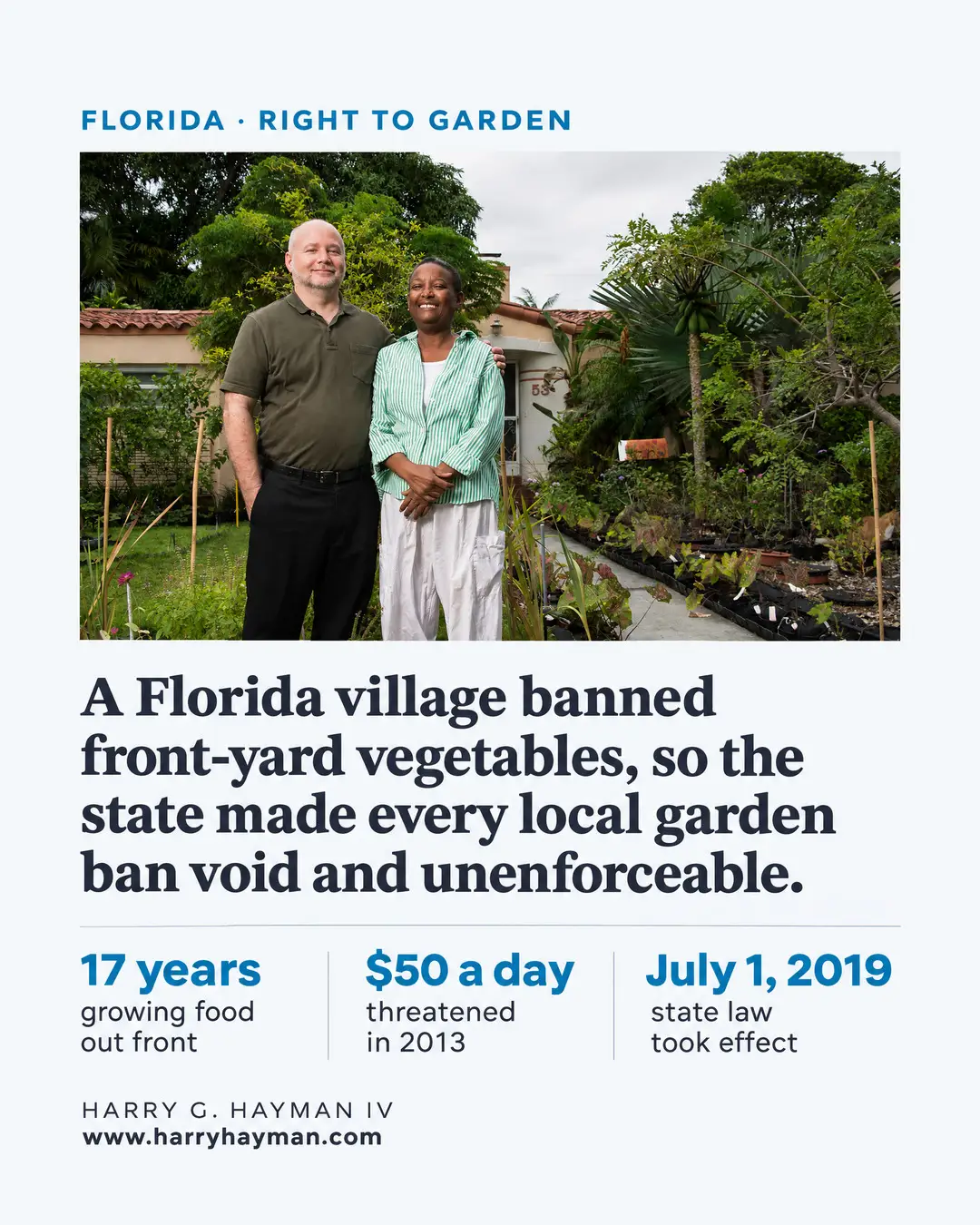
On July 1, 2019, Hermine Ricketts and Tom Carroll put okra, bell peppers, cherry tomatoes, jalapeños and squash back into the front yard of their home in Miami Shores, Florida. NPR reported the planting on the day a new state law took effect. Six years earlier their village had made that same garden illegal, and they had lost every round in court trying to keep it. What changed was not a judge’s mind. The Florida Legislature wrote a few lines that took vegetable gardens off the list of things a town can ban. I keep coming back to that, because it is a policy model, and models travel. In October I wrote about a gardener in Chino, California, who ended up at a code hearing. That piece was about the fight. This one is about the fix, who has already written it into law, and what a version could look like for Philadelphia.
The few lines Florida wrote
The law is section 604.71 of the Florida Statutes, created by Senate Bill 82 in 2019. It is short enough to read on a phone. It opens by saying the Legislature wants to encourage growing vegetables and fruit at every level, including for personal use. Then it does the work: a county, municipality or other political subdivision “may not regulate vegetable gardens on residential properties,” and any local ordinance or regulation that does is “void and unenforceable.”
The definition is generous. A vegetable garden is a plot where “herbs, fruits, flowers, or vegetables are cultivated for human ingestion.” And the law keeps what towns actually need. Local governments can still pass general rules on water use during drought, fertilizer use and the control of invasive species, as long as those rules are not aimed at vegetable gardens in particular. It took effect on July 1, 2019.
Read it as a city operator and the design is clean. The state does not tell anyone what to plant. It removes one kind of local rule, the kind that treats food as an eyesore, and leaves the rules about water, chemicals and pests where they were.
Why a courtroom could not fix it
The story behind the law is laid out on the Institute for Justice case page. For 17 years, Ricketts and Carroll grew food in their front yard. NPR explained why the garden sat out front: the house faces south and the backyard is mostly in shade. In May 2013 the Miami Shores Village Council amended its zoning code to read, “Vegetable gardens are permitted in rear yards only.” Within days the couple received a notice, with fines of $50 a day if the vegetables stayed. They pulled the garden up.
They sued that November. They lost on summary judgment in 2016, and in November 2017 Florida’s Third District Court of Appeal upheld that ruling, finding no constitutional right to grow vegetables on their own property. The Florida Supreme Court declined to hear the case.
I do not read that as a story about bad people at the village. Inspectors enforce what a council writes. The ordinance said rear yards only, so a garden in a sunny front yard became a violation. The trouble was the rule. And a court can only ask whether a rule is allowed. It cannot write a better one. The legislature can, and in June 2019 Governor Ron DeSantis signed it.
Illinois, Maine and California each drew a different line
Florida did not stay alone for long. In 2021 Illinois passed its own garden law, Public Act 102-0180. The municipal law firm Ancel Glink summarized it this way: “any person may cultivate a vegetable garden on their private property or on private property with the owner’s permission.” Illinois kept a little more for towns than Florida did. Local governments can still regulate “height, setback, water use, fertilizer use, or control of invasive or unlawful species,” and the law overrides home rule, so a large city cannot opt out. I like that balance. Nobody needs corn blocking the sight line at a corner, and a height rule handles that without banning the tomatoes.
Maine went to its constitution. On November 2, 2021, voters approved Question 3 with 60.84 percent of the vote, declaring a right “to grow, raise, harvest, produce and consume the food of their own choosing” for each person’s own nourishment. Maine Public reported it was the first right to food amendment in any state constitution. It is broader and vaguer than Florida’s law, and Maine’s high court ruled in March 2024 that it does not override the state’s ban on Sunday hunting. A constitutional right states the value. A statute like Florida’s spells out the rule.
California took a narrower path aimed at private rules rather than city ones. Section 4750 of the California Civil Code makes any homeowners association rule “void and unenforceable” if it “effectively prohibits or unreasonably restricts the use of a homeowner’s backyard for personal agriculture.” Backyard only, but it reaches the association rulebooks that a city ordinance never touches.
Three states, three tools: a statute that preempts towns, a constitutional right, and a limit on private covenants. Together they cover most of the ways a home garden gets shut down.
England and Wales made it a duty to provide land
The English model works from the other direction. It is not about your own yard at all. It is about land for people who do not have any. Section 23 of the Small Holdings and Allotments Act 1908, still in force in England and Wales, says that if a borough, urban district or parish council is “of opinion that there is a demand for allotments,” the council “shall provide a sufficient number of allotments” and let them to residents who want them.
The trigger is the part I find most useful. Any six registered electors, or six residents who pay council tax, can make a written representation that the council has a duty to act, and the council “shall take such representation into consideration.” Six neighbors and a letter. The law does not hand anyone a plot on demand, and it is not a right to a garden in your front yard. It puts the question on the council’s desk and keeps it there.
The protection for the land is just as important. Under section 8 of the Allotments Act 1925, land a council bought or set aside for allotments cannot be sold or used for anything else without national government consent, and that consent is given only when adequate provision is made for the displaced plot holders, or when that provision is unnecessary or not reasonably practicable. In plain terms, you cannot quietly pave a garden.
What Philadelphia already allows
Here at home, a good deal of the foundation is already in place. The Philadelphia Property Maintenance Code, section PM-302.4, requires properties to stay free of “weeds or plant growth in excess of 10 inches.” Then it defines weeds and says the term “shall not include cultivated flowers and gardens.” So the weed rule that gets used against overgrown lots does not reach a tended garden, front or back.
On lots, our zoning treats growing food as a real land use. Grounded in Philly, a project of the Garden Justice Legal Initiative, lays out the four urban agriculture categories and where each is allowed. Community gardens are allowed in residential and mixed residential districts, among others. Market or community supported farms are allowed in most residential areas, with a special exception needed in districts zoned for single family detached homes. A garden that is a new use of a parcel needs a one time use registration permit, which costs $125.
The scale is real. The city’s first urban agriculture plan, Growing from the Root, led by Philadelphia Parks and Recreation, counts about 450 active agricultural spaces on nearly 130 acres, from individual and school gardens to community and market farms. Its first goal is to provide access to growing space in all neighborhoods.
The weak point is the ground underneath. In 2023 the city bought back tax liens on 91 garden parcels, and in August 2025 the Land Bank bought 35 more garden parcels at sheriff’s sale, according to WHYY, with plans to transfer them to gardener groups and land trusts. In 2024 Pennsylvania cut the time a Philadelphia garden must be used before gardeners can claim the lot through adverse possession from 21 years to 10, with a deed restriction keeping the land a garden for at least seven years, as WHYY explained. Those are real wins. They are also a patchwork, and none of it puts a duty on anyone.
Three moves I would make here
First, Harrisburg. Pennsylvania could pass its own vegetable garden protection law on the Florida and Illinois pattern: growing food on residential property cannot be banned by a local rule, while height near corners, setbacks, water, fertilizer and pest rules stay local. It is a short bill. Florida’s operative section runs to a few sentences.
Second, borrow England’s trigger, not its whole system. When a set number of residents on a block, six is England’s number, ask in writing for a place to grow, a named office in city government answers in writing within a set time and lists the public vacant land nearby that could work. That is a duty to answer, not a promise of a plot, and it costs very little. The Parks and Recreation team that wrote the urban agriculture plan, working with the Land Bank, is the obvious home for it.
Third, protect garden land once the public holds it. England’s 1925 rule is the model. When the Land Bank or the city holds a lot that is used as a community garden, it should not go to another use without a replacement plot for those gardeners, or a public finding that one is not practicable. Every lien buyback and every sheriff’s sale purchase is worth more if the garden cannot simply be lost again later.
None of this asks anyone to like the look of a squash vine. It asks the rules to say plainly what most of us already believe: growing food where you live should not need permission, and the land under a working garden should not disappear quietly.
If you want one thing to do this week, ask your state representative whether Pennsylvania should copy Florida’s section 604.71, and ask your councilmember who in City Hall answers when six neighbors write in asking for a plot.
Sources and references
- Florida Statutes section 604.71, Local regulation of vegetable gardens: the preemption wording, definition, general rule exception and history note (chapter 2019-120).
- Florida Senate Bill 82 (2019): the bill that created section 604.71, effective July 1, 2019.
- Institute for Justice, Florida Vegetable Gardens case: the 17 years, the May 2013 ordinance wording, the $50 a day fines, the court rulings and the June 2019 signing.
- NPR on the July 1, 2019 replanting: what was planted and why the garden was in the front yard.
- Ancel Glink on Illinois Public Act 102-0180: the right to cultivate, the local carve outs and home rule preemption.
- 2021 Maine Question 3: the amendment wording, the vote and the 2024 Sunday hunting ruling.
- Maine Public on the right to food amendment: first state with a right to food amendment.
- California Civil Code section 4750: personal agriculture in homeowners association backyards.
- Small Holdings and Allotments Act 1908, section 23: the council duty to provide allotments and the six resident representation.
- Allotments Act 1925, section 8: limits on selling or changing the use of allotment land.
- Philadelphia Property Maintenance Code, section PM-302.4: the 10 inch weed rule and the cultivated garden exclusion.
- Grounded in Philly, Growing food in Philadelphia: urban agriculture zoning categories, special exceptions and the $125 use registration permit.
- City of Philadelphia, Growing from the Root: about 450 agricultural spaces on nearly 130 acres.
- WHYY on the Land Bank’s garden lot purchases: 35 garden parcels in 2025 and the 2023 lien buyback of 91 parcels.
- WHYY on the 2024 Pennsylvania garden law: adverse possession cut from 21 years to 10 for Philadelphia gardens.
- My October piece on the Chino front yard garden.
- Photograph: Hermine Ricketts and Tom Carroll in front of their Miami Shores home, Institute for Justice press photograph from the case page media resources, credit Institute for Justice. The poster at the top of this page is a designed graphic built from this photograph.