Arpeggio Jazz Ensemble, Zanzibar Blue and a Night for Gil Scott-Heron
Arpeggio Jazz Ensemble played opening night at Zanzibar Blue in 1990. This weekend at SOUTH in Philadelphia they brought my Gil memories back.
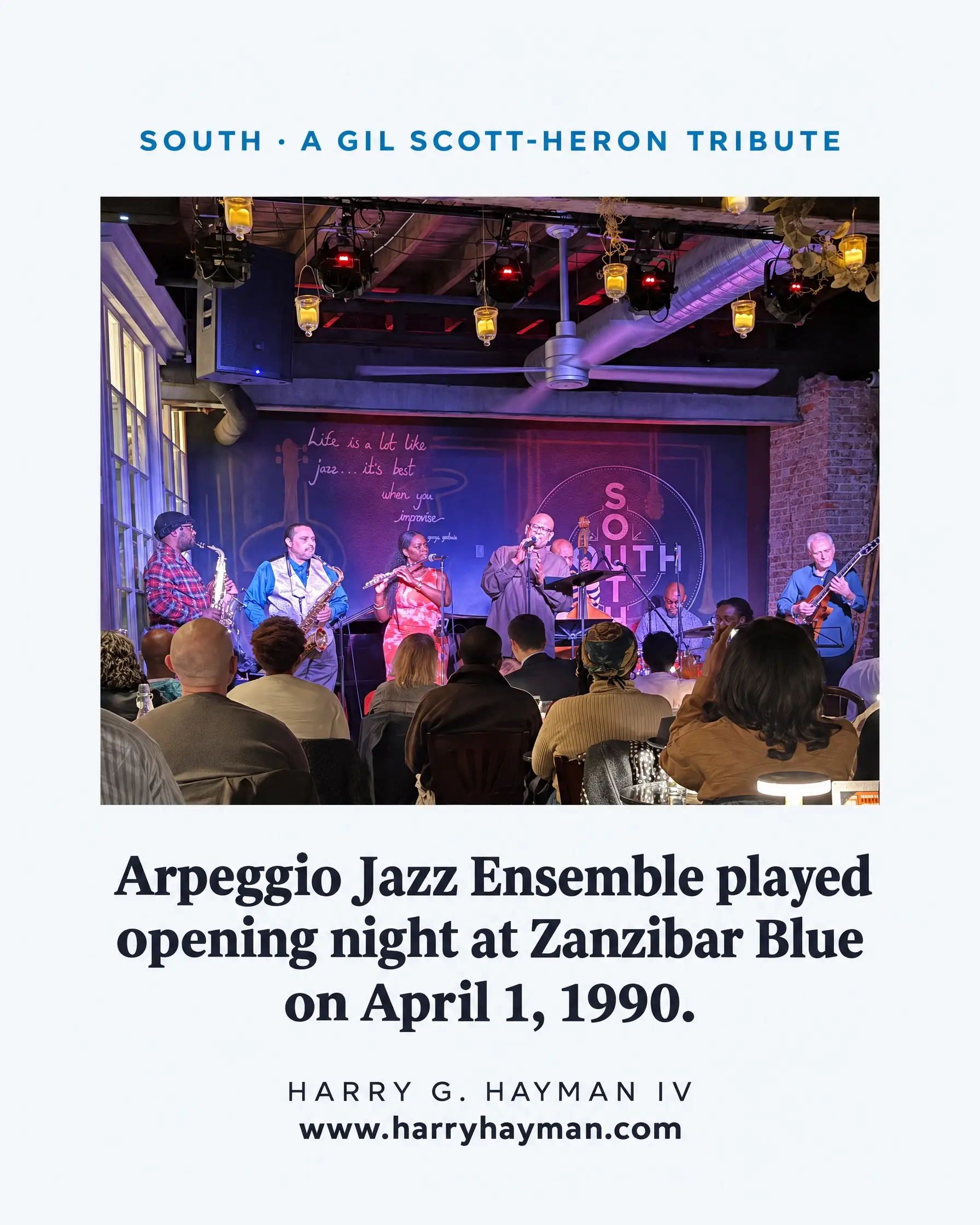
Little bit of Philadelphia jazz history for you. On April 1, 1990, the Arpeggio Jazz Ensemble played opening night at Zanzibar Blue. This weekend I heard that same band at SOUTH Restaurant & Jazz Club, paying tribute to Gil Scott-Heron, and the whole evening turned into a walk down memory lane. This one is closer to home than most. The band was there at the start of a chapter of my life. The poet they were honoring is someone I got to meet a couple of times. And the club they were playing is the Bynum brothers’ room on North Broad. That’ll conjure up happy memories in a hurry.
Opening night at Zanzibar Blue
Zanzibar Blue was Robert and Ben Bynum’s idea. The Inquirer’s look back at the brothers puts it in one line: in 1990 they opened a live jazz venue that gave food and music equal footing while serving a diverse clientele. It started on 11th Street near Pine, later moved downstairs at the Bellevue, and ended a 17 year run in 2007. The club’s Wikipedia entry remembers the Sunday brunches that WJJZ broadcast from the room and names like Lou Rawls, Chick Corea and Chuck Mangione on its stage.
I wasn’t behind the bar that first night. I came in two years later. The Inquirer’s 2022 collection of Zanzibar Blue memories has it right: I started as a bartender in 1992 and did almost every job in the Bynum organization before I landed on special events. So Arpeggio on that opening bill is history from just before my time. Hearing the band in the years that followed is not. I’m grateful I got to hear this band at the beginning of one chapter of my life, and I get to hear them now.
One more thing about that date, because I can’t leave it alone. Gil Scott-Heron was born on April 1, 1949, in Chicago. Zanzibar Blue opened on his 41st birthday. Thirty six years later the band from that first night stood on a Philadelphia stage and played his music. I don’t need the calendar to mean anything. I just like that it lines up.
The band Warren Oree built
Arpeggio is Warren Oree’s band, and in this city that sentence carries weight. WRTI’s profile of the bassist and composer, Warren Oree’s unlikely road to a life in jazz, describes him as a stalwart of Philadelphia’s jazz scene and calls Arpeggio one of the region’s most in demand jazz groups. The same piece lists the jobs he holds at once: composer, musician, educator, concert promoter, with tours through Europe, South America and the Caribbean.
The band’s own page on the LifeLine Music Coalition site says that for more than four decades the ensemble has blended original compositions, jazz standards, world rhythms and improvisation, under a sound it calls Undefeated Jazz. It lists nine recordings, Man Bites Dog, Lifeline and Slo-Burn among them. When WRTI recorded the group live in its studio in 2018, the station called Warren a West Philadelphia native and noted that he also runs LifeLine Music Coalition, which has produced some of Philadelphia’s most prominent jazz events.
Think about what that adds up to. Bands come and go in every city. Keeping one working for more than forty years means somebody keeps booking it, keeps the players together, keeps finding the next room and the next audience. That’s labor nobody claps for. Warren has been doing it the whole time I’ve been in this business, and longer.
My photo from this weekend shows the lineup spread across the SOUTH stage: two saxophones, a flute, a singer at the center microphone, an upright bass, drums and a guitar. Candle lanterns hang over them. On the wall behind the horns, in the room’s own lettering, is a line signed George Gershwin about life being a lot like jazz, best when you improvise. Hearing Warren Oree and Arpeggio get inside that music again brought all of it back.
Gil, the Arts Bank and London
I had the chance to meet Gil a couple of times. We produced a show with him at the Arts Bank during the Zanzibar Blue years. If you don’t know that building, it sits at Broad and South. According to the Inquirer’s reporting on its reopening, Philadelphia architect Ralph B. Bencker designed it, it was finished in 1929, and it served as the headquarters of Southwestern National Bank until the bank closed in 1933. The University of the Arts bought and renovated it in 1994 and used it for music, theater and dance classes and for performances. A bank building turned into a stage. Philadelphia does that kind of thing better than it gets credit for.
I caught him in London in the ’80s too, after leaving The Spice of Life, hanging out with my dad. That decade was a strange one for him on the record side. His biography notes that Arista dropped him in 1985 and he quit recording for a while, though he kept touring. So the way to know Gil then was to be in the room.
And the room is where he made sense. He called himself a “bluesologist”, his own word for someone concerned with the origin of the blues. His work with Brian Jackson fused jazz, blues and soul with lyrics about the social and political issues of the time, and “The Revolution Will Not Be Televised”, delivered over a jazz and soul groove, is widely considered a major influence on hip hop. The Rock & Roll Hall of Fame, which inducted him in 2021, says his fusion of jazz, blues, soul and funk challenged the status quo with biting satire.
Biting satire is accurate, but it misses the part I remember most. Gil could make you laugh at something and then make you think about why you laughed. Three minutes later the band would still be in your head and so would the damn question. That’s a rare double. Plenty of artists can make a room laugh. Plenty can make a room think. He did both in the same breath and left you holding the bill.
Rooms change hands, the music stays
Here’s what struck me this weekend, in one room and thinking about two others.
Zanzibar Blue closed in 2007. When the Bynums came back, they came back on North Broad. The Inquirer’s 2016 report on SOUTH described it as a new restaurant and “jazz parlor” counterintuitively located on North Broad Street, and in the 2018 interview Robert says they did think about calling it Zanzibar Blue, then decided they would be competing every day against people’s memory of the old rooms. You’ll find SOUTH at 600 North Broad Street, and that’s where this tribute happened.
The Arts Bank had a harder road. The University of the Arts closed abruptly in June 2024, and WHYY reported that the building was sold at the bankruptcy auction to Quadro Bay LLC for $2.7 million. The good news is in the same Inquirer story I linked above: Music Theatre Philly has signed a 10 year lease, plans to use the whole building for its productions, and has a ribbon cutting planned for December 8. The stage where we put Gil in front of a Philadelphia audience is going back to work.
I keep coming back to that. Buildings get sold. Clubs close. Universities fold. What survives is the people who carry the music from one room to the next: a bassist who has kept a band together for four decades, two brothers who kept building jazz rooms in this city, an audience that still shows up on a weekend night. That’s infrastructure, the same as a bridge. It just doesn’t get a ribbon cutting every time it holds.
So this weekend wasn’t nostalgia, exactly. It was proof of continuity. The band that played the first night of one of this city’s great jazz rooms is still giving Philadelphia something worth coming out for. Next time Arpeggio is on a bill near you, go. Bring somebody who has never heard of Gil Scott-Heron, and let the band do the rest.
Sources and references
- The Inquirer: Bynum brothers take a tip from jazz (Zanzibar Blue’s 1990 opening, 11th Street near Pine, the Bellevue, 2007 close, naming SOUTH)
- Wikipedia: Zanzibar Blue (WJJZ Sunday brunch broadcasts, performers)
- The Inquirer: Zanzibar Blue memories (2022)
- Wikipedia: Gil Scott-Heron (birth, Brian Jackson, Arista, influence on hip hop)
- WRTI: Warren Oree’s unlikely road to a life in jazz
- LifeLine Music Coalition: Warren Oree and the Arpeggio Jazz Ensemble
- WRTI: the Arpeggio Jazz Ensemble live from the WRTI 90.1 performance studio (2018)
- The Inquirer: the Arts Bank building and Music Theatre Philly (2026)
- Rock & Roll Hall of Fame: Gil Scott-Heron, 2021 inductee
- The Inquirer: Bynum brothers bring jazz and food to South on North Broad (2016)
- SOUTH Restaurant & Jazz Club
- WHYY: Arts Bank sold at auction
Photos: Harry Hayman.