Pamela Anderson's Garden Feeds Food Banks. A Philadelphia Backyard Can Too
Pamela Anderson gives her garden surplus to food banks. Here is how a Philadelphia backyard can plant one row for a pantry and get it there.
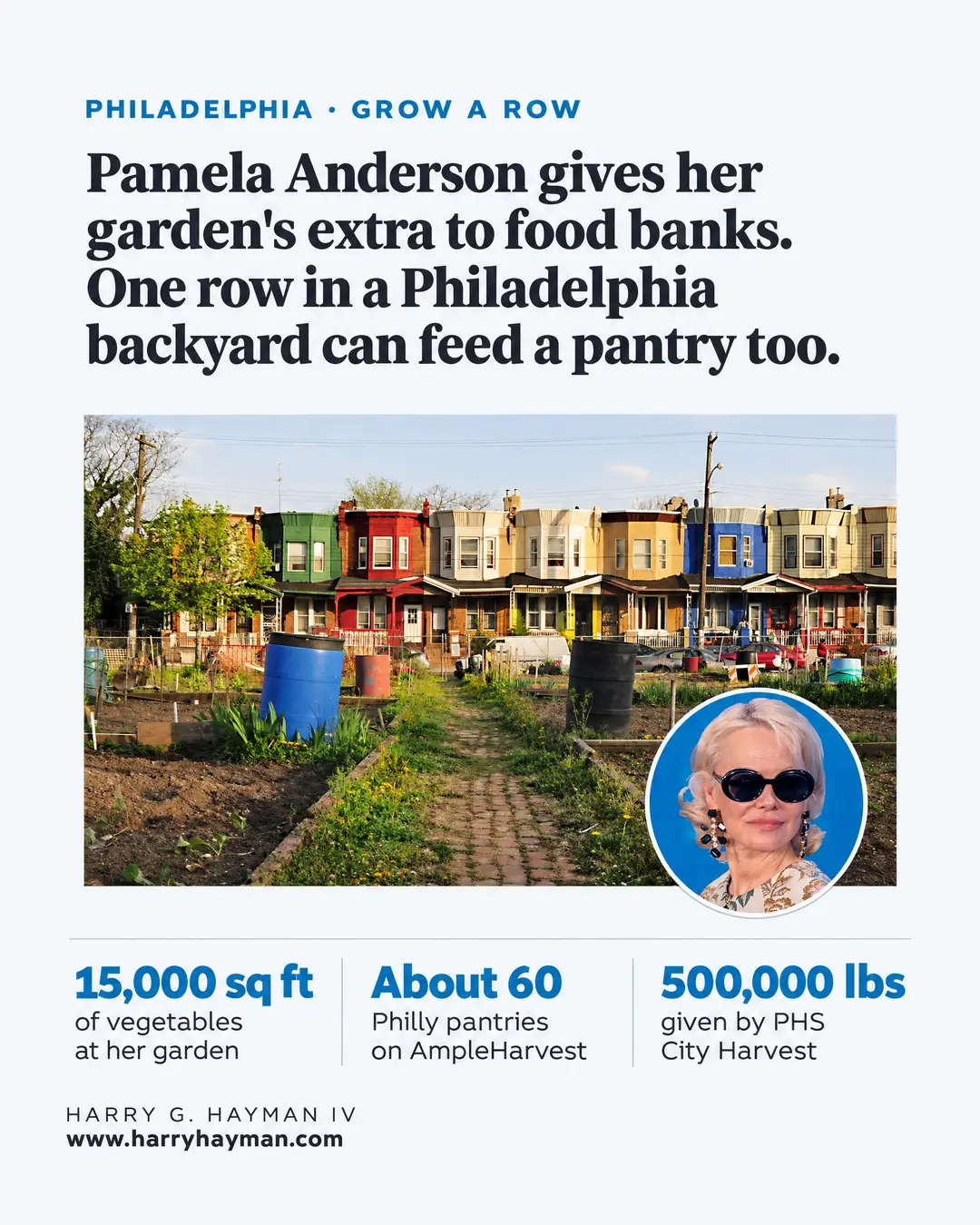
“The pumpkins are growing over the fences and down onto the beach.” That is Pamela Anderson, talking to Vogue Scandinavia about her garden at Arcady, the family property on Vancouver Island she bought from her grandparents. Most people read that line and picture a celebrity with a green thumb. I read it and thought about logistics. A garden that big makes more food than one household can eat, so where does the rest go? She answered that too. It goes to food banks, soup kitchens, churches, schools and neighbors. I want to walk through how that works, because the same model fits a Philadelphia backyard with room for one extra row, and the hard part has nothing to do with growing.
What Arcady does with the extra
Start with the numbers she gave. Architectural Digest describes Arcady as a seven acre property that Anderson bought from her grandparents 30 years ago, and she told the magazine there is “about 15,000 square feet of vegetables now.” She said the garden kept growing as she redesigned it with her sons, with deer fencing and big vegetable boxes, until “it was so much bigger than I thought it was going to be.” Then the line that matters for this piece: “We get to feed a lot of food banks, soup kitchens, churches, neighbors, and family and friends.”
In the Vogue Scandinavia cover story she named more of the people on the receiving end. She gives most of the produce away, the magazine reported, to local schools, First Nations communities and neighbors. “My garden does a lot of good,” she said. “Nothing goes to waste.” Whatever she keeps, she cans: tomatoes roasted and stewed with lemon and garlic.
I like her advice for a first garden even more. Asked what to tell a beginner, she said: “Just make a lot of mistakes and try. Really, it’s soil, water, and sun.” That is the whole growing manual. It leaves out the piece that takes real planning, which is getting fresh food from a garden bed to somebody’s plate while it is still fresh.
One row is the whole idea
You do not need fifteen thousand square feet to do a version of this. Gardeners figured that out decades ago. Plant a Row for the Hungry has been running since 1995, led by GardenComm, the association that used to be called the Garden Writers Association. The idea fits in a sentence: grow a little extra, set it aside for donation, and give it to a local food bank or pantry. Home gardeners, community gardens, schools and other organizations all take part, and local programs run on their own under the national banner.
What I love about the row is that it changes the question. Most of us end August with too many zucchini and a vague plan to drop some at a neighbor’s door. A row planted on purpose is different. You already know it is leaving. You can choose what goes in it based on what the people receiving it actually want, instead of whatever overgrew. That is the shift from surplus to supply, and it is the same thing Arcady does at a bigger scale.
The handoff is the hard part
Here is where the backyard version usually stalls. Fresh produce needs a cold place to sit and a day when somebody is there to take it. A can of beans can wait on a shelf for a year. A bag of lettuce cannot wait for the weekend.
Philadelphia knows this problem well. When The Philadelphia Inquirer looked at gardens supplying pantries in 2024, Adam Hill of the Pennsylvania Horticultural Society put it simply: there are about 500 pantries in the city, and not all of them deal with fresh produce. So the job is matching. You want the pantry that has a refrigerator, a cooking program or a distribution day that lines up with your harvest.
That matching is what AmpleHarvest.org was built for. It is a free national registry where food pantries list themselves so gardeners can find them, and it says 8,935 pantries across all 50 states have registered. Its pantry map lists about 60 with Philadelphia addresses. The site also makes a point I would have missed: fresh herbs like chives, parsley and mint are especially welcome at pantries, which means even a windowsill can take part.
Two Philadelphia listings show how specific the details get. Broad Street Ministry’s listing says it accepts fresh fruits and vegetables, meat and other raw food because it prepares free meals, and it asks donors to call or email first. The Food Cupboard on West Carpenter Lane in Mount Airy posts its open hours and a phone number. AmpleHarvest itself recommends calling or emailing a pantry ahead of time to make sure its days and hours have not changed. I read that as the most useful sentence on the whole site.
The region’s food bank says the same thing from the other side. Philabundance asks one time donors with less than 1,000 pounds to deliver to a local agency near them, using its Find Food map, and to call that location beforehand to make sure it can accept the donation. Philabundance distributed 44 million pounds of food in 2025. A backyard row is a rounding error next to that, and it is still a basket of fresh tomatoes on a table that would otherwise have none.
How Philadelphia gardens already do it
The city already runs the bigger version of this, garden by garden. The Pennsylvania Horticultural Society’s City Harvest program supports established community gardens and grow sites so they can grow more vegetables and share the harvest with food pantries, mutual aid groups and neighbors. Participating gardens get organic vegetable seedlings, seeds, pest control supplies and things like row cover and trellis stakes. PHS counts the impact so far at 500,000 pounds of produce, worth about $800,000, or 4 million servings of vegetables. To join, a garden has to be enrolled in the PHS Community Gardens Program for at least a full season first.
The seedlings are a story on their own. The Inquirer reported that City Harvest grows 275,000 seedlings a year across 140 varieties of vegetables and herbs, handed out at three giveaways a season that PHS values at $1,200 to $1,500 per garden. The boxes include collard greens, which the Inquirer noted most garden centers no longer carry.
And then there are the gardens themselves. At Glenwood Green Acres in North Philadelphia, a plot created in memory of the garden’s founder grows food for Grands as Parents, an organization about a mile away that runs a food pantry and supports grandparents who are caregivers, according to the same Inquirer piece. Ready, Willing and Able’s culinary director told the paper his agency has taken produce from gardeners, including South Street Community Garden, for the 14 years he has been there. In the 2021 season, PHS reported that Spring Gardens donated 2,579 pounds of produce through its Harvest initiative.
Those gardens solved the handoff the way Arcady did. Each one has a short list of people it gives to, the same ones, season after season. That relationship is the real infrastructure. The row is easy.
Four steps for a backyard, starting this winter
So here is how I would do it with one raised bed in a Philadelphia yard, in order.
First, pick the pantry before you pick the seeds. Open the AmpleHarvest pantry map, look at what is within a short drive or walk, and choose one. One is plenty. A garden that gives a little to the same place every week is worth more to a pantry than a garden that shows up once in August with forty pounds of squash.
Second, call. Ask three things: what do your clients cook, can you keep fresh produce cold, and which day and hour should I come. Broad Street Ministry’s listing tells you to do exactly this, and so does Philabundance. If the answer is that they have no refrigerator, that is useful information too. Find the next one on the map.
Third, plant the row for that pantry. If they say greens and herbs, grow greens and herbs. If they cook for a dinner program, ask what fills a pot. This is where Plant a Row stops being a slogan and becomes a plan. Remember Anderson’s rule and make a few mistakes.
Fourth, harvest on the morning you drop off. Not the night before, and not on Sunday for a Thursday distribution. Fresh is the entire point of giving garden food instead of cans, so protect it. If your garden belongs to a community group, look at PHS City Harvest for next season, because the seedlings and supplies make the row bigger for free.
That is it. A celebrity on Vancouver Island with fifteen thousand square feet and a Philadelphia backyard with one raised bed can run the same model. The difference is scale, not method. I would love to see a block in every neighborhood with one row planted on purpose for the pantry around the corner. Make the call this winter and the row will know where it is going in spring.
Sources and references
- Architectural Digest, “Pamela Anderson’s Renaissance Started in Her Home Garden” (June 17, 2025): Arcady as a seven acre property bought from her grandparents, about 15,000 square feet of vegetables, the food banks, soup kitchens and churches quote, and her advice for beginners.
- Vogue Scandinavia cover story on Pamela Anderson (December 2, 2025): the pumpkins line, produce given to local schools, First Nations communities and neighbors, “My garden does a lot of good,” and the canned tomatoes.
- GardenComm, Plant a Row for the Hungry: founded in 1995, how the program works and who takes part.
- AmpleHarvest.org for food growers: the free national registry, 8,935 registered pantries and the note on fresh herbs.
- AmpleHarvest.org pantry map: about 60 pantries listed with Philadelphia addresses (searched November 17, 2026) and the advice to call ahead.
- Broad Street Ministry on AmpleHarvest.org: accepts fresh fruits and vegetables for the meals it prepares, call or email first.
- The Food Cupboard, Mount Airy, on AmpleHarvest.org: listed hours and phone number.
- Philabundance, Donate Food: guidance for one time donors under 1,000 pounds and 44 million pounds distributed in 2025.
- The Philadelphia Inquirer, “At peak harvest season, Philly food pantries get the best organic local produce from city gardeners for free” (August 18, 2024): about 500 pantries in the city, City Harvest seedlings, Glenwood Green Acres and Grands as Parents, Ready, Willing and Able.
- Pennsylvania Horticultural Society, Community Gardens and City Harvest: what City Harvest provides, eligibility and 500,000 pounds of produce to date.
- Pennsylvania Horticultural Society, 2021 Harvest season results: Spring Gardens donated 2,579 pounds of produce.
- Photograph: Pamela Anderson at the Berlin Film Festival 2026, by Celestinesucess, Wikimedia Commons, licensed CC BY-SA 2.0 or later. The poster at the top of this page is a designed graphic built from this photograph.
- Photograph: Glenwood Green Acres, Philadelphia, April 2009, by Tony Fischer, licensed CC BY 2.0. The poster at the top of this page is a designed graphic built from this photograph.

