Shyamalan's $5 Million House Loan and the Philly Films It Paid For
How M. Night Shyamalan borrowed against his estate to pay for The Visit, Split and Glass, and what Philadelphia producers can learn from owning a film.
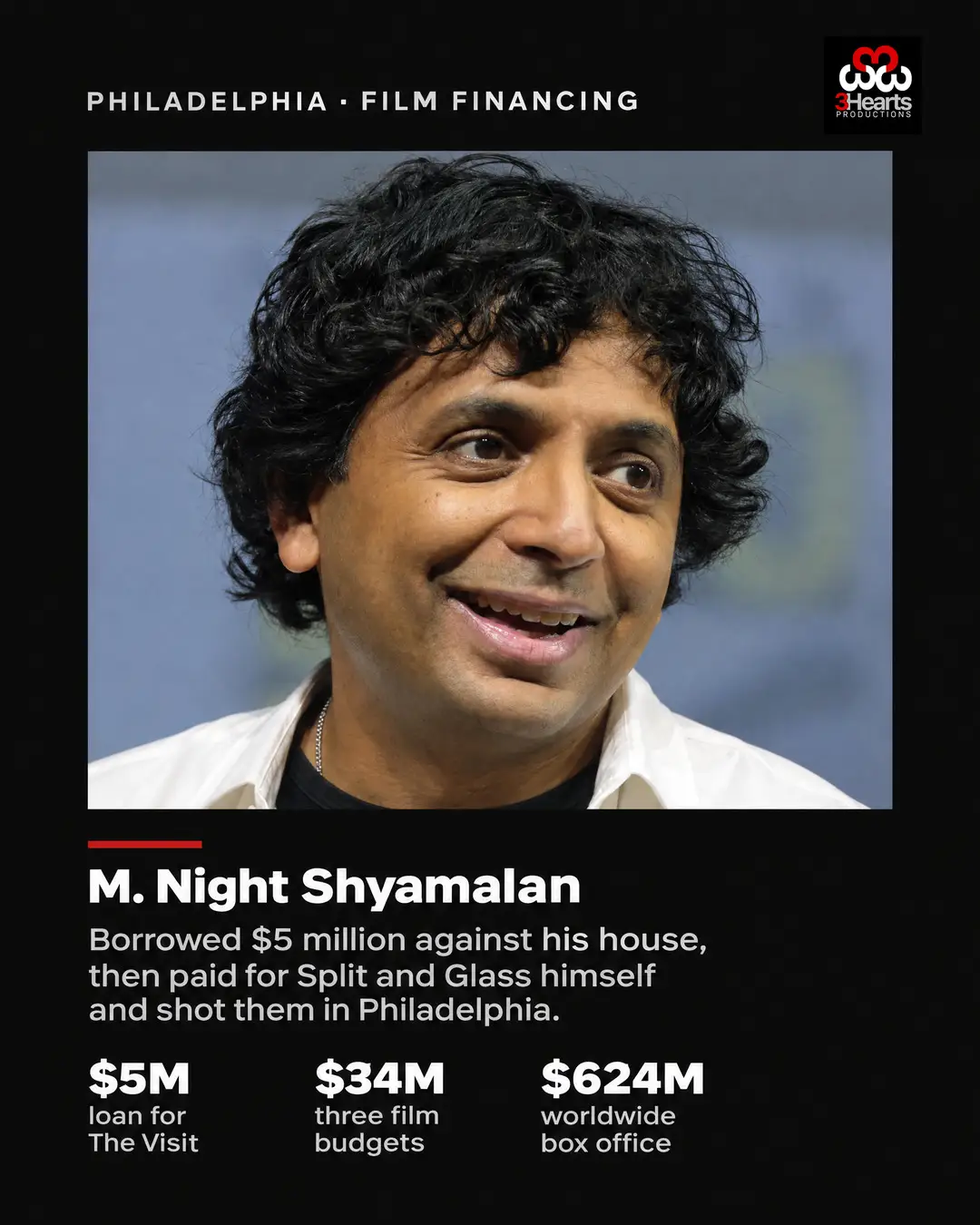
He borrowed $5 million against his own house to make a small horror movie that nobody had bought. That is how M. Night Shyamalan made The Visit, and it is the reason I keep coming back to his story. I’m Harry Hayman, and at Another 3 Hearts I think about films the way a producer has to: who pays, who decides, who owns the thing when it’s done, and where it gets made. Shyamalan answered all four questions with his own money, and he answered the last one with Philadelphia. The Visit led to Split, Split led to Glass, and the three of them together cost $34 million and took in about $624 million at the worldwide box office. Two of those three were shot here. That is not a celebrity anecdote to me. It is a working model, and I want to walk through it in order, the way the money moved, because the order is the lesson.
The loan behind The Visit
By his own account the years before The Visit were rough. In a long Rolling Stone profile from December 2018, he describes an industry that had decided he was finished. What he did next is the part a producer should study. Rolling Stone reports that he took out a $5 million loan against his estate to pay for a tight little found footage horror film himself. The same piece places that estate on 125 acres west of Philadelphia, where his family has lived since 2007. A 2019 roundup in Slashfilm, quoting Forbes, describes the collateral the same way: a 125 acre Pennsylvania estate.
Then the hard part. He flew to Los Angeles with a rough cut and showed it to every Hollywood studio. According to Rolling Stone, they all passed. He went back, kept working, and took a new cut to Universal, and Jason Blum came on as a producer. The film went out in 2015.
Here is the scoreboard. Box Office Mojo lists The Visit with a $5 million budget and a worldwide gross of $98.5 million. Count it out and that’s nearly twenty times the budget in ticket sales. I would want to see the actual deal terms before I called any of that profit, because a gross is the ticket money, not the producer’s check. Still, the direction is obvious. The bet paid.
Rolling it forward into Split and Glass
What strikes me most is what he did with the win. He did not cash out and he did not run back to a big studio budget. He put the money straight into the next film.
Split was the next rung. Rolling Stone says he paid for it himself again, spending $9 million, and Box Office Mojo puts Split’s worldwide gross at $278.5 million on that same $9 million budget. The shoot was a Philadelphia shoot. In October 2015, Philadelphia magazine reported that Sharon Pinkenson of the Greater Philadelphia Film Office confirmed shooting would begin in Philadelphia in mid November.
The Hollywood Reporter caught the logic early. In a January 2017 Heat Vision piece, he explained why the small budget mattered so much: “The burden is off of the movie because it’s made for such a low budget that it’s almost certain everyone has won.” Then the line I wish every first time producer had taped to a wall: “It doesn’t have to make hardly any money for it to be successful, and that’s a wonderful, wonderful feeling.”
Then Glass, the third rung and the biggest bet. Box Office Mojo lists a $20 million budget and a worldwide gross of $247 million. Rolling Stone reports he paid for it with his earnings from the previous two films plus more collateral from his property, and he did not dress it up. “My house right now is completely encumbered by this movie,” he told the magazine, and he joked about sleeping on the reporter’s couch if January went badly. Glass was made close to home too. On October 26, 2017, 6abc reported that production had begun filming earlier that month in Philadelphia locations and was moving to the former Allentown State Hospital, a building put up in 1912 and closed in 2010.
So count the ladder out loud. Five million, then nine, then twenty: $34 million in budgets. Ninety eight and a half, then two hundred seventy eight and a half, then two hundred forty seven: about $624 million worldwide. Each rung was paid for, at least in part, by the one below it. That is the move.
Why he still pays his own way
It would be easy to call this a lucky streak and move on. He doesn’t treat it that way, and neither do I.
In September 2026, ahead of a Beyond Fest retrospective, he sat down with TheWrap. The interview by Drew Taylor reports that since The Visit he has mostly paid for his own features, working with more limited budgets and smaller casts and crews, to make things free from executive interference or studio notes. He put the reason in his own words: “This self-financing has allowed me to follow those instincts so that I don’t have to fit into whatever mores of the time in the industry.” And then: “I can be the one that proves the thesis. That’s my hope.”
The same piece mentions a museum of props and costumes at his compound outside Philadelphia, and it notes that his 18th film, Remain, opens through Warner Bros. TheWrap had already reported in February that Warner Bros. moved Remain from October 23, 2026 to February 5, 2027. So the studio is the distributor. The decisions about the film itself sit with the filmmaker.
I find that split clarifying. A studio is very good at putting a film in theaters around the world. Nobody is arguing it should stop doing that. The question is who sits at the table while the film is being made, and his answer is: the person who paid for it.
The Philadelphia part
He has said it simply. “I make movies at home,” he told Rolling Stone, and the magazine notes that he sets nearly all of his films in or around Philadelphia, where he grew up. So when his own money went into Split and Glass, the shoots happened here.
And sets train people, which is the part that compounds. Ricky Staub is the clearest example I know. Variety’s 2021 profile says that after moving to Los Angeles he was hired as an assistant to producer Sam Mercer and followed him to Philadelphia on Shyamalan’s The Last Airbender. Staub went on to create Neighborhood Film Co., based in Brewerytown, which has hired and trained adults coming home from incarceration, and he directed Concrete Cowboy for Netflix.
The training loops back. In a 2021 Philadelphia Citizen interview, Staub described an apprentice named Andrew who worked on Concrete Cowboy and The Cage, and who had just finished Season 2 of Servant with Shyamalan. One production brings a young assistant to town. That assistant builds a company. The company trains a person who walks onto the next production. That chain is exactly what a film economy is supposed to look like.
What I take from it at Another 3 Hearts
I am not telling anyone to mortgage their house. He told Rolling Stone himself that it felt like going to Vegas and putting it all on the next hand, and he said it smiling. Most filmmakers do not have an estate to borrow against, so the loan is not the part to copy.
What does travel is the structure underneath it. Keep the budget small enough that the film can succeed without being a hit. Own enough of it that a win pays for the next one. Make it where you live, so the crews, the locations and the vendors get stronger every time. Rent the studio for distribution, not for permission.
That is the producer’s question I want Philadelphia to sit with. We have people like Staub who learned on these sets. We have neighborhoods that already show up on screen. What we have fewer of are producers who own the films they make here, rolling the money from one picture into the next. How many more mid budget films could get made in Philadelphia if more of them were owned by the people who made them?
If you are a Philadelphia filmmaker sitting on a script you would rather own than sell, tell me what it is. Then go see Remain in February, and think about who paid for it.
Sources and references
- Rolling Stone, The Fall and Rise of M. Night Shyamalan (December 2018)
- Slashfilm, M. Night Shyamalan Has Been Self-Financing His Recent Films, quoting Forbes (January 2019)
- Box Office Mojo, The Visit (2015): budget and worldwide gross
- Box Office Mojo, Split (2016): budget and worldwide gross
- Box Office Mojo, Glass (2019): budget and worldwide gross
- Philadelphia magazine, Split shooting in Philadelphia (October 2015)
- The Hollywood Reporter, Split: how his $5 million gamble set him free (January 2017)
- 6abc, Glass to film in shuttered Allentown State Hospital (October 2017)
- TheWrap, Drew Taylor interview on his Beyond Fest retrospective and self-financing (September 2026)
- TheWrap, Warner Bros. moves Remain to February 5, 2027 (February 2026)
- Variety, 10 Directors to Watch: Ricky Staub (February 2021)
- The Philadelphia Citizen, Concrete Cowboy and Neighborhood Film Co. (March 2021)
- Photograph of M. Night Shyamalan at San Diego Comic-Con 2018 by Gage Skidmore, via Wikimedia Commons. Credit: Gage Skidmore, CC BY-SA 2.0. Licensed under Creative Commons Attribution-ShareAlike 2.0 Generic. The poster at the top of this page is a designed graphic built from this photograph, and that adaptation is shared under the same licence.
