Atlanta's Azalea Fresh Market and Philadelphia's Grocery Question
A private grocer owns Atlanta's Azalea Fresh Market and the city financed it. I look at the money, the open questions and what Philadelphia should ask.
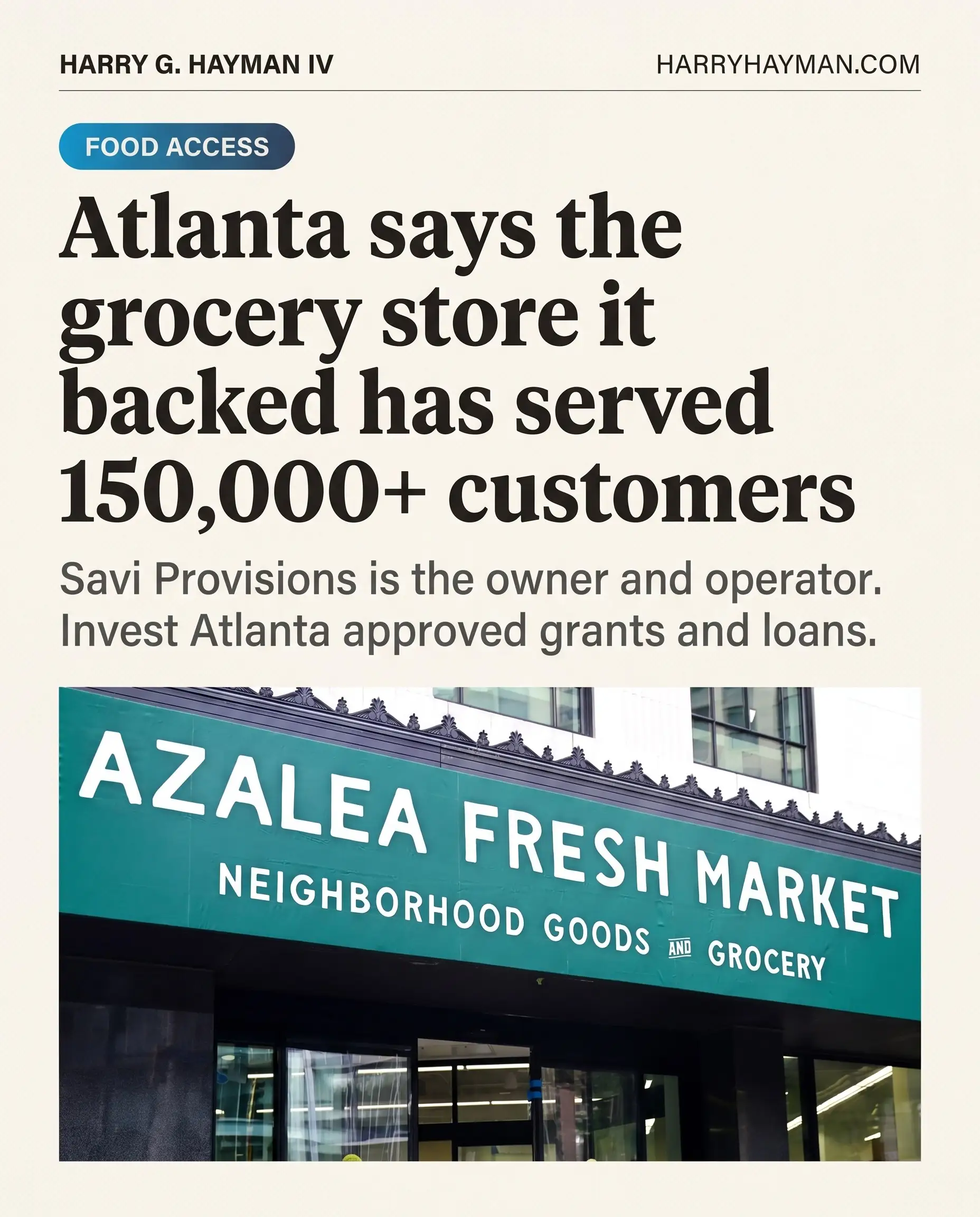
At seven o’clock on Monday morning, September 8, 2025, a grocery store opened on Peachtree Street in downtown Atlanta. On that first day, the City of Atlanta’s media advisory says, Azalea Fresh Market welcomed 728 customers and took in several thousand dollars. It sits in the historic Olympia Building, where a Walgreens closed in April 2024 after hundreds of people had signed a petition to keep it, as the AJC reported. Fox News described it as a city run grocery, and I understand why, since the city’s own advisory calls it a municipal grocery store. But that same advisory names Paul Nair of Savi Provisions as the store’s owner and operator, and the detail changes what Philadelphia should take from Atlanta. On October 8, our City Council approved hearings on a grocery store supported by the city. Before that hearing happens, I want the facts straight.
Who Owns It, and Who Paid
The ownership answer comes from the city itself. The advisory describes Nair as “founder and CEO of Savi Provisions and the owner/operator of Azalea Fresh Market,” and Invest Atlanta, the city’s development authority, published the same line. Bisnow reported that Savi’s chief operating officer, Mike Fogarty, said the company is fully self operated and shares no revenue with the city or other entities. “We’re a private business incentivized to operate a private business at these two locations,” he said. “It’s up to us, frankly, to make it work or not.” In September 2026, The Shelby Report paraphrased Ashley Page, who leads the Independent Grocers Alliance’s community development program: press coverage has sometimes suggested the city owns the stores, but they are public and private partnerships in which both the city and Nair have invested significantly.
What the city did do is finance it. In December 2024, Invest Atlanta’s board, which the mayor chairs, approved up to $8,174,991 for two Savi stores, one downtown and one on Campbellton Road. Mayor Andre Dickens told reporters why. “Time and time again, we have been looking for grocery stores to invest in these areas and we’ve offered incentives, and no one has signed up,” he said. “But Savi has stepped up to be able to take on this charge.” That is a market failure argument in the mayor’s own words, and I take it seriously. It is also an argument for financing a private operator, which is a different thing from buying a store.
The Money, Line by Line
Here is where I have to be careful with the word paid. The board’s February 2025 finance committee agenda lists the downtown store’s awards as amounts “not to exceed”: a $2,000,000 loan from the Grocery Loan Fund, a $594,991 loan from the Economic Opportunity Fund, a $1,000,000 grant from the Eastside Tax Allocation District, and two small grants of $75,000 and $50,000. Added together, the downtown lines come to as much as $3,719,991, and $2,594,991 of that is loans rather than grants. Those are caps, not payments. I could not find the loan terms or what has actually been disbursed.
Atlanta News First reported at the opening that the city “invested $3.5 million into the $5.4 million project.” I could not find that split in a city or Invest Atlanta release, and the board lines run a little higher, so I treat $3.5 million as a reported figure, not an audited one. The operator has money in the deal as well. The AJC reported in December 2024 that Savi was putting in $1 million of its own and taking $2.3 million in loans from two community organizations, against about $11.5 million in total funding for both stores.
So the accurate sentence is not that the city owns a grocery store, and I would not say it paid for one either. Atlanta’s development authority put public grants and loans behind a private grocer who owns the business and carries the risk.
What 150,000 Customers Does and Does Not Tell Us
The headline number is 150,000. The city’s June 18, 2026 release says that nine months after opening the store is “serving more than 150,000 customers.” It does not say whether that counts people, visits or receipts. The early figures point to visits: 728 customers on opening day and, according to CBS Atlanta, around 600 customers a day by October 2025, a pace that lands in the same range over nine months. I read 150,000 as customers served, not 150,000 different people, until the city says otherwise.
What nobody has published is what would let a taxpayer judge the rest: prices against nearby stores, total sales, or public dollars per customer. The city does report that average daily revenue is up close to 20 percent since opening. Nair told What Now Atlanta that he wants both stores to sustain themselves within a couple of years. Fogarty was just as direct with Bisnow: he called the venture a high risk endeavor, said the low margin food business is sensitive to inflation, and said theft has been an issue at Azalea, which has full time security and no dedicated parking. I read that as an operator telling the truth about thin margins.
Even the city’s stated reason deserves a careful read. Its advisory says 14 percent of Atlanta is experiencing food insecurity and that the store serves a USDA designated low income, low access area. Those are two different measures. Food insecurity describes people; low access describes places. I have seen the 14 percent described as the share of residents living in a food desert, and the city’s own words do not say that.
The Second Store, and What Is Still Open
The second Azalea is planned for 2080 Campbellton Road SW, in a former Super Giant in Campbellton Plaza. The city’s release says the 16,000 square foot store was 30 percent complete in June and expected to open in fall 2026. I have seen no official opening date. The Shelby Report wrote in September that it opens October 28, and I treat that as a plan until the city or Invest Atlanta confirms it. Dr. Eloisa Klementich, Invest Atlanta’s president and CEO, said the store is expected to serve more than 1,700 residents each month and generate a projected $2 million in annual economic impact. The schedule has moved: Invest Atlanta’s December 2024 announcement expected both stores to open in the second half of 2025.
Here the public body sits closer to the building. That announcement says Savi would run the Campbellton store under a sublease with Invest Atlanta, and the AJC reported that the city holds the lease. One figure I cannot reconcile. Invest Atlanta’s May 2026 update says the store has funding assistance “including $6 million in Campbellton TAD grants,” meaning money from the Campbellton tax allocation district. The board’s Project Savi fact sheet shows a $2,030,000 grant from that district, approved in May 2024. More may have been approved since, and I have not found the paperwork, so I am asking rather than telling.
Rodney Lyn, dean of Georgia State University’s school of public health, told a student news site in December 2025 that he doubted downtown was where people suffer most and pointed to Southwest Atlanta, where people are low income and “don’t have the options around [transportation].” Campbellton Road is in that part of the city.
What Philadelphia Is Asking, and What Pennsylvania Already Did
On Thursday, October 8, Philadelphia’s City Council approved two resolutions authorizing hearings, one on city supported grocery stores and one on supermarket pricing technology. Councilmember Nicolas O’Rourke introduced the grocery resolution, and the Inquirer reported that the hearing will consider various models for how such a store could be structured, along with similar efforts in other cities. There is no design yet. Council President Kenyatta Johnson’s wider package, the Philly Food Affordability Act, would also create an Office of Food and Nutrition Security, which needs a Home Rule Charter amendment and a vote in May 2027. Johnson told PhillyVoice the idea is less foreign than it sounds: “It’s no different than some of our largest retail grocery stores receiving (Redevelopment Assistance Capital Program) from the state to allow them to build.”
He is right that Pennsylvania has done this before. In 2004 the state began the Fresh Food Financing Initiative. Reinvestment Fund, its administrator, says the state seeded it with a $30 million grant and Reinvestment Fund brought in $145 million in additional investment. By June 2010 it had financed 88 projects and approved more than $73.2 million in loans and $12.1 million in grants. That is the same structure Atlanta used: public grants and loans behind the operators who run the stores. The Food Trust, a partner in the original program, says its success made the structure a model for other cities and states, and its PA FFFI page says the program was recapitalized in 2018 and has a 2026 request for applications, with grants from $5,000 to $200,000.
The need has not gone away. Feeding America’s 2024 data put food insecurity in Philadelphia County at 17.3 percent. Metro Philadelphia reported nearly 275,000 people, including 27 percent of children, and said SNAP enrollment among city residents fell by 59,000 after new work requirements took effect in September 2025. It also reported that Mark Edwards, the Food Trust’s CEO, shared the chair of the Council task force whose June recommendations Johnson says his bill builds on.
Questions for the Hearing
I have argued for years that food is infrastructure. Atlanta is a useful reminder that infrastructure has owners, maintenance bills and ways to fail. Kansas City, Missouri is the cautionary case: the city owned the building, a nonprofit ran its Sun Fresh Market, and the store closed in August 2025 after months of empty shelves. Atlanta kept the business in private hands, which spares the city the daily work of stocking shelves and also limits what it controls. The sharpest objection I have read comes from Nicole Huyer of the Heritage Foundation, who told Fox News that opening government owned and operated grocery stores “will have disastrous consequences for not only consumers but also for local competition.” Atlanta’s stores are owned and run by a private company, but any store with public money behind it invites the competition question, and a hearing is the place to ask it.
So here is what I would want on the record. What does the city want to buy: lower prices, a closer store, jobs, or all three? How much of any support is a loan, how much a grant, and what happens to the loans if sales fall short? What will a customer count mean, and will prices be compared with nearby stores and published? Who holds the lease, and who keeps the building if an operator leaves? Pennsylvania has been financing grocers since 2004, so we do not have to guess what this looks like. A hearing is the chance to ask what the public got back, here and in Atlanta, before anyone writes the next check.
Photo in the poster: City of Atlanta (Joshua Spruiel).
Sources and references
- City of Atlanta media advisory: First Municipal Grocery Store Opens (Wayback copy)
- AJC: Azalea Fresh Market to open in former downtown Atlanta Walgreens location
- Fox News: Atlanta’s city run grocery sees early success
- Invest Atlanta: Atlanta’s First Municipal Grocery Store Opens
- Bisnow: Second Atlanta Supermarket For Underserved Residents Proposed
- The Shelby Report: IGA Community Development Builds Momentum
- Invest Atlanta: $8.1 Million to Help Establish Two Grocery Stores
- AJC: Atlanta officials approve more than $8M for two new grocery stores
- Invest Atlanta finance committee agenda, February 18, 2025
- Atlanta News First: First of its kind grocery store opening in Downtown Atlanta
- City of Atlanta press release, June 18, 2026 (Wayback copy)
- CBS Atlanta: Downtown Atlanta opened a new grocery store, what’s happened since
- What Now Atlanta: Azalea Fresh Market bringing groceries to Southwest Atlanta
- Invest Atlanta: A Peek Inside New Azalea Fresh Market Location
- Invest Atlanta: Project Savi Grocery Development Agreement fact sheet
- The Southerner Online: Azalea Fresh Market combats downtown food desert
- Philadelphia Tribune: Philly Council eyes city backed supermarkets
- The Philadelphia Inquirer: Should Philly open a city supported grocery store
- PhillyVoice: Council to consider food insecurity office and city run grocery store
- Reinvestment Fund: Pennsylvania Fresh Food Financing Initiative
- The Food Trust: Healthy Food Financing Initiatives
- The Food Trust: PA Fresh Food Financing Initiative
- Feeding America: Map the Meal Gap, Philadelphia County
- Metro Philadelphia: Council president calls for food insecurity office
- KCTV5: After months of empty shelves, Sun Fresh Market closes shop
About the Author
Harry Hayman is a Philadelphia-based entrepreneur, music producer, and cultural advocate. Through his work with the Feed Philly Coalition, he explores and documents the creative, culinary, and civic life of a city he believes is one of the most inspired places in America.