Tokyo's Designer Toilets and the Cleaning Schedule Behind Them
Tokyo's designer public toilets work because of a written cleaning routine. Philadelphia's Philly Phlush pilot already pays for the same thing.
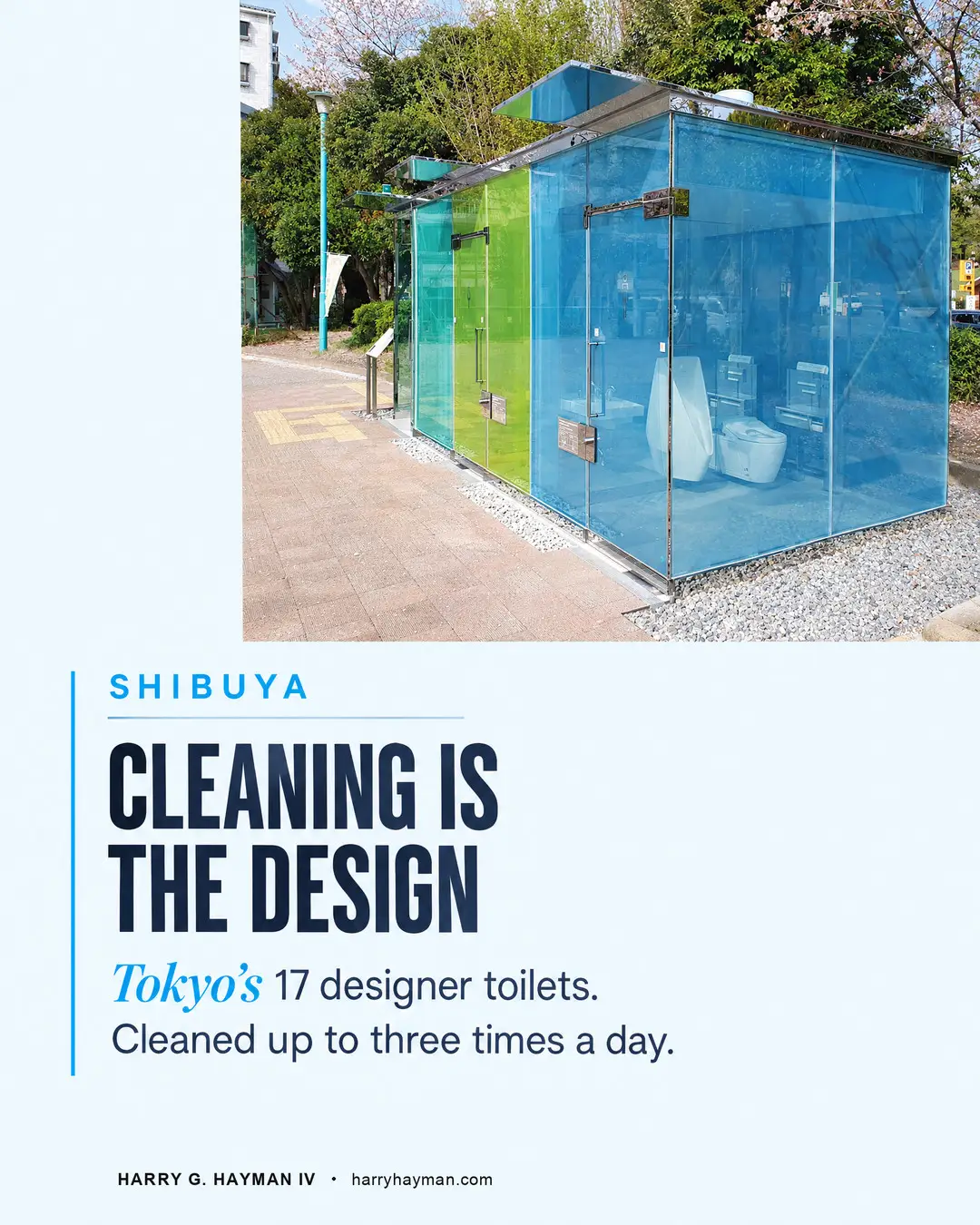
Anyone who has run a restaurant knows the oldest rule in the business: check the bathroom. It tells you about the kitchen, the staff and whether anyone is paying attention. So when I came across a glass toilet in a Shibuya park, blue and green and clear, I did not stop at the photograph of Shigeru Ban’s design at Haru-no-Ogawa Community Park. I went looking for the unglamorous page behind it. I have not made the trip to Shibuya for this. What follows comes from the project’s own pages, from Philadelphia’s public health department and from the reporting of the Inquirer, and I have linked every one so you can check me.

The glass is the photograph, the schedule is the page
THE TOKYO TOILET is a real project with a real number attached. According to its own press release, it redesigned 17 public toilets in Shibuya through the vision of 16 creators, launched in 2018 with the initiative and funding of Koji Yanai and day to day oversight by The Nippon Foundation. The list of designers reads like a conference program for architecture: Tadao Ando, Kengo Kuma, Toyo Ito, Fumihiko Maki, Shigeru Ban and NIGO among them, as the project’s maintenance page shows.
Ban’s two toilets get most of the attention, and for good reason. At Yoyogi Fukamachi Mini Park the glass turns opaque when the door is locked, which the project says lets users check the cleanliness and whether anyone is inside from the outside. You can read a stall before you walk up to it. That is a design idea about trust, and it is a good one.
It is also the part everybody photographs. I understand why. Colored glass in a park is a gift to a camera. But a toilet with a beautiful wall and a dirty floor is a bad toilet, and the people who built this project seem to know it. Their maintenance page opens with a sentence I keep rereading: the project is not only about designing new facilities, it is about organizing all aspects of the project so the facilities can be maintained well and used comfortably by everyone.
What the maintenance page actually says
Here is the routine, in the project’s words and mine. Cleaning is divided into three types: daily cleaning performed up to three times a day, regular cleaning once a month, and special cleaning once a year. The daily frequency depends on how dirty each restroom gets, so a busy one is cleaned more often than a quiet one. Dry cleaning, which uses no water, can happen often. Wet cleaning with special solvents removes water stains and yellowing. The yearly deep clean reaches the exterior walls, the lighting and even the leaves on the roof.
Then comes the part I find most interesting, because it is the part restaurants know best. Somebody outside the operation checks the work. A third-party consultant, Amenity Co., inspects all the toilets every month. The consultant’s note on the page says the ATP reading, the contamination index from a swab test, “has become much lower than it was at the beginning of the project.” Cleaning is done by Tokyo Sanitation Co., and the page is clear that the staff pick the right tools and agents so they do not harm the stainless steel, the glass or the painted walls.
The project also states its theory in one line: “Public restrooms can become dirty if they are not properly sanitized on a regular basis, but people find it hard to spoil something that has been carefully cleaned.” I cannot prove that sentence, and neither can the project. The page itself is honest about the limits: there have been reports of graffiti and damage at the more heavily used toilets, such as Jingu-Dori Park and Ebisu East Park. A clean routine is not a cure. It is a bet that care invites care.
One more fact about timing. Renovation of all 17 was completed in 2023, and from April 1, 2024, Shibuya City took over direct responsibility for maintenance. A private funder built the thing and the city kept it running. I come back to that split below.
The people in the uniforms
The detail that stopped me is about clothes. NIGO oversaw the design of a uniform for the staff who clean the toilets every day. The project reports that wearing it has helped them interact more with the people who use the toilets: many approach them to talk, take photos, and even give them drinks and snacks.
Sit with that for a moment. In most cities, the person who cleans a public restroom is invisible by design, and a good day for them is a day nobody notices. Tokyo made the opposite choice. It dressed the work so that people would see it and thank it. The film that grew out of these toilets, Wim Wenders’ Perfect Days, follows a Tokyo public toilet cleaner through the routine of his life, and the project’s press release notes that its restrooms served as settings. I would not call a film a policy. I would say it shows a culture willing to look at the work.
What Philadelphia already pays for
Now the home question. Philadelphia’s Philly Phlush pilot has three standalone restrooms. The Center City and Fotterall Square units opened in 2023, and the Clark Park unit opened in late October 2025 after a delay of about two years, according to the Inquirer. The City’s page on the pilot says the restrooms are cleaned when they are opened, closed and multiple times throughout the day. It also says they are cleaned and maintained by public restroom specialists from the Substance Use Prevention and Harm Reduction division of the Department of Public Health, who used to clean the City’s porta potties.
The Inquirer’s Stephanie Farr, who has followed the Phlush since launch, put a number on the rhythm. In her July 2025 column, the units are visited, cleaned and restocked every two hours by three public restroom specialists. According to the Health Department’s spokesperson, James Garrow, as reported there, maintaining the two units then open costs about $322,656 a year, including supplies, vehicles and repairs. The same column reports that the pilot was planned as six units at an annual cost of $656,864, that the sixth unit “will not be possible with the pilot’s current funding,” and that the City will decide the pilot’s budget in fiscal year 2028 and beyond. The City’s own page says funding supports the pilot through summer 2027. These cost figures come from the Department as relayed by the Inquirer, not from my own accounting, and I would not treat them as audited.
I want to be careful and respectful about who does this work. The same City page lists what each unit carries: a baby changing table, a handwashing station, free menstrual products, a container to dispose of used sharps, and free naloxone, plus signs with phone numbers that connect people to services. The specialists open and close the units each day, and the City says they are a visible presence who engage people and connect them to shelter, food, treatment and clothing. Every two hours, someone is showing up. That is Tokyo’s lesson, already on a Philadelphia payroll, and I think it deserves the thanks the uniforms in Shibuya earn.
There is also the neighbor story. The Inquirer’s October 2025 column on the Clark Park opening reports that until the unit opened, the Friends of Clark Park paid for porta-potties out of its own money, a burden now lifted thanks to the city-funded and maintained Phlush. Public money for the cleaning means a volunteer group can go back to what volunteers do best.
What does not travel
I should not oversell the comparison, because it breaks in a few places. Seventeen toilets and three toilets are not like for like. THE TOKYO TOILET is a design program inside a ward that also has many ordinary public toilets, and it started with a private funder paying for the build. Philadelphia’s pilot is an operations program run by a health department. They solve different problems.
There is a seasonal caveat as well. An official notice, photographed at Haru-no-Ogawa park in January 2024, says the glass stays opaque in the cold months, from October 2023 to mid May 2024. A visitor in November may not see the see-through effect at all, which is a useful reminder that even the famous feature of a design has a schedule.

Philadelphians told the City what they wanted before any of this existed. The City’s 2022 survey of 480 people found that 93 percent had needed a public restroom in Center City at some time, and only 47 percent had used the porta potties. Across all questions, respondents defined a successful public restroom as cleaned often, well monitored, and safe and accessible for everyone. The report adds that most questions were about operations, not about the model or location of the permanent unit. Philadelphians described the Tokyo lesson before Tokyo came up.
What I would ask next
So here is where I land, and I am admitting I am not certain. Maybe the lesson of Shibuya is not the glass. Maybe it is that Tokyo made the cleaning the story, with a schedule people can read, an outside inspector, and uniforms that invite a thank you. Philadelphia has the hardest part running already.
The questions I would put to the people who decide this: What would it look like to publish the Phlush cleaning schedule the way Tokyo publishes its own? Could an independent inspection, with a simple score anyone can read, sit beside it? And if the pilot is worth keeping past 2027, who pays for what, given that Tokyo paired a private funder for the build with a city that took over upkeep? I do not have the answers. I would like to hear them from the people who do.
About the Author
Harry Hayman is a Philadelphia-based entrepreneur, music producer, and cultural advocate. Through his work with the Feed Philly Coalition, he explores and documents the creative, culinary, and civic life of a city he believes is one of the most inspired places in America.
Sources and references
- THE TOKYO TOILET, Maintenance: cleaning types, monthly third party inspection, uniforms, graffiti note
- THE TOKYO TOILET press release (October 2026): 17 toilets, 16 creators, funding, Shibuya City maintenance from April 2024
- THE TOKYO TOILET, Yoyogi Fukamachi Mini Park: glass that turns opaque when locked
- Perfect Days (2023 film), Wikipedia
- City of Philadelphia, Department of Public Health: Introducing the Philly Phlush (October 16, 2024, archived page)
- City of Philadelphia, Center City Public Restroom Pilot Survey Results (2022)
- Philadelphia Inquirer, Stephanie Farr, July 17, 2025: Two years after its debut, is Philly’s public restroom project a royal flush or circling the drain?
- Philadelphia Inquirer, Stephanie Farr, October 28, 2025: A “Be the Phirst to Phlush” lottery was held to open Clark Park’s new public bathroom
- Hero photograph: Shigeru Ban’s glass toilet at Haru-no-Ogawa Community Park, by Syced, Wikimedia Commons, CC0
- Notice that the glass stays opaque in cold months, Haru-no-Ogawa park, January 2024, Wikimedia Commons, CC0