Jeffrey Gibson in Venice: Native Art in the Present Tense
Jeffrey Gibson's Venice exhibition gives me a way to approach contemporary Native art from Philadelphia during Native American Heritage Month.
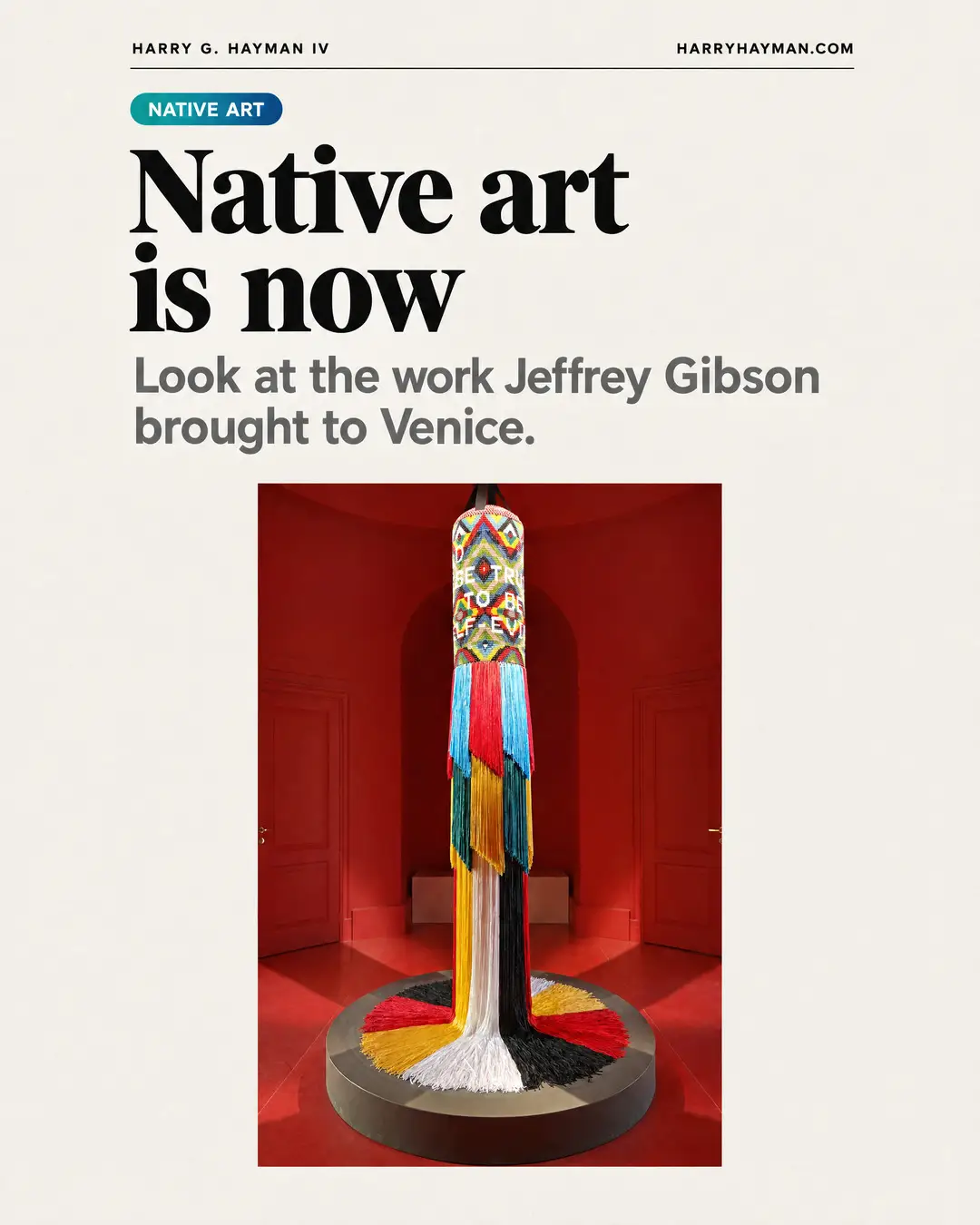
A punching bag hangs in a red room. Beads cover its upper body; long lengths of fringe reach the floor and spread over a round base. That is the object in Annie Dalbéra’s photograph of Jeffrey Gibson’s installation in Venice. I want to begin there for Native American Heritage Month, with something an artist made and the time it takes to look at it. On Harry Hayman Creative, the question I keep coming back to is why respect for Native history should ever limit our curiosity about Native artists working now. Yes, learn the history. Keep learning it. But leave enough room in the conversation for an artist to surprise you. From Philadelphia, I can start by looking carefully at this photograph and following the exhibition’s records, without pretending I stood in that room.
The milestone needs its full sentence
In 2024, Jeffrey Gibson became the first Indigenous artist to represent the United States with a solo exhibition at the Venice Biennale, as organizer SITE SANTA FE records. The words “with a solo exhibition” matter. Removing them would turn a specific milestone into a broader claim about Indigenous participation that this record does not establish.
The exhibition’s biography of Gibson identifies him as a member of the Mississippi Band of Choctaw Indians and of Cherokee descent. I want those distinctions kept intact, too. Membership and ancestry are different descriptions. Neither needs to be blurred for the sentence to carry weight.
There is a temptation to let the first fill the entire story. I understand it. A milestone gives a reader an immediate reason to pay attention. But once attention arrives, where does it go? I want to spend some of it on what Gibson actually put in the pavilion. Otherwise, an acknowledgment can become an announcement about an artist without making much room for his art.
A title, two curators, a completed exhibition
The title is the space in which to place me. Portland Art Museum’s exhibition record gives the public dates as April 20 to November 24, 2024. This is a look back at that presentation, not an invitation to an exhibition still open in Venice. La Biennale’s 2024 archive confirms those dates for the 60th International Art Exhibition.
The United States pavilion listing names Kathleen Ash-Milby and Abigail Winograd as curators. Its commissioners are Ash-Milby, Louis Grachos and Winograd. Those roles deserve separate credit. The exhibition’s project credits also explain that the title comes from part three of Oglala Lakota poet Layli Long Soldier’s poem Ȟe Sápa.
I like that the title sends me toward another maker. The Kenyon Review publishes Long Soldier’s poem, where it can be read in its own setting. I don’t need to borrow a few lines and make them stand for the entire exhibition. Following the reference gives the poem its space, and gives me another place to continue reading after the image has caught my eye.
Give the punching bag some time
The exhibition’s checklist of artworks and their references identifies glass and plastic beads, nylon thread, acrylic felt and a found punching bag among this work’s materials. Its reference links connect the words on the bag to the Declaration of Independence. That provides something firmer than an adjective about how the object looks.
In the photograph, the fringe changes what I notice first. It carries the eye down, past the bag, to the base where the strands spread outward. The room’s red walls remain visible on either side. The object has enough space around it to make me slow down and consider the relationship between its weight and the material hanging from it.
A punching bag is made to absorb blows. Putting the Declaration’s language on that form gives me a question about the distance between a promise and an experience. That is my reading of the juxtaposition, not a quotation or an intention I am assigning to Gibson. I can offer it while leaving the artist’s own account available to the reader.
This is the part of art conversation I enjoy: the moment a material choice interrupts the easy description. “Beaded sculpture” gets us started. Then we have to stay long enough to notice which object was beaded, how the words sit on it and what the fringe does to its shape. The milestone cannot do that looking for us.
The entrance was part of the work
The presentation also changed how people could use the space outside. The curators’ account of Gibson’s forecourt sculpture describes classical pedestals brought together into a monumental outdoor work, making the entrance a gathering place.
That detail interests me because it puts gathering into the discussion. A pedestal usually directs my attention upward toward whatever has been placed on top. Here, the curators describe an entrance where people can come together. What would I notice approaching that arrangement? Where would I pause? I can think about those questions without claiming to know how every visitor felt.
It is also a useful reminder to look beyond a single photograph. The punching bag has its room; the outdoor sculpture has a different relationship to its audience. One image can introduce a body of work, but it cannot hold every encounter the exhibition made possible. I want the photograph to open the record, then let the record widen what I see.
Older work can enter a new composition
Another decision keeps me reading. SITE SANTA FE’s exhibition essay describes Gibson incorporating beadwork from his collection into new works on paper, keeping the found objects intact. The official checklist credits unknown Indigenous makers alongside the materials in these compositions.
I find that more useful to think about than a general statement that an artist honors the past. There is a practical choice here about an older object and how it is incorporated into a new composition. The record makes the decision visible. It leaves a question open without treating uncertainty as permission to invent a name.
It also stops the argument about contemporary art from becoming an argument against history. That would miss what is happening. Older making and a new composition can be present together. I don’t have to choose which one deserves attention, and I don’t have to treat the older object as anonymous decoration simply because the maker’s name has not yet been recovered.
For anyone working with photographs, film or visual storytelling, there is plenty to consider in that example. What do we know about the material we are using? What remains unknown? Can the next person follow the credit and understand the distinction? Those are questions I can bring to my own work without pretending to resolve them for somebody else.
An assignment for looking from Philadelphia
For this Native American Heritage Month post, I want “Native art is now” to work as an instruction to myself. Look at the work in front of you. Read its materials. Follow a title back to the writer it credits. Give an artist enough attention to make decisions you did not expect.
None of that requires dismissing a history museum or setting contemporary work against an older collection. I am pushing at a habit of attention: reaching for the historical explanation so quickly that the making happening in front of us gets less time. Gibson gives me a specific place to interrupt that habit. I can move between an object, a room and a poem, each with its own maker and context.
The next step is small enough to do today from Philadelphia. Open the pavilion record beside the photograph. Spend a little time with the object before scrolling to the next image. Then read the material description and look again. See whether the second look changes the question you brought to the first.
Sources and references
- Annie Dalbéra: photograph of Gibson’s United States pavilion installation. Photograph credited in the description to Annie Dalbéra, shared through Jean-Pierre Dalbéra’s account. Licensed CC BY 2.0. The poster at the top of this page is a designed graphic built from this photograph; the artwork is by Jeffrey Gibson.
- SITE SANTA FE: Gibson at the 60th Venice Biennale
- Gibson exhibition: artist biography and national affiliations
- Portland Art Museum: exhibition title and public dates
- La Biennale di Venezia: 2024 exhibition archive
- La Biennale di Venezia: United States pavilion and curatorial credits
- Gibson exhibition: project credits and title attribution
- The Kenyon Review: Layli Long Soldier’s poem Ȟe Sápa
- Gibson exhibition: checklist, materials, artist credits and text references
- Kathleen Ash-Milby and Abigail Winograd: exhibition essay and forecourt sculpture