Native Filmmakers, Sugarcane and Who Holds the Camera
A Philadelphia producer considers Native authorship through Sugarcane, Sterlin Harjo and the history of Sundance Institute support.
The director’s chair is where I want this conversation to begin. Yes, a documentary takes a crew. It takes people with different skills and different relationships to the material. I welcome that. But when we acknowledge Native American Heritage Month, I want us to ask who gets to shape the film before the cameras arrive. I’m Harry Hayman, writing from Philadelphia through Another 3 Hearts, and the production questions interest me as much as the finished frame. Who decides what to ask? Who can recognize when a question is wrong? Who has the authority to leave something out? Those decisions are part of authorship. A statement of respect ought to reach the people making them, and the resources that let those people do their work.
Sugarcane and the directing credit
Sugarcane’s filmmaker biographies name Julian Brave NoiseCat and Emily Kassie as its directors. The same page identifies NoiseCat as a member of the Canim Lake Band Tsq’escen and a descendant of the Lil’Wat Nation of Mount Currie. Those are specific relationships, and I want to name them rather than treating Native identity as an interchangeable description. I also want to credit Kassie accurately. The shared directing credit is a collaboration between two people; it does not tell us that they have identical backgrounds or relationships to the story.
The film follows an investigation into abuse and missing children at an Indian residential school near Williams Lake, British Columbia, which NoiseCat’s family attended. That family connection changes the authorship question for me. The filmmaker’s relationship to the material cannot be reduced to having obtained access for an interview. His own family history is involved.
The film’s official account places that investigation within a community and its families. I want to keep the people in view when discussing the filmmaking. An investigation is the subject, but the people living with it have lives beyond the questions a film can answer.
Sugarcane received a nomination for Documentary Feature Film at the 2025 Academy Awards, confirmed by Disney’s nomination announcement. I value that recognition. I don’t want the award discussion to swallow the production discussion, though. An Oscar nomination can draw attention to a film; it cannot tell me everything about the decisions and relationships that made it possible.
Access takes more than permission
In their directors’ statement, NoiseCat and Kassie describe living alongside participants for nearly three years. They also describe bringing insider and outsider perspectives to the collaboration. I read that as a reason to take the work of relationship seriously. The time involved is part of their own account of making the film, rather than something I can infer from its finished images.
I don’t know their private production arrangements. Their statement doesn’t give me grounds to announce who held contractual final cut, what every participant consented to, or how each difficult decision was resolved. I won’t fill those gaps with a story about perfect practice. What it does give me is a documented example of filmmakers spending sustained time with the people whose lives they were recording.
For our own production thinking, I want that to become a practical question. Does the budget leave time to return without a camera? If a participant needs a question explained differently, can the crew slow down? Can somebody say that a scene needs more context without becoming an obstacle to the schedule? These are questions I would bring to a project, not claims about what happened on Sugarcane’s set.
Access to a person isn’t ownership of their story. I can have permission to record a conversation and still have more listening to do. A release form cannot make an editorial choice for me. Nor can a good intention. I want the planning to leave room for that unfinished work, including the possibility that the strongest decision is to stop filming and ask again.
Sundance’s commitment has a history
The history needs its dates in the right places. Sundance’s account of its early commitment says Native American filmmakers participated in its founding meetings and first filmmaking Lab in 1981. That is the beginning of the relationship described by the Institute. It should not be confused with the date the formal program was created.
In its history of the 1990s, Sundance identifies 1994 as the year it formally created the Indigenous Program. Both details matter. The earlier participation shows the commitment’s roots; the later date identifies an organized program built around support for Indigenous artists. I don’t want to compress that history into a convenient anniversary claim.
The Indigenous Program’s own description names labs, fellowships, screenings and gatherings among its forms of support. It describes that work as responding to the needs of Native and Indigenous storytellers. These are different points in a filmmaker’s working life. A lab can help while a project is being developed. A screening brings work into contact with an audience. They answer different needs, and a production culture ought to make space for both.
That’s the part I want to carry into this month’s acknowledgment. Support should be available while a filmmaker is deciding how to make the work. Waiting until a finished film earns recognition leaves out the period when somebody needs time, collaborators and a chance to keep developing an idea. My interest is in the conditions that allow a filmmaker to continue, including when the result is still uncertain.
Sterlin Harjo belongs in the frame
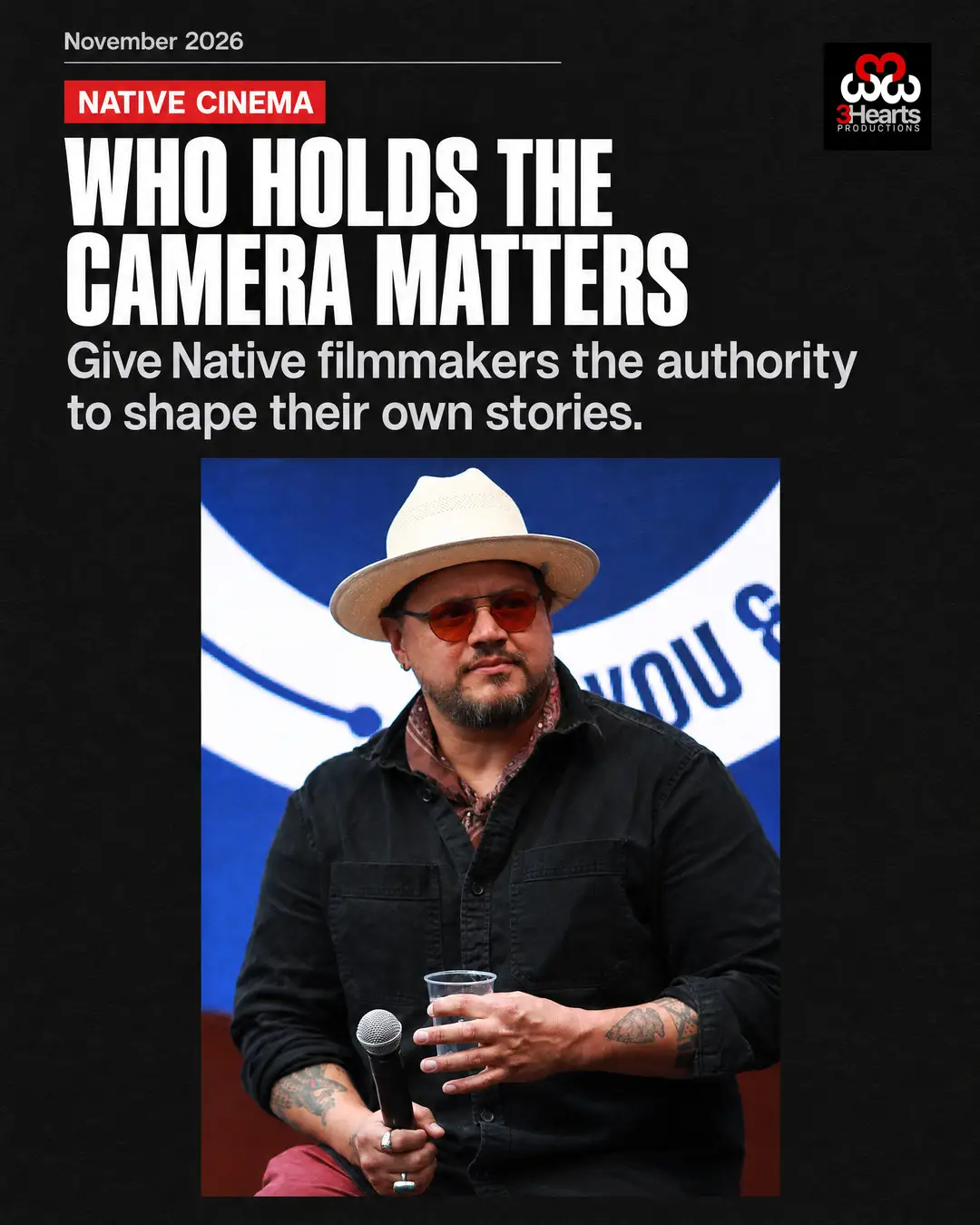
The photograph accompanying this piece shows Sterlin Harjo at South by Southwest in Austin. He is seated with a microphone, wearing tinted glasses and holding a cup. It is a professional setting, with the filmmaker visible as a person doing public work. He is not one of Sugarcane’s directors, and I want that distinction clear.

The Seminole Nation Museum identifies Harjo as a member of the Seminole Nation of Oklahoma and names his documentary This May Be the Last Time. I chose a filmmaker for this image because the argument belongs to the person making decisions behind the camera. A general image of a camera would leave that person out.
Harjo’s conversation with Sundance about the 2004 Directors Lab gives the program history a working example. He discusses learning how to direct and work with a crew, the encouragement he received, and the importance of making his own stories. Sundance also identifies This May Be the Last Time as his 2014 documentary. His account joins training to authorship without treating them as competing priorities.
I like that specificity. Learning to work with a crew does not require a filmmaker to surrender the reason they wanted to make the film. It can help them communicate that reason to other people. That’s a useful way for me to think about collaboration: the skills and the support should help someone make decisions, including decisions that another director would make differently.
My production questions at Another 3 Hearts
Who holds the camera matters. I mean the authorship behind the image as well as the person physically operating the equipment. Before a documentary has a finished frame, someone has chosen its questions, its point of entry and the people who will help make it. I want Native filmmakers to have the opportunity and authority to make those choices about their own stories.
I can bring that position into a Philadelphia production conversation without pretending to speak for Native people. I can ask whose work we are reading and watching. I can ask whether a proposed collaborator is being invited to shape the film or simply to reassure us about decisions already made. If the invitation arrives after the central choices have been settled, I want to know what is still open to change.
That question has consequences for time and money. I want a production plan that lets people participate in decisions, with enough time to understand what is being proposed. When there is disagreement, I want it addressed before the shoot turns a rushed choice into footage everyone feels obliged to use. These are standards I am arguing for, not a claim that our own company has solved every difficulty involved.
I also want to stay with the individual filmmaker’s work. NoiseCat, Kassie and Harjo are named here for specific credits and documented accounts, rather than as substitutes for a whole people or a whole cinema. Read those accounts on their own terms. For a film company acknowledging this month, start before the shoot: put Native filmmakers in the director’s chair, and back their authorship with time and resources.
Sources and references
- Sugarcane filmmaker biographies and directing credits.
- Sugarcane official film description.
- The Walt Disney Company announcement of its 2025 Academy Award nominations.
- Sugarcane directors’ statement.
- Sundance Institute: Why We Celebrate Indigenous Voices, including the 1981 founding meetings and Lab.
- Sundance Institute history of the 1990s, including the formal creation of the Indigenous Program in 1994.
- Sundance Institute Indigenous Program.
- Photograph of Sterlin Harjo at SXSW by Andrew Lih, Wikimedia username Fuzheado. The Wikimedia version is already cropped. Licensed under Creative Commons Attribution 4.0 International. The poster at the top of this page is a designed graphic built from this photograph.
- Seminole Nation Museum: Sterlin Harjo’s membership and filmmaking.
- Sundance Institute conversation with Sterlin Harjo about the 2004 Directors Lab.