The Three Sisters: Indigenous Knowledge for Modern Growers
Corn, beans and squash offer Philadelphia growers a lesson in connected growing systems, rooted in Indigenous agricultural knowledge.
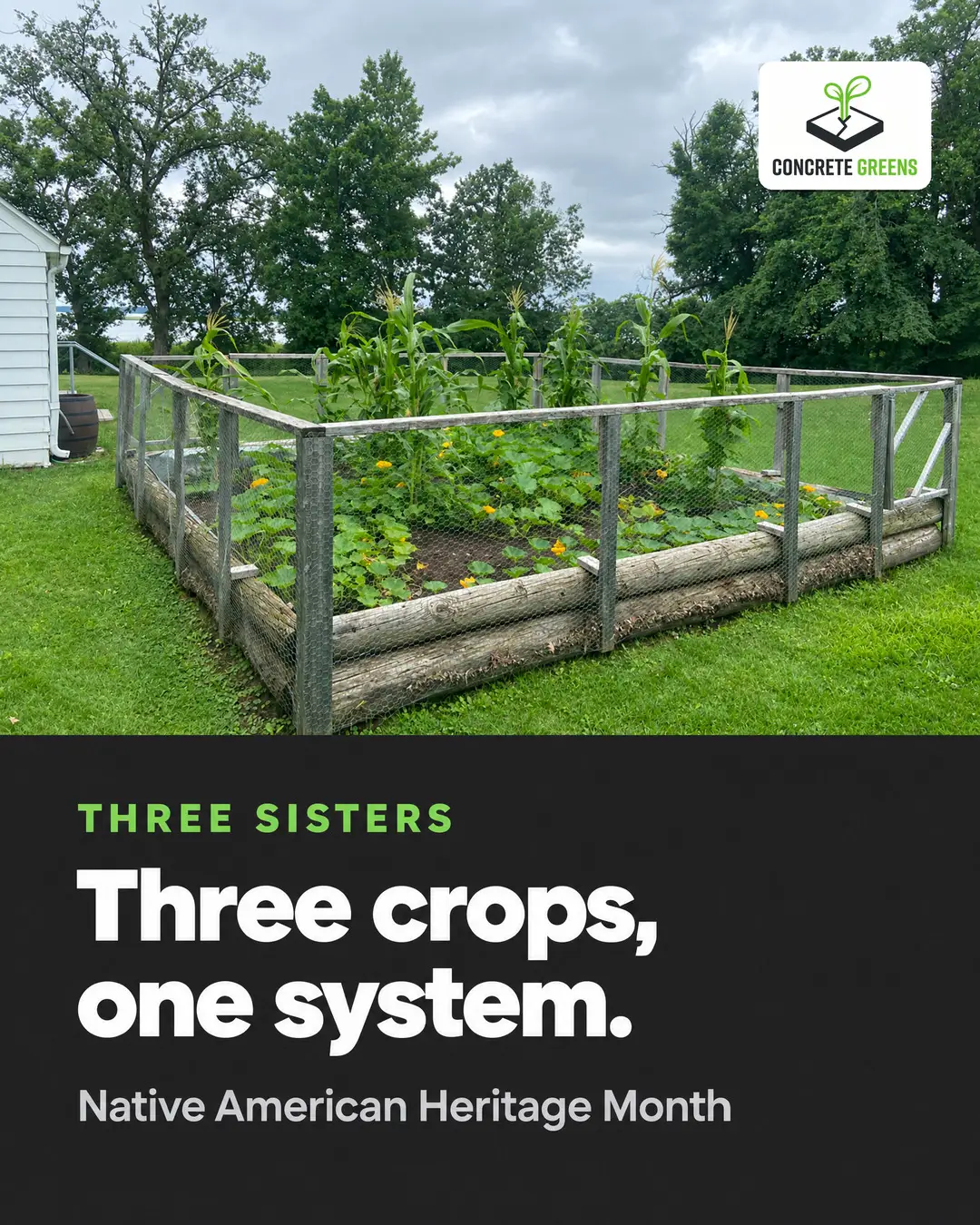
Corn stands above a bed of squash, with bean vines climbing among the stalks. The photograph by Myotus at the Mille Lacs Indian Museum and Trading Post gives me a useful place to begin: with plants occupying the same patch of ground in different ways. I want to keep looking at the connections between them. During Native American Heritage Month, the Three Sisters deserve that attention from those of us thinking about urban agriculture in Philadelphia. Corn, beans and squash grown together are an expression of Indigenous agricultural knowledge documented by the National Agricultural Library. Calling the arrangement clever gets us only so far. I want to understand what each crop contributes, where the limits are, and what a modern grower should ask before borrowing an idea from it.

Start with the people who hold the knowledge
The Oneida Nation’s account of its community gardens describes families growing traditional Three Sisters mounds and heirloom white corn. Families plan, plant, tend and harvest their gardens. The account connects that work with cultural relationships and learning together. Those are people practicing agriculture, with their own reasons for doing it.
I don’t want that specificity to disappear when the conversation turns to growing systems. Credit belongs in the explanation itself. If I describe the Three Sisters only as an efficient arrangement of crops, I leave out the communities whose knowledge makes the example available to me.
The Oneida Indian Nation’s explanation of the Three Sisters names corn, beans and squash as the Sustainers of Life. I can direct readers to that account without pretending to speak for the Nation or to explain everything the plants mean within its traditions. That distinction matters. Reading an agricultural explanation gives me something to learn, and it gives me a responsibility to identify where I learned it.
The National Agricultural Library also describes the Three Sisters as a cultural and spiritual relationship alongside an agricultural practice. My operational interest is one way into the subject. It should leave room for readers to hear more from Indigenous sources.
What the plants do together
The physical arrangement is wonderfully concrete. Corn provides a stalk for climbing beans, while squash spreads broad leaves near the ground. The Oneida Indian Nation describes both the living trellis and the squash canopy’s role in retaining moisture. There is structure above the soil and cover over it. Each matters to the plants sharing that space.
That is the part I want modern growers to study closely. A corn stalk is doing more than holding up its own leaves. A squash leaf changes the conditions underneath it. When I look at the bed as a whole, the placement of each plant starts to matter as much as the plant itself.
The Oneida Indian Nation’s account of the three sisters describes the squash vine’s wide leaves shading the soil, holding back erosion and weeds and keeping moisture in. Its planting guidance puts the corn in first and adds the beans and squash once the corn is about six inches high. Timing is part of the arrangement too. A support has to be ready when something needs to climb it.
I find that sequence as interesting as the finished garden. The photograph shows the plants together. The growing instructions explain some of the work needed to get them there. Cooperation between crops still asks the grower to make decisions.
Nitrogen needs a more careful sentence
Beans fix nitrogen through a relationship with bacteria. More precisely, Mississippi State University Extension explains that soil bacteria associated with legumes fix nitrogen for the plants to use. That biological relationship belongs in the explanation of the Three Sisters. So does a limit on what we promise about it.
It is tempting to jump from nitrogen fixation to the claim that a bean plant supplies all the neighboring corn’s fertilizer. The Oregon State University Extension answer on planting the Three Sisters cautions that nitrogen in the beans’ fixing nodules is available to the beans, while corn and squash are heavy feeders. That is a reason to resist the easy version of the story.
The Oneida Indian Nation makes a related distinction in its container planting instructions: growers should provide adequate nitrogen, and the account connects later availability with the breakdown of bean roots. Fixation and the timing of nitrogen becoming available elsewhere are separate questions.
I would rather take the extra sentence than turn a useful explanation into a bad growing instruction. The system remains worth studying with that qualification in place. In fact, it becomes more interesting, because now I have to ask where the nutrient is, who can use it, and when. That is the kind of question a grower needs answered before making a change.
Indoor growers can study the relationships
Before somebody asks whether this means putting corn, beans and squash into an indoor production room, fair question. My interest here is in the questions the arrangement raises. I am not proposing a production recipe or reporting a Three Sisters planting at Concrete Greens.
For an indoor grower, I would start with a drawing of the growing space. Where does the light land? What occupies the space underneath the leaves? How are nutrients supplied? What has to happen before the next stage can begin? I would want those questions answered together before signing off on any one part of the design.
The outdoor example gives those questions a physical form. Virginia Cooperative Extension’s explanation of companion planting identifies support for climbing beans and soil cover from squash as functions within the Three Sisters arrangement. I take the design lesson to be that a change in one part needs to be considered alongside what it does to the others. That is my application of the example, rather than a claim that this specific planting has been validated for an indoor facility.
I also want the accounting to include what an idea requires. If a proposed change adds a task, somebody has to do it. If it depends on another process, that dependency belongs on the drawing. I would ask for the timing, the measurements and the person responsible before calling the design ready.
Keep the learning connected to its source
This knowledge has living practitioners. The Three Sisters Project at Iowa State University describes collaboration between Native gardeners and researchers, guided by an advisory board of Native gardeners. Its partners include gardeners associated with the Oneida and Menominee nations. The project studies cultural and agronomic questions together.
That is a useful place for me to send a reader who wants to keep learning. A short post can open the subject, but the people doing the growing and research deserve the next part of the reader’s attention. Native American Heritage Month should lead somewhere beyond the caption.
For Concrete Greens, I want this discussion to sharpen the questions behind local food production throughout the year. I want an operating model that can cover its costs, complement traditional farms and direct surplus toward communities facing food insecurity. That is a statement of purpose, not evidence of a particular crop trial or an outcome already achieved.
The Three Sisters give me a specific assignment: trace the relationships before approving the parts. Read the Indigenous accounts. Keep the nutrient qualification attached to the nitrogen claim. Then take a growing plan and mark every place where one decision changes the conditions for something else. I want those marks visible at the next design conversation.
About the Author
Harry Hayman is a Philadelphia-based entrepreneur, music producer, and cultural advocate. Through his work with the Feed Philly Coalition, he explores and documents the creative, culinary, and civic life of a city he believes is one of the most inspired places in America.
Sources and references
- Oneida Nation: A community garden is strengthening cultural ties.
- Oneida Indian Nation: The interworking of the three sisters.
- USDA National Agricultural Library: The Three Sisters of Indigenous American Agriculture.
- Mississippi State University Extension: Do I need to add nitrogen for beans?.
- Oregon State University Extension: Tips for planting corn, beans and squash?.
- Virginia Cooperative Extension: Companion Planting in Gardening.
- Iowa State University: Three Sisters Project.
- Hero photograph: Three Sisters Garden, by Myotus, via Wikimedia Commons. Licensed under Creative Commons Attribution ShareAlike 4.0 International. The supplied asset is a Wikimedia resized version of the original photograph. Any subsequent crop, color treatment or poster adaptation must be identified in its reuse credit and distributed under the same or a compatible license. Credit belongs here and with the published reuse, never on the poster face.