Argus Farm Stop: Farmers Keep 70 Cents of Every Dollar
In Ann Arbor, a farm stop pays farmers 70 cents of every dollar. Harry Hayman on why the model matters for Philadelphia's food economy.
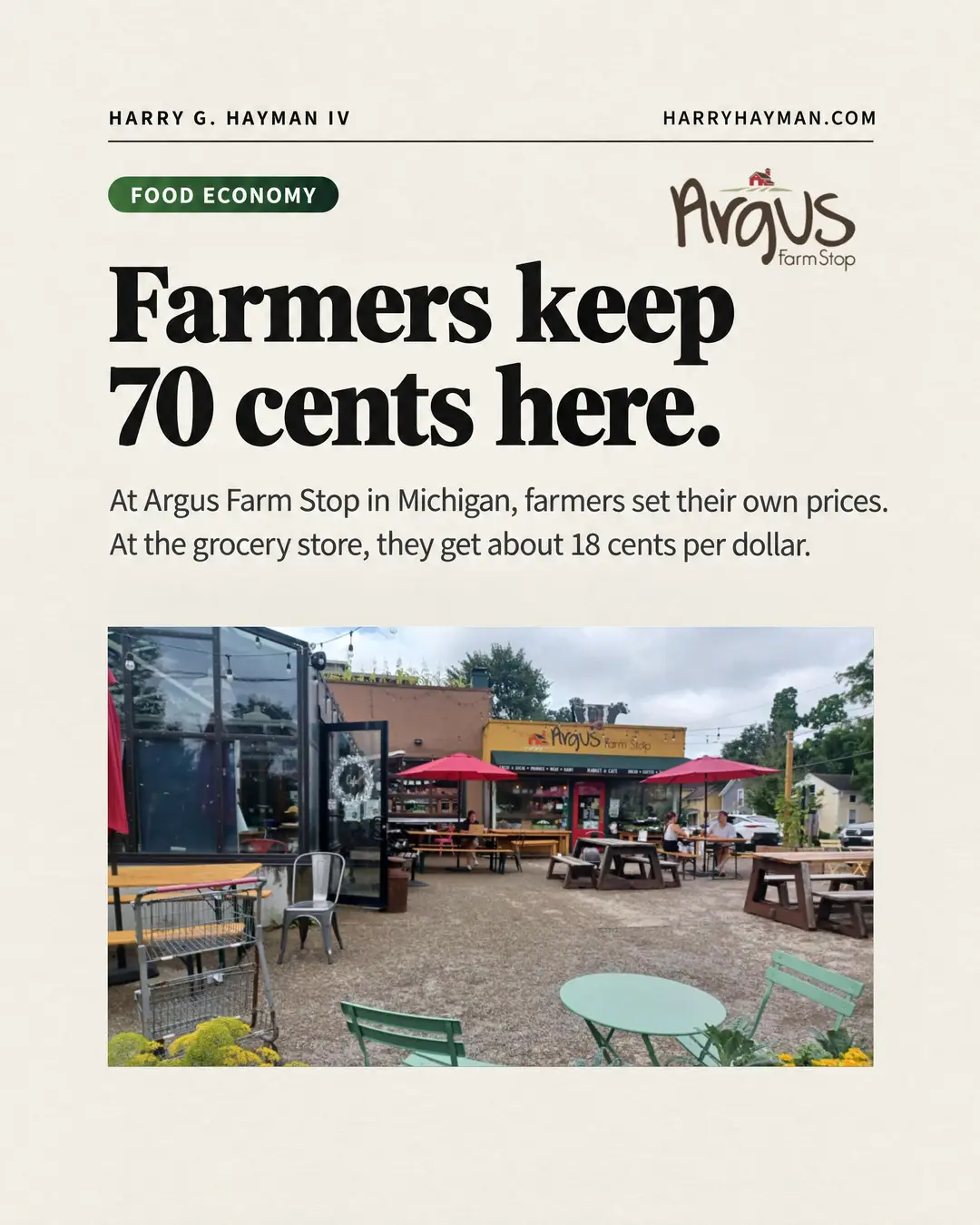
The photograph of Argus Farm Stop in Ann Arbor does not look like a policy argument. A yellow storefront with the name painted across it, red umbrellas over picnic tables, kale and marigolds growing in wooden planters in the gravel yard. I started reading about Argus Farm Stop recently, and I kept going back to a single number: the farmers who sell there keep 70 cents of every dollar. Not 18 cents. Not a fraction of a margin left over after a distributor, a buyer and a logistics chain each take their share. Seventy cents. I want to sit with that for a minute, because I think it reframes what a food economy can actually be set up to do, and because it raises a question I find myself asking constantly in my own work: who is this system designed to benefit?
What Argus Farm Stop Actually Is
Kathy Sample and Bill Brinkerhoff opened Argus Farm Stop in August 2014, in a gas station that had sat empty for years at 325 West Liberty Street in Ann Arbor, Michigan. The idea was specific from the beginning. Everything in the store would come from local producers, and those producers would own their goods until they sold. That is the consignment model, and on paper it sounds simple. In practice, it shifts who holds the risk and, more importantly, who holds the pricing power.
According to the Argus sell page, farmers set their own prices, deliver their products and receive 70 percent of each sale. Argus keeps 30 percent and charges a small shelf fee per payout, which is waived for the first two payouts and scales with sales volume after that. There is no wholesale negotiation. There is no buyer dictating a price to a grower who has already spent a season raising what is about to be sold. The farmer decides what the product is worth to them, and 70 percent of that number comes back when someone buys it.
By August 2024, Civil Eats reported that Argus was doing roughly $6.5 million in annual sales, working with about 200 local farmers, food producers and artisans, and employing 65 people. The store has three locations in Ann Arbor, the original West Liberty site plus a second that opened at 1200 Packard in 2017, and a third down the same block in 2022. Since opening, Argus has paid over $26 million to its producers. I have spent a fair amount of time thinking about food economics, and that cumulative figure is one of the more meaningful ways to measure what a retail model actually does over time.
The 70 Cents Sitting Next to the 18 Cents
The context that makes 70 cents meaningful is the figure it sits next to. The USDA Economic Research Service Food Dollar Series, updated in March 2026 with 2024 data, puts the farm share of a grocery dollar at about 18 cents. That is the average share going back to the farmer when you buy food at a conventional store. The rest covers transportation, processing, packaging, distribution and retail operations. Eighteen cents is the answer to what the farmer gets when the whole chain runs through standard commercial grocery.
The gap between 18 cents and 70 cents is not a small adjustment. It is a different model of where value is captured and who it flows to. When a farmer sets their own price and keeps 70 percent of it, they are working with a floor they defined. That is a structurally different position than selling into a wholesale market where a buyer sets the terms and the grower accepts or walks.
I want to be precise here. The 18 cent figure is a national average across grocery store food categories, and individual outcomes vary by crop, by region and by what a particular farm has negotiated. But averages tell you something about the center of gravity in a system, and a center of gravity at 18 cents means most of the money most consumers spend on food is not reaching the farm.
A County That Bucked the Direction Everyone Else Was Moving
What happened in Washtenaw County, where Ann Arbor sits, during the same years Argus was growing is worth knowing about separately.
According to the USDA Census of Agriculture data for Washtenaw County, the number of farms harvesting vegetables, potatoes and melons for sale grew from 111 in 2017 to 170 in 2022, a gain of 59. That was the largest increase of any Michigan county in that category over that period. And these were not large operations expanding. The total vegetable acreage in the county actually fell from 897 acres to 647 over the same span. The county added small farms while the country around it was going the other direction.
Brinkerhoff described it plainly in an April 2024 Concentrate magazine article: “What we’ve seen in our county is a slight uptick in overall farms that bucks the trend.”
The trend he is referring to is steep. The USDA NASS Farms and Land in Farms report from February 2026 shows the United States lost about 15,000 farms in 2025, bringing the national total to roughly 1.865 million. Averaged over 365 days, that is about 41 farms a day. The national direction is a slow bleed, and as I read it, a lot of the pressure comes from economics that favor scale and consolidation over small farm viability. Washtenaw County adding 59 vegetable farms between two census counts does not reverse that direction nationally, but it is a signal worth reading.
I cannot prove that Argus Farm Stop caused the growth in Washtenaw County farms, and I am not trying to make that argument. What I can say is that the timing is there, the model is there, and a structure that pays 70 cents on the dollar instead of 18 cents changes the math for whether a small farm can survive long enough to become an established one.
Who Is Capturing the Rest of the Grocery Dollar
One more piece of context before I get to what I think about this in terms of Philadelphia.
The 18 cent farm share exists inside a grocery market that has been concentrating for decades. According to an analysis by the Institute for Local Self-Reliance based on 2018 data, one company takes about one in four grocery dollars spent in the United States, and in 203 local markets it holds 50 percent or more of all grocery sales. When a buyer controls that share of any market, the people supplying it do not have much room to negotiate on price. Pricing power in those supply chains runs in one direction.
The Argus model does not solve grocery consolidation. Nothing at the scale of one store does. But it demonstrates that a different set of terms is achievable, and that those terms can hold up commercially. $6.5 million in annual sales is not a novelty. That is a functioning business with 65 employees, 200-plus producers, and over $26 million paid out since 2014. The terms work.
What I Keep Thinking About for Philadelphia
I serve as a Senior Fellow at the Economy League of Greater Philadelphia, where my focus is food economy and policy. A lot of what I think about in that role circles back to the question of where money actually ends up in a food transaction, and how you build a system that keeps more of it close to the people doing the growing.
Philadelphia is not Ann Arbor. Our scale is different, our existing food infrastructure is different, and our regional farm geography is its own thing. I am not suggesting we need a single store that solves the whole picture. What I find myself wondering, looking at what Argus built, is whether the design assumption most food retail starts from, that the farmer is the one who absorbs the most risk and captures the least value, is actually the only way to do this.
The consignment model flips that assumption. It says the farmer prices what they grow, and the store takes a percentage of that number rather than a margin on top of a wholesale price the store set. That is not a charitable arrangement. It is a structural choice about who the system is designed to work for.
The 41 farms a day disappearing nationally are not failing because farming is broken. A lot of them are failing because the economics of selling what you grow, into a market built around buyers with enormous market concentration, do not pencil out over time. A model that keeps 70 cents with the farmer is not a feel good story. It is a different answer to the question of how you keep a regional food economy alive. I do not know exactly what that looks like at Philadelphia’s scale, and I am not pretending there is a simple version of this ready to transplant. But Washtenaw County, adding small vegetable farms while the rest of the country lost them, is a data point I keep returning to.
Sources and references
- Argus Farm Stop: About
- Argus Farm Stop: Sell at Argus
- Civil Eats: Farm Stops Create New Markets for Small Farms
- USDA ERS Food Dollar Series: Quick Facts
- USDA Census of Agriculture 2022: Washtenaw County, Michigan
- USDA NASS Farms and Land in Farms, February 2026
- Concentrate: Ann Arbor Local Food Story, April 2024
- Institute for Local Self-Reliance: Walmart’s Dominance in Grocery Markets
- Economy League of Greater Philadelphia
- Hero photo: National Dragon, Wikimedia Commons, CC BY 4.0