Singapore's Half-Rent Stalls for First-Time Cooks
Singapore rents new cooks a fitted hawker stall at half the market rent. What the model is and what Philadelphia could ask of it.
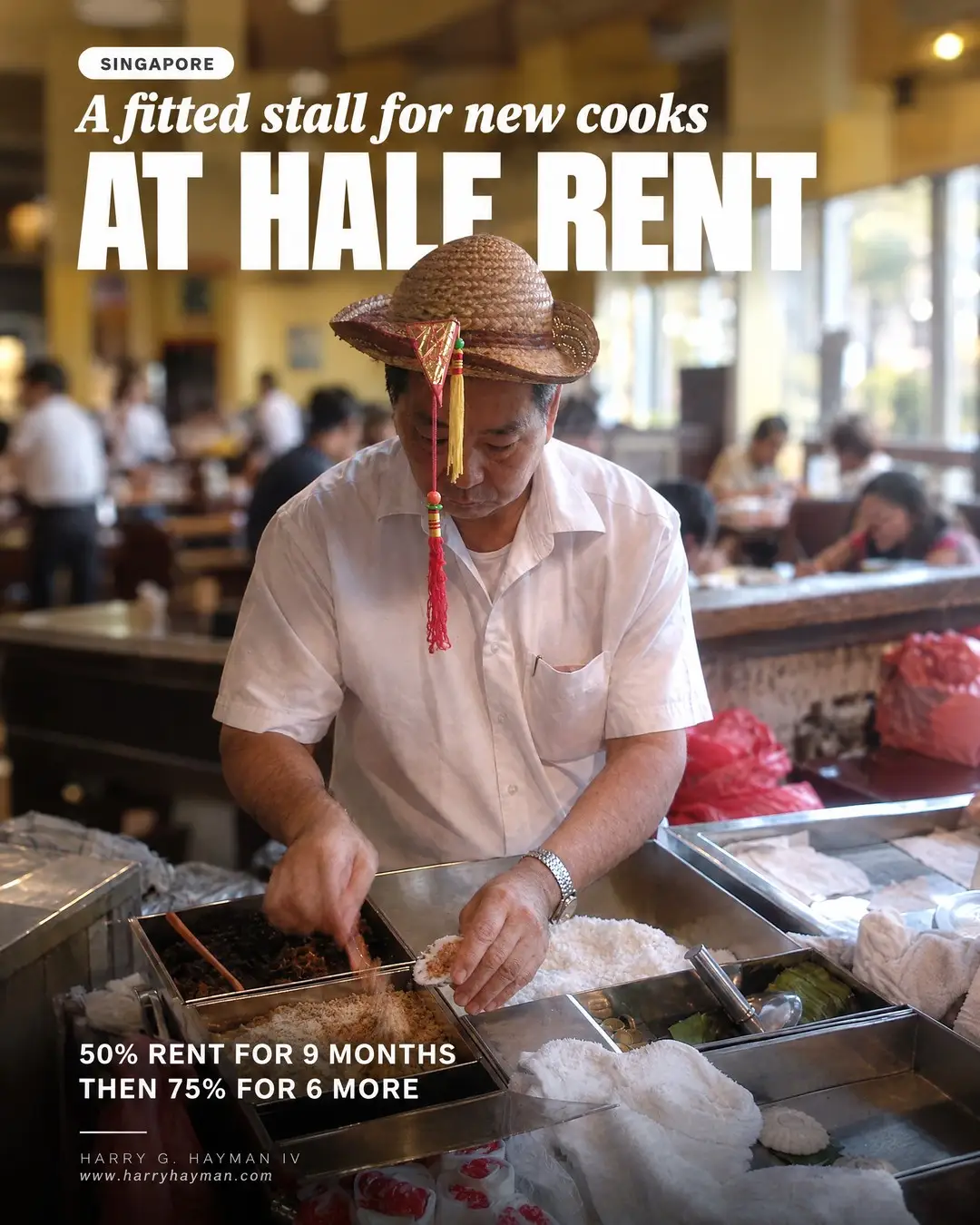
The photograph I keep coming back to has no skyline in it and no skyscraper. It is an older man in a white shirt and a straw hat with a red tassel, bent over a stainless steel counter, filling a small rice cake with his right hand while his left hand spoons crushed peanut from a tray. The photographer filed it on Wikimedia Commons as kueh tutu preparation, in the category for Singapore’s hawker centres. I cannot tell you which stall it is, and I will not guess. What I can tell you is what the picture made me ask. Who paid for that counter, those trays, the hood somewhere above his head? In most of the restaurant world I know, the answer is the cook, before the first customer shows up. In Singapore, for a certain kind of first-time cook, the answer is partly the government, and the rent is half of what everyone else pays. I wanted to understand exactly how that works before I said anything about Philadelphia.

What Singapore built, and when
Start with the building, because the program makes no sense without it. The National Environment Agency says that Singapore’s hawker centres were built from the 1970s to resettle and house street vendors under one roof, with proper water and sewerage facilities and electrical supply. After the resettlement programme was completed in 1986, the government stopped building new centres. By 2011, the same agency writes, it had become clear that Singapore needed more of them, because of dual-income families, new housing estates and changing dining patterns.
Today the agency manages 123 markets and hawker centres and regulates the tenancies and the public health side of each one. I want to be careful with that number. It is a count of markets and hawker centres together, as the agency states it, and it is the agency’s own figure, not mine. But the shape of it is the point. This is not a food festival or a pop-up. It is public infrastructure, run for decades, the way a city runs a library system or a bus network.
UNESCO took notice. Hawker culture in Singapore was inscribed on its list of intangible cultural heritage in 2020. I mention that only because it tells you the building and the food are not separable there. The infrastructure came first, and the culture grew inside it.
Half rent, then three quarters
Now the part that stopped me. The Incubation Stall Programme aims to support aspiring hawkers, particularly those without prior food stall or food shop management experience. The agency’s own words: successful applicants will be offered stalls at 50 percent of the market rent for nine months, followed by 75 percent of the market rent for another six months. And the stalls will be fitted out with basic fittings and equipment to lower the upfront capital investment needed for the setting up of a stall.
Read that second sentence twice. The program names the upfront capital as the barrier, and it answers the barrier directly. It does not offer advice or a mentorship brochure. It hands a new cook a stall that already has the basics in it, and it charges half the rent while the cook finds out whether the business works.
I have thought about restaurant economics for a long time, and the hardest money in the business is the first money. The hood, the walk-in, the build-out, the deposits, all of it gets paid before a single plate is sold, and it is paid by the person with the least information about whether the place will work. A city pays for that too, in the good cooks who never open. The program does not make the risk disappear. It moves a piece of it off the cook’s shoulders for fifteen months.
The entry ticket
It is not free money, and that matters to me. To apply, the agency lists three requirements besides age and residency: completing the Institute of Technical Education’s short course, Introduction to Managing a Hawker Business, or holding a business management qualification that covers similar modules, submitting a concise business plan, and passing a food tasting session. Applicants must also be Singapore citizens or permanent residents aged at least 21.
I like the shape of that. A course teaches the business side, a plan forces the cook to put numbers on paper, and a tasting checks the one thing a rent discount cannot fix, whether the food is good. Three small gates, each one cheap compared with a lease and a build-out. The program is asking the cook to show the work before the public pays for the stall, which is a fair deal in both directions.
Keeping the old recipes alive
There is a second program I will mention once and leave alone. The Hawkers Succession Scheme pairs a veteran hawker with a successor. The successor takes on conditions: keep the veteran’s signature dishes and the stall name for the first three years, and keep the food price of the signature dishes for the first eighteen months. It is a different problem from the incubation stall, how a recipe survives its cook, but it comes from the same instinct. The public landlord has a stake in who cooks in the building, and it writes that stake down.
What does not travel
Now the honest part, because I do not want anyone to read this as a cut-and-paste proposal. Singapore is a city-state. Its government built these centres on land it controls, as part of a resettlement of street vendors, with a single national agency running the portfolio. Philadelphia does not have that structure. We have a city government, a school district, a port authority, a patchwork of nonprofits and private owners, and a food scene that grew up by a very different route. I also have no Philadelphia figure for what it costs to fit out a starter stall, and I am not going to make one up. Nobody should quote a number here until someone has priced a real space.
So the model would need adapting, and some pieces may not adapt at all. Who owns the building, who pays for the fit-out, who carries the lost rent for fifteen months, and what the program does when a stall fails are all questions Singapore has answered in its own context and Philadelphia would have to answer in ours. I would rather say that plainly than sell a tidy parallel.
The question I would ask in Philadelphia
Here is where I land, and it is a question, not a policy. Philadelphia already runs a public food hall. Reading Terminal Market describes itself as one of America’s largest and oldest public markets, housed since 1893 in a National Historic Landmark building. I want to be careful here too: it is a public market, and it is not a hawker centre, and I am not claiming the two are the same thing. They were built for different reasons, in different decades, in different places.
But a public market is a building where a city has already decided that many small food businesses belong under one roof. That is the one thing the two have in common, and it is the thing the Singapore program depends on. So I wonder what a starter stall would look like inside a building like that, or inside one of our neighborhood market buildings. A stall with the basics already installed. A rent that starts at half. A short course, a plan and a tasting as the entry ticket, rather than a lease and a loan. I do not know whether it works here, and I would want the people who run these buildings in the room before anyone drew a plan.
What I do know is that the first-money problem is one of the oldest in restaurants, and nothing about it stops at a city line. Singapore looked at that problem, decided the cook should not carry all of it alone, and wrote it into a program with numbers on it. I think that is worth a look, and worth a harder question than most of us have been asking.
Sources and references
- Wikimedia Commons: Kueh tutu preparation, photo by Chensiyuan, CC BY-SA 3.0
- NEA Singapore: Hawker Management overview
- NEA Singapore: Hawker Centres, from street hawkers to community hubs
- NEA Singapore: Incubation Stall Programme
- NEA Singapore: Hawkers Succession Scheme
- UNESCO: Hawker culture in Singapore, community dining and culinary practices in a multicultural urban context
- Reading Terminal Market: About the Market