A Farmer's Corner Store and the Philadelphia Fund Behind It
A farmer opens a corner store at 9th and Market, and I trace the Philadelphia built Pennsylvania fund that finances fresh food retail across the state.
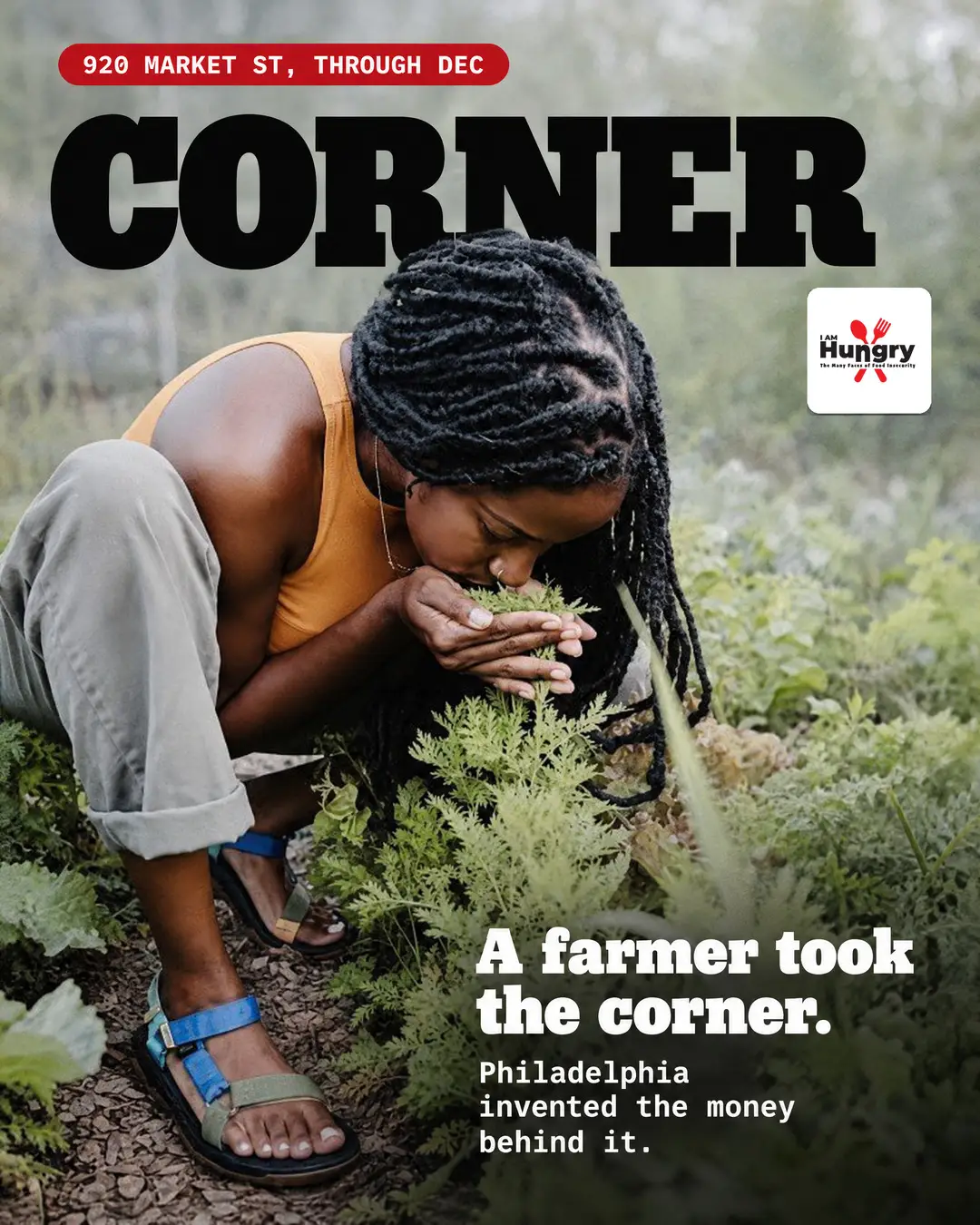
Christa Barfield walked into the corner stores near her and asked the owners to stock more fresh food. Food Tank’s profile of her puts the result in one flat line: “At each one, she received the same answer: No.” Then it gives her reaction, which is the sentence I keep rereading. “It was a business decision purely, and that made sense to me,” she told Food Tank. “You’re not going to buy something that’s going to die on the shelf.”
I think that is the most honest thing anyone has said in the whole hunger conversation. Nobody on that block is the villain. A bag of lettuce that does not sell is money in the trash, and I suspect a small store can’t absorb many of those. So the shelf fills with what lasts. I am writing this for I Am Hungry in Philadelphia because the interesting question is what happens next, and Philadelphia already answered it once.
Why the shelf stays the way it is
When people talk about corner stores and fresh food, the conversation usually drifts toward customers and what they choose to buy. Barfield’s story points the other way. The owners she asked were not refusing out of indifference. They were pricing a risk. Fresh produce spoils, and spoilage comes out of the owner’s pocket.
That reframes hunger as a financing problem rather than a character problem, which is exactly the lens this account exists to use. If the barrier is the cost of being wrong about a crate of greens, then the useful tool is something that absorbs part of that cost: a grant for a cooler, a loan for shelving, help with the first months of inventory. That is not a charity idea. It is how we already treat roads, ports and bridges, where public money takes on risk that no single business could carry.
The map that started it
Here is the part I did not know until I went looking. The tool exists, and it was born here. The Food Trust’s own history of the program says that in 2001 it published a report called Food For Every Child: The Need for More Supermarkets in Philadelphia, which mapped food access across the city. The report found that the city’s lower income communities also had the lowest supermarket access and the highest rates of diet related deaths. That map spurred Philadelphia City Council hearings.
From those hearings came a state program. According to The Food Trust, Pennsylvania’s Fresh Food Financing Initiative was originally launched in 2004, and it was seeded with $30 million in state funds over three years, with The Reinvestment Fund, a community financial development institution, stretching that seed money further. The Food Trust reports that the program approved 88 projects, representing 1.67 million square feet of retail space and 5,000 jobs created or retained, making healthy food more available to an estimated 400,000 of the state’s low access residents.
It also got noticed outside Pennsylvania. The same page says the initiative was named one of the top government innovations in the country by Harvard University’s Kennedy School of Government, and that its public and private structure became a model for other cities and states. The national Healthy Food Financing Initiative, a partnership among the federal Departments of Treasury, Agriculture and Health, grew out of that wider effort.
What the money looks like at corner scale
Numbers like 1.67 million square feet are hard to picture, so I want the small version. The Food Trust published a case study of EC Food Market in Haddington, West Philadelphia. It describes a neighborhood with a median household income of $46,492 compared to Pennsylvania’s $76,081, with 40% of families receiving SNAP benefits. The nearest full service supermarket was nearly a mile away, and the existing corner stores offered little to no fresh produce.
The store applied for and received funding through the program. According to the case study, that funding paid for major renovations, including repairing the floors and upgrading signage, plus new equipment such as a freezer for healthy proteins like chicken, fish and shrimp. The Food Trust reports increased sales, particularly from SNAP and EBT purchases of healthier items, and three full time employees. Notice the scale. This is a floor, a sign and a freezer, and it changes what a corner can carry.
The program has kept going. The Food Trust says the initiative was recapitalized in 2018 by the Pennsylvania Department of Community and Economic Development, and its projects page says that since 2018 it has funded 78 healthy food retail projects across the commonwealth. Awards range from $5,000 to $200,000, and the program works with nonprofit, for profit and cooperative food businesses serving low to moderate income communities. The 2026 application is closed, and The Food Trust says it will reopen in 2027.
The live case at 9th and Market
Now the farmer. Wooder Ice, the media partner for the opening, announced that CornerJawn would open at 920 Market Street, at 9th and Market in Center City, on Thursday, October 29. It describes a store that replaces the processed snacks of a typical convenience store with fresh produce grown on FarmerJawn’s 128 acre regenerative farm. The quote that went with the announcement states the problem plainly: “For too long our corners have been stocked with chips and soda while the good food stayed out of reach.”
The storefront sits in a block of temporary shops. Billy Penn reported in August that pop up shops in Market East, part of the Meantime on Market initiative, would stick around through December. FarmerJawn’s own Instagram post says its pop up at 920 Market Street runs through December 31, and I am leaning on the farm’s own word for that date, since I could not find it confirmed anywhere else. That same post describes a permanent location planned for Kensington. I have no opening date for it, and neither, as far as I can tell, does anyone outside the project.
The link back to the fund is also worth a careful sentence. The Food Trust’s Instagram post about CornerJawn says CornerJawn is a 2025 grantee of the Pennsylvania Fresh Food Financing Initiative. I could not find a web page from the program that lists it, so I am attributing the claim to The Food Trust rather than stating it as settled record. I am also leaving out the dollar figures and construction details that appear only in those posts, because I would rather publish less than repeat numbers I cannot check.
What I can say is the shape of it. A farmer who was told no at every corner decided to own the corner instead, and the public financing tool that Philadelphia invented in 2004 appears to be part of the stack behind her. That is the working model: public money absorbs the risk, a producer who understands spoilage runs the shelf, and the result is a store that treats fresh food as the product rather than the liability.
What I won’t claim
The Food Trust’s published results for the program are outputs. They count projects, square feet, jobs and the number of people living within reach of a better store. They are not measured drops in hunger, and I do not want to turn them into one. A store existing is not the same as a household eating differently, and the case study’s own evidence is higher sales of healthier items, which is encouraging without being the same as an outcome.
I also want to be plain about what this post is. It is about a financing model and one store that is testing it, and CornerJawn is a for profit shop. I am not asking anyone to give money to anything. The dates are information, nothing more. If you are in Center City before the pop up closes, you can read the shelf yourself, and that is entirely up to you.
The question I keep asking
Here is what I cannot stop turning over. If a program built from one Philadelphia map can put a floor, a sign and a freezer into a Haddington corner store, and if a farmer can run a corner at 9th and Market with that same program in her corner, then what would it take to do it for every corner in Kensington?
I do not have the full answer, and I would rather say so. Some of it is scale, because awards between $5,000 and $200,000 only reach as far as the number of applications. Some of it is time, since the next round does not open until 2027. And some of it is whether the people who run our corners ever get asked what would make fresh food safe to stock. Barfield asked, got no, and understood why. That is where I would start.
Sources and references
- Food Tank: Christa Barfield wants to flip the script on corner stores. Elena Seeley, July 3, 2025. The corner store refusals and Barfield’s quotes.
- The Food Trust: Healthy Food Financing Initiatives. The 2001 report, the $30 million seed, the 88 projects, 1.67 million square feet, 5,000 jobs and 400,000 residents, and the Harvard Kennedy School recognition.
- The Food Trust: Pennsylvania Fresh Food Financing Initiative. Launch in 2004, recapitalization in 2018, grant range and 2026 application status.
- The Food Trust: PA FFFI funded projects. The 78 projects funded since 2018.
- The Food Trust: EC Food Market case study. Haddington figures, the renovations and the results.
- Wooder Ice: CornerJawn opens at 9th and Market. Wooder Ice was the media partner for the opening, not independent press.
- Billy Penn: Market East pop up shops extension. August 20, 2026.
- FarmerJawn Agriculture on Instagram, October 28, 2026. The pop up end date and the planned Kensington location, attributed to the farm.
- The Food Trust on Instagram. The statement that CornerJawn is a 2025 grantee, attributed to The Food Trust.
- Photograph: a FarmerJawn and CornerJawn press image as published by Wooder Ice on October 14, 2026, photographer not credited.