One Step Closer to a Permanent Office of Food and Nutrition Security
A Philadelphia City Council committee advanced a proposed charter office for food and nutrition security. Here is what it would do and what comes next.
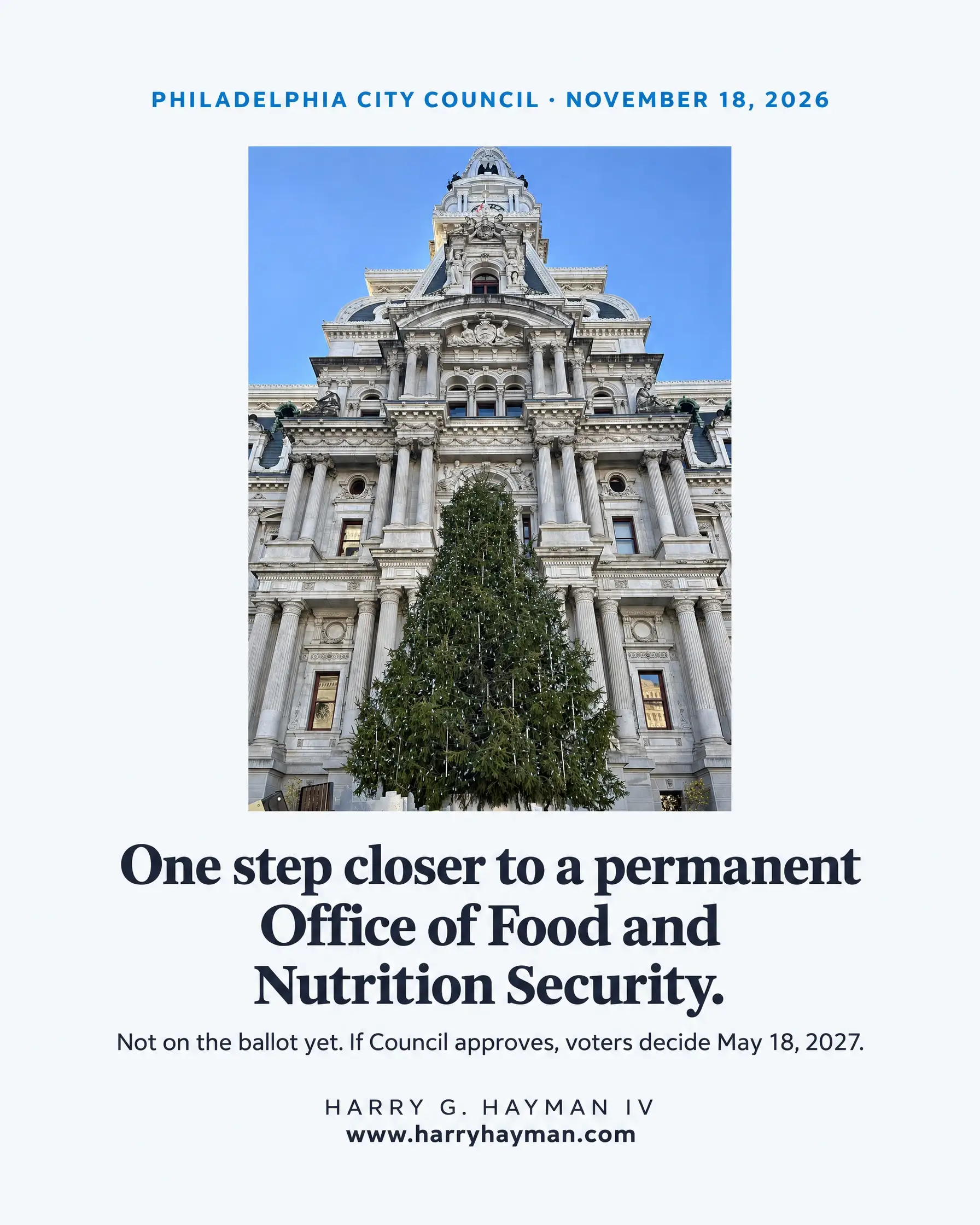
Philadelphia, this one is big, and we are not at the finish line yet. I’m Harry Hayman, and on November 18, 2026, I sat in a hearing room at City Hall while the Committee on Law and Government took up legislation that would put a permanent Office of Food and Nutrition Security into the Philadelphia Home Rule Charter. The legislation received a favorable committee recommendation. I have been making the argument for this for years, and I can’t tell you how good it felt to watch the conversation finally reach a point where it could become law. Then I walked outside, past the holiday tree in front of City Hall, and reminded myself that a committee vote is a step, not the end.
What Happened in Room 400
The committee’s published agenda for the day lists two items on this subject. One is an ordinance, Bill No. 260829, which would submit to the city’s qualified electors a proposed amendment to the Philadelphia Home Rule Charter relating to the creation of the Office of Food and Nutrition Security and the Food and Nutrition Security Advisory Commission. The other is Resolution No. 260845, which proposes that amendment itself. You can search both numbers on the Council’s legislative information center and follow what happens next.
Here is the part that matters most. This is NOT on the ballot yet. City Council still has to act. If Council approves, Philadelphia voters would have the chance to weigh in on May 18, 2027.
Where This Came From
None of this appeared out of nowhere. Council President Kenyatta Johnson brought together the Food and Nutrition Security Task Force, and the two leaders were George Matysik of SHARE Food Program and Mark Edwards of The Food Trust. According to The Food Trust’s account, the task force worked for 17 months and released its recommendations on June 23, 2026. The report itself sets out twelve, and the first is to create a permanent Office of Food and Nutrition Security to coordinate food policy and programming across the city. Among the others, The Food Trust highlights SNAP and WIC enrollment, community led strategies in every Council district, neighborhood food infrastructure and healthy food retail, nutrition education, and a coordinated Food as Medicine strategy.
A big thank you to Council President Johnson for convening this work, to George and Mark for leading it, and to ALL the people who gave their time, energy and expertise. I mean that. Task forces are easy to start and hard to carry across the line.
The Problem the Office Is Meant to Solve
When the proposal was introduced, 6abc reported that more than 200,000 city residents face food insecurity every day. The task force’s own report, available on the Council’s website, adds that federal cuts have made a hard situation harder. It says Philadelphia lost more than 25,000 residents from SNAP rolls because of new work requirements, and that SNAP-Ed was eliminated from schools and community sites across the city.
The same report is just as clear that we are not starting from zero. It points to community fridges providing more than 200,000 meals a year, the Food Justice Initiative investing more than $2.5 million in neighborhood level access, and the Growing from the Root urban agriculture plan. The report’s diagnosis is that the challenge has not been a lack of ideas. It is a system with no mechanism to align them. Its phrase for the office is the “air traffic controller” the system lacks, and I have not heard a better description. That is exactly my question: how do we better coordinate these efforts, invest in our local food economy, and measure whether fewer Philadelphians are going hungry?
What the Proposed Office Would Be
The legislation as introduced in October has details worth knowing, and PhillyVoice laid them out. The office would be led by a director appointed by the mayor and subject to Council approval, someone with at least five years of senior leadership experience. It would develop food insecurity and nutrition strategies, coordinate food access initiatives including with private sector partners, and collect data on food insecurity. A Food and Nutrition Security Advisory Commission would advise the mayor and the office, and it would submit recommendations to the mayor and the Council president by December 31, 2029. If voters approve, PhillyVoice reports the changes would take effect on January 1, 2028.
I am quoting the bill as it was introduced. Amendments can change a bill on its way through committee, so read the version that comes before Council before you form a final view.
Why a charter change rather than an ordinance or an executive order? The task force report answers directly. It calls for a legal foundation that survives political transitions and cannot be reduced or eliminated at administrative discretion. It also says the new office must have real authority and must be clearly different from the Food Policy Advisory Council and earlier advisory structures. In other words, it is asking for an office that keeps working when administrations change.
Philadelphia Has Done This Before, and So Has New York
This would not be the first time Philadelphia voters were asked to make an existing mayoral office permanent. Billy Penn explained that the Mayor’s Office for People with Disabilities was created by a 2017 executive order, which meant a future mayor could disband it, and that the November 2023 ballot question asked voters to write it into the charter so it would stay regardless of who is mayor. The same logic applies to food.
New York City offers a model on the food side. Local Law 41 of 2020 amended the New York City charter to direct the mayor to establish an office of food policy, headed by a director. By the law’s text, the director recommends food policy to the mayor and agencies, coordinates multi agency initiatives, does outreach to advocates, community organizations and academic institutions, and supports initiatives that promote healthy food access for communities that have historically lacked it. It is a coordinating role written into the city’s founding document, which is precisely the idea the Philadelphia task force is putting in front of us.
How a Charter Amendment Reaches the Ballot
Many people do not know how this works, so here is the short version. Philadelphia Magazine’s explainer on ballot questions says Council can approve a charter change by a two thirds vote and send it to a primary or general election ballot, or residents can collect 20,000 signatures to request one, after which Council votes on placing the question. Either way, Council keeps the final say. That is why the two items on the agenda matter. One proposes the amendment and the other submits it to the voters.
So the road from here is Council action, then the ballot, then a majority of voters. Only after that does the work of building the office begin.
What I Want You to Do Next
Pay attention. Read the proposal. Talk to your Council representatives. Ask questions, and make sure you understand what is being proposed and what it could mean for the city.
For me, the really interesting work is what comes next. How would this office actually function? How would it coordinate the resources we already have? Who would be accountable for the results? Philadelphia has an incredible collection of people, institutions, food businesses, growers and community organizations already doing good work. Imagine what we could accomplish if we got more of them working together.
I’m thrilled with today’s progress, but what I ultimately want to see is fewer people going hungry in Philadelphia. That is how I will measure success. ACTA NON VERBA.
Sources and references
- Philadelphia City Council: legislative information center (Bill No. 260829 and Resolution No. 260845)
- The Food Trust: Philadelphia takes a major step toward a more connected food system
- 6abc: Philadelphia City Council introduces plan to create office to address food insecurity
- Food and Nutrition Security Task Force report and recommendations (Philadelphia City Council, June 2026)
- PhillyVoice: Council President introduces the Philly Food Affordability Act
- Billy Penn: Philadelphia ballot question on a permanent Office for People with Disabilities (November 2023)
- New York City Local Law 41 of 2020: Office of Food Policy
- Philadelphia Magazine: Do you know why you’re voting on four ballot questions this year?
The committee agenda (Bill No. 260829, Resolution No. 260845) was supplied from the Committee on Law and Government meeting agenda for November 18, 2026. The poster at the top of this page is a designed graphic built from Harry Hayman’s photograph of City Hall and its holiday tree.