MISSION Story Slam at Triple Bottom Brewing in Philadelphia
A Philadelphia night of five minute true stories at Triple Bottom Brewing, and why a city should hear from the people doing the work in their own words.
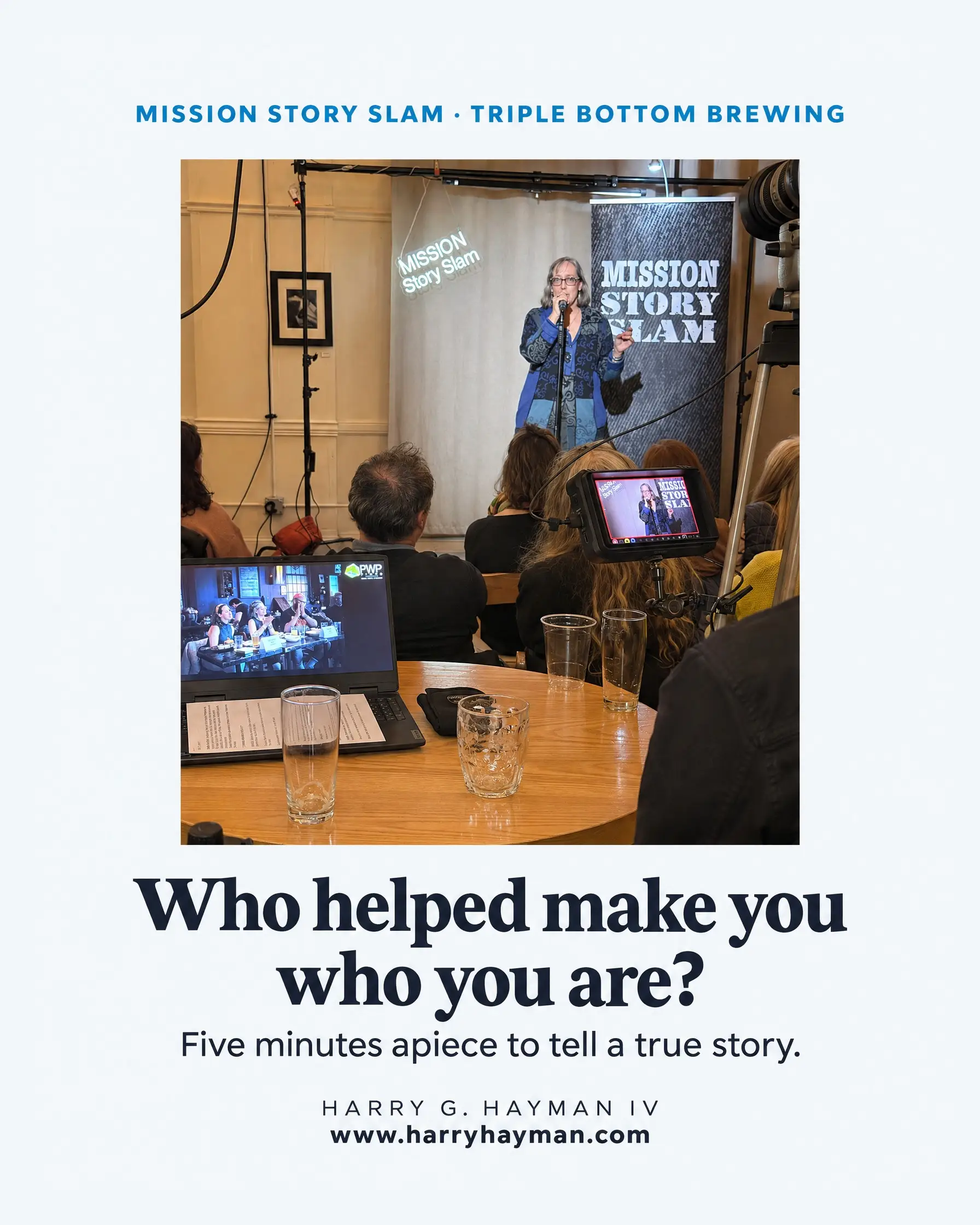
Philadelphia, that was a hell of a night. I’m Harry Hayman, and on Tuesday evening I sat in the taproom at Triple Bottom Brewing on Spring Garden while MISSION Story Slam asked a room full of Philadelphians one deceptively simple question: Who helped make you who you are? Then they handed people a microphone and gave them five minutes apiece. Five minutes! Some people can’t order lunch in five minutes. These folks managed to tell a true story, move a room, and send me home thinking about the people I ought to call and thank. I was happy to have the easy job of sitting there and taking it in.
A Room, a Microphone, Five Minutes
The slam is simple on purpose. As The Philadelphia Citizen described it, storytellers stand at a microphone and speak without music, props or notes, and each story runs five minutes. According to Billy Penn’s profile of the series, the stories are meant to connect a speaker’s personal experience to their organization’s mission and to the night’s theme. The producer behind the idea, Dave Winston, told Billy Penn it is “not a TED Talk” and “not an elevator pitch.”
That is the part I keep chewing on. Most of us who work around nonprofits and mission-driven businesses have a polished pitch. We can deliver it in a hallway, in an elevator, on a panel. What the five minute rule asks for instead is the reason underneath the pitch. This week’s theme question made that even sharper, because nobody can answer “Who helped make you who you are?” with a mission statement. You have to name a person.
Who Is Behind It
I want to give the credit where it is owed. Michael Schweisheimer and the PWPvideo team produced the night. Billy Penn reports that PWPvideo is a company that makes videos for nonprofits and sustainable businesses, and that Schweisheimer is its founder and the slam’s founder and executive producer. The same article says the idea came from Winston, a PWPvideo producer, and that the company films the stories and posts them online as free, shareable content for the organizations involved.
Here is something I did not know before reading up. According to The Philadelphia Citizen, the first MISSION Story Slam was held in 2018, and the June 2025 edition was the twelfth, counting a few virtual ones during the pandemic. So this is not a pop-up. It is a series with a track record, built one evening at a time.
Michael, you brought together people from Philly’s nonprofits, neighborhood organizations and mission-driven businesses, and gave them a room where they could put down the elevator pitch and tell us something real. That takes work. The energy in that room was your receipt.
The Awards Keep Going After the Mic Goes Off
I love how this competition is scored and what it pays. Both outlets describe a three judge panel for the evening, and The Philadelphia Citizen says the judges’ award is $250 and the audience favorite award is $100. Those are the same two awards I saw announced on Tuesday: the $250 Judges’ Award and the $100 Crowd Favorite Award. What I love is where the money goes. The two awards go to nonprofits chosen by the winning storytellers.
Think about what that does to the room. A storyteller is not performing for a trophy or a gift card. The winner gets to point the prize at a cause they care about, and the audience has already spent an evening hearing why. The Citizen quotes Winston calling the whole thing “a pebble in a pond,” and he says the ripples go out. I will take that kind of ripple over a plaque any day.
Big love to every storyteller who got up there, and to the judges who somehow had to put numbers on all that.
What Fair Chance Hiring Looks Like at Triple Bottom
Now to the venue, because the place matters. Tess Hart and the entire Triple Bottom Brewing crew deserve their own round of applause. As someone who spends a lot of time thinking about hospitality, I love what you’ve built on Spring Garden. You make great beer, practice fair chance hiring, and open your doors to nights like this.
Fair-chance hiring can sound like a slogan until you read how it actually works. According to the City of Philadelphia’s own Fair Chance Hiring Initiative spotlight, Triple Bottom is a Certified B Corporation that has operated as a fair chance employer since it opened in 2019. In 2024 it launched the Future of Service Apprenticeship, a 16 week paid training and leadership program for people who are justice impacted or housing insecure. Apprentices earn $15 an hour for at least 24 hours a week of classroom instruction, plus on-the-job training in the taproom and help with job placement.
The supports are what caught my eye. The city page lists monthly SEPTA passes, daily meals, financial literacy workshops, expungement clinics, mental health and deescalation training, and a dedicated job coach on every shift. Hart is quoted there saying “a job alone isn’t enough,” and that hiring a justice impacted person and leaving them on their own is not fair chance employment. The same page reports that across the first four cohorts the apprenticeship has a graduation rate above 85 percent, and that Triple Bottom was one of 15 local businesses the city recognized as a 2026 Employer of Choice.
The idea is not new for them. Before the doors opened, The Philadelphia Citizen reported that the brewery sits at 915 Spring Garden in a building that once held a YMCA, and that Project HOME, the Youth Sentencing and Reentry Project and Mural Arts Philadelphia refer candidates and keep supporting team members. CBS Philadelphia’s profile of Hart says Hart uses “fair chance” for people affected by the justice system or who are housing insecure, that she came to brewing from community and economic development, and that the brewery opened in 2019, a few months before the pandemic. Yale’s School of Management, in its profile of the company, calls it one of only a handful of Certified B Corp breweries in the United States and describes a focus on “Beer, People, and Planet” rather than profit alone.
Why a Room Like This Matters
You can tell a lot about a place by what happens when it hands the room over to its community. A brewery that hires people others overlook, and then turns its floor over to a night of nonprofit storytellers, is making a statement about what a business is for. I did not need a slide to understand it. I could see it in who was standing at the microphone and who was pouring the beer.
Philly, we need more rooms like that one. We spend plenty of time hearing about this city, from reports, from headlines, from people who analyze it at a distance. Tuesday night we got to hear from the people doing the work, in their own words, with the rest of us close enough to listen. That is what a civic conversation looks like when it is not performing for anyone.
Call Someone
Before you go on with your week, here is my one ask. If somebody came to mind while you were listening to the stories, or while you read this, call them. Tell them what they did for you. They might have no idea.
I am making a few of those calls myself. Thank you to Michael Schweisheimer and PWPvideo, to Tess Hart and Triple Bottom Brewing, and to every person who stood up and spent five minutes telling us the truth.
Sources and references
- The Philadelphia Citizen: The Citizen Recommends, MISSION Story Slam
- Billy Penn: MISSION Story Slam 12 and PWPvideo
- City of Philadelphia: Fair Chance Hiring Initiative spotlight, Triple Bottom Brewing
- The Philadelphia Citizen: Triple Bottom Brewing
- CBS Philadelphia: Meet the woman behind Triple Bottom Brewery
- Yale School of Management: Social entrepreneurship at Triple Bottom Brewing
Photos: Harry Hayman.