Philadelphia Offers Every Student a Free Lunch. About Half Take It.
Philadelphia has offered every student a free school lunch since 2014, and about half take it. I read the numbers beside New York and Pennsylvania.
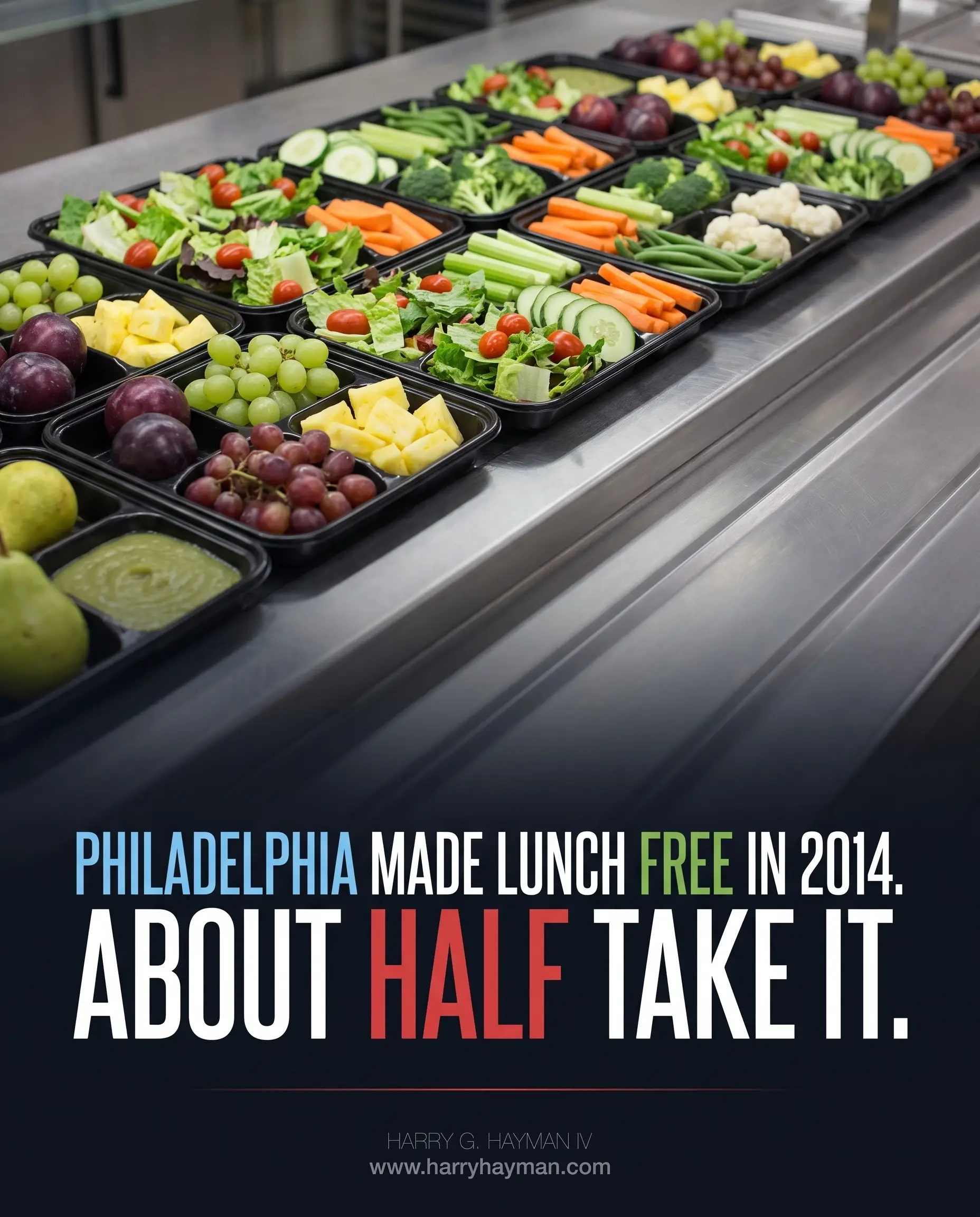
A restaurant owner learns early that a plate coming back to the kitchen full is information. The guest is not being difficult, and the price was never the issue, because the plate was already paid for. The dish is telling you something. I thought about that plate when I read how Philadelphia feeds its students. Every child in the School District of Philadelphia has been offered a free breakfast and a free lunch since the fall of 2014, which removes cost from the conversation entirely. By the district’s own latest figures, about half of enrolled students take the lunch on an ordinary school day, and about a third take the breakfast. In June, New York announced a statewide number that sounds enormous. Philadelphia made every school meal free years before that, and the number I care about comes after the meal is free.
What New York Counted
On June 26, 2026, Governor Kathy Hochul’s office announced that 396 million free school meals have been served statewide in the 2025 to 2026 school year, the first full year of the state’s Universal School Meals Program. The release says the program guarantees every student access to breakfast and lunch at participating schools. Its subheadline counts 2.7 million New York students receiving free breakfast and lunch at school, and that is a count of students with access, not a count of students who ate.
The money is stated plainly. The FY27 enacted budget included $395 million for school meals, a $55 million increase over the year before, and the State pays the student’s share of the cost for meals served to students who were not already receiving them free. I think that is a good decision made at the right scale, and it takes a real burden off families.
What the release does not give is a participation rate, and I do not hold that against a press release. But a count of meals served and a count of children offered them leave one question open, the one every restaurant owner asks sooner or later: of everything we put out, how much did people want?
Free Since 2014 in Philadelphia
Philadelphia answered the first half of that question a long time ago. WHYY reported in September 2014 that the district had moved to the federal Community Eligibility Provision, an option that lets districts skip household income applications, and that starting that fall it would serve free breakfasts and lunches to all students. About 80 percent of students already met income guidelines for school meals then, so the change mostly removed paperwork and the stigma attached to it. The Inquirer’s 2024 guide for families describes how it works today: families do not apply, and every student is offered breakfast, lunch and dinner at no cost.
It covers the whole district. A Food Research and Action Center fact sheet built on 2024 to 2025 data lists 232 of 232 eligible Philadelphia schools as participating, with 116,297 students enrolled in them.
Two Thirds, Then About Half
The School District of Philadelphia publishes school by school meal participation on OpenDataPhilly, and the file runs from 2013 to 2014 through 2024 to 2025. I added up the school rows for the most recent year. On an average day the district served 59,073 lunches and 36,472 breakfasts to 113,608 enrolled students. That is 52 percent for lunch and 32 percent for breakfast, which matches what the district told the Inquirer in October 2024: only about half of all students take the free lunch and about a third the free breakfast. The file also adjusts for attendance, and counting only the students who were actually in the building, 58 percent ate lunch. I would say it this way: only about half of students take the free lunch, and about four in ten of those who are present still do not.
For the current school year I went to the state. The Pennsylvania Department of Education posts monthly meal claims for every school district on its Food and Nutrition reports page. Running the district’s own method on the 2025 to 2026 claims gives about 51 percent for lunch and about 32 percent for breakfast, so the pattern held.
Then I looked at the years before. Added up the same way, lunch participation was 62 percent in 2013 to 2014, the last year before the district went all in. It rose to 66 percent in the first free year, 2014 to 2015, and stayed between 63 and 66 percent through 2019 to 2020. It was 49 percent in 2022 to 2023 and has crept back to 52 percent. So free meals did what free meals are supposed to do, and for about six years roughly two thirds of Philadelphia students took the lunch. The district did not publish the two pandemic years. I did not find any source that explains the drop afterward, and I will not guess at one.
It also helps to see where the rest of the country sits. The Congressional Research Service put it at approximately 57 percent of children receiving school lunches in fiscal 2023, about 30 percent for breakfast. The Food Research and Action Center found that the biggest driver of the 2023 to 2024 gain in participation was the growth in schools offering meals to all students, after a drop in 2022 to 2023 when the pandemic waivers expired. Philadelphia is near the national figure, which is the Inquirer’s own point: this is not unique to the city.
What Students and Researchers Say
A team at Temple University studied exactly this. Their paper in Implementation Science Communications, published in April 2025, draws on eight Philadelphia schools and 193 teachers, parents, students, administrators and food service workers. It reports that “many concerns were raised about the quality and appearance of school meals,” that students described having little time to eat a full meal and feeling rushed, and that stigma was an issue in every school, though less so where participation was higher. It also notes that for a meal to be reimbursable by the federal government, a student must take every item offered, which may deter a student who dislikes something on that day’s tray. The lead researcher told Billy Penn in 2023 that food quality was outside the scope of the study. The later paper still lists it among the concerns, which looks to me like several causes at once, not one. I also went looking for a current count of schools with full service kitchens against schools that heat meals prepared elsewhere. I could not find one. The most recent figure I found is from a 2016 Chalkbeat report, which counted 107 schools with full service kitchens and 131 locations on pre plated meals. The Temple study did not test kitchens against participation, so I will not claim a link.
The students themselves are easy to hear. At a district food show in November 2025, the Inquirer reported that 33 manufacturers showed 55 products not yet in cafeterias and that hundreds of students tasted them and scored them by phone. Most of the students the paper spoke to said they eat school food only sometimes and bring lunch from home most days. Lisa Norton, the district’s executive director of food services, put the goal in one sentence: “We want to buy food they’ll eat.”
What Pennsylvania Pays For
The Department of Education says that beginning in the 2023 to 2024 school year, participating schools must offer every student a free breakfast, with the state funding the additional reimbursement. The 2023 budget signing put a $46.5 million increase behind universal free breakfast for 1.7 million public school students. The 2025 to 2026 budget, signed November 12, 2025, continued it, and the Department said in July that the 2026 to 2027 budget funds it for a fourth consecutive year.
Lunch is a different story. The same budget summary names free lunch for 22,000 eligible students, the reduced price group, not for everyone. Spotlight PA reported in June 2025 that lawmakers had introduced bills for universal school meals, with an estimated cost near $360 million a year including the breakfast money already spent. The Senate version, Senate Bill 180, was referred to the Education Committee on May 22, 2025, and I could not find any later action. So Philadelphia’s free lunch comes from a federal option, not from Harrisburg. Pennsylvania pays for breakfast for every student and not yet for lunch.
A Menu Problem Is Fixable
If the barrier were price, Philadelphia would have solved it in 2014. It did solve that part, and I am proud of a city that did. What remains is the plate, the clock and the room: how the food looks, how many minutes a child really has, and whether taking a free tray feels ordinary or marked. Those are menu problems and scheduling problems, and a restaurant owner will tell you they are the fixable kind.
The money is tight, and Superintendent Tony Watlington said so plainly to City Council. The food program must be funded completely by reimbursements from the U.S. Department of Agriculture, and “The dollars are not robust enough to have filet mignon everyday, but it is sustenance,” he said. The federal notice for the 2026 to 2027 school year sets the national average payment for a free lunch at $4.31 plus 47 cents for districts where 60 percent or more of lunches go to free and reduced price students. That is what a district builds a tray from, which is why I read the November food show as good news: the people running the program asked the eaters.
I think of food as infrastructure, something a city builds and maintains so everyone can count on it, like a bridge. A bridge nobody crosses has the same problem as a lunch nobody eats, and in neither case do you fix it by announcing it again. You count who uses it, you ask why the rest do not, and you change the part that is stopping them. So here is what I would like to see published beside the participation file each year: the schools where more than two thirds of students take lunch, and what those schools do differently at lunch.
Photo in the poster: USDA Food and Nutrition Service, a school lunch line in Lebanon, Pennsylvania (public domain).
Sources and references
- Governor Hochul announces 396 million free school meals served statewide in 2025 to 2026
- WHYY: Let them eat lunch, all Philly students now eligible for free school meals
- Inquirer: How students can get free school meals from the School District of Philadelphia
- Food Research and Action Center: Pennsylvania community eligibility fact sheet
- OpenDataPhilly: School Meals and Nutrition
- Pennsylvania Department of Education: Food and Nutrition reports
- Congressional Research Service: School Lunch and Breakfast Participation
- Food Research and Action Center: The Reach of School Breakfast and Lunch, 2023 to 2024
- Implementation Science Communications: determinants of universal school meals
- Billy Penn: Temple study aims to boost participation in free breakfast and lunch
- Chalkbeat Philadelphia: More full service kitchens open
- Inquirer: Philly kids critique school lunches
- Pennsylvania Department of Education: School Breakfast Program
- Governor Shapiro signs ceremonial budget bill creating universal free breakfast
- Governor Shapiro signs 2025 to 2026 budget into law
- Pennsylvania Department of Education: free meals and the 2026 to 2027 budget
- Spotlight PA: Free school lunch in Pennsylvania, lawmakers want it in the budget
- BillTrack50: Pennsylvania Senate Bill 180
- Federal Register: National School Lunch Program payment rates, 2026 to 2027
About the Author
Harry Hayman is a Philadelphia-based entrepreneur, music producer, and cultural advocate. Through his work with the Feed Philly Coalition, he explores and documents the creative, culinary, and civic life of a city he believes is one of the most inspired places in America.