Missouri Has the Law, Pennsylvania Has the Waiver, Nobody Has Paid
Missouri wrote Food is Medicine into law with no waiver and no money. Pennsylvania has the waiver and no funding. A Philadelphia look at who pays.
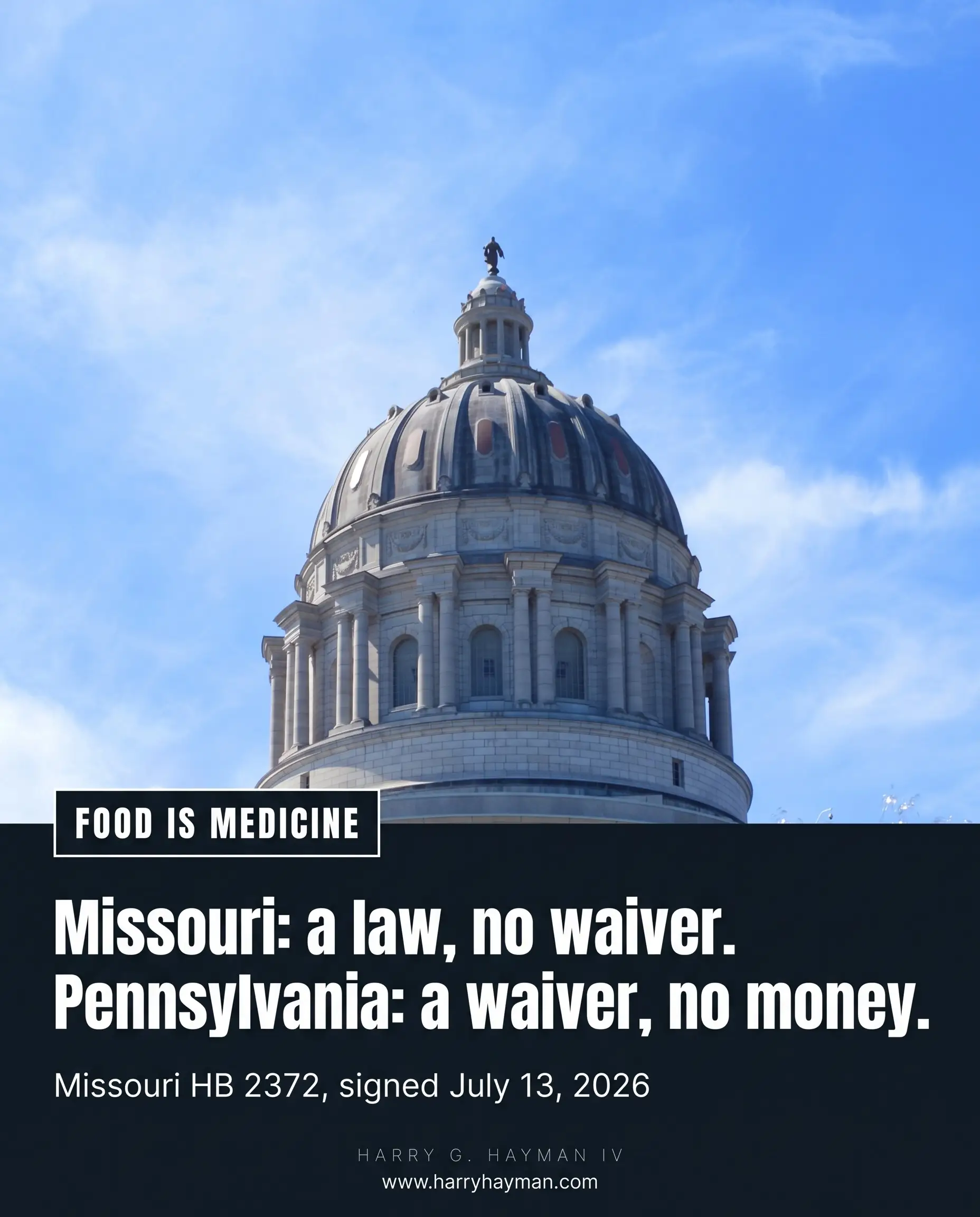
Section 208.270 of Missouri’s revised statutes is short enough to read standing up. It names itself the Food is Medicine Act, defines three things a dietitian or doctor could prescribe, and then says the state’s Department of Social Services “may apply” to Washington for permission to pay for them. I am Harry Hayman, I work on food and hospitality in Philadelphia, and I read that sentence twice, because the word “may” is carrying the whole load. Governor Mike Kehoe signed the bill that holds it on July 13, 2026. I cannot find an application, and the section spends no money. Across the Pennsylvania line the picture is nearly the mirror image: federal permission in hand, state money missing. Put the two states side by side and you get the question I care about, which is who pays for the vegetables before we pay for the hospital.
What Missouri Actually Wrote Down
The text of RSMo 208.270 says the Department of Social Services may apply to the Centers for Medicare and Medicaid Services for a Section 1115 demonstration waiver, for the purpose of providing nutritional support through MO HealthNet, the state’s Medicaid program. Covered services “may include, but shall not be limited to” case management, nutrition counseling and food that a registered dietitian, physician or clinical team prescribes: medically tailored groceries, medically tailored meals and produce prescriptions. The statute describes the last of these as fruits, vegetables or other healthy foods with no added fats, sugars or salts, typically as coupons or vouchers for farmers’ markets, grocery stores or mobile markets.
It was not always “may.” When the House passed it in April, the Missouri Independent reported that the legislation “would require” the department to seek federal approval. By May, St. Louis Public Radio wrote that the final health bill “permits the state to apply” and that earlier versions would have required it. The language travelled inside House Bill 2372, a 110 page omnibus carried by Representative Tara Peters and Senator Mike Bernskoetter. Representative Holly Jones, who sponsored the standalone version, said her bill is “not about telling people what to eat.”
Here is a detail I find telling. The governor’s release on the signing lists telehealth, community paramedics, anesthesia coverage, hospital pricing and tracking of alpha gal syndrome, and it does not mention Food is Medicine at all. That is not a criticism. A bill that size has dozens of parts. It does mean that if you saw a headline saying Missouri put produce on Medicaid, the law says something smaller.
The Price Tag Nobody Has Budgeted
The Missouri legislature’s own fiscal note shows what a start could look like. The Department of Social Services assumed a waiver beginning in July 2027 for 4,182 people, with benefits that could reach as many as 356,000 depending on design. It put the first full year at roughly $15 million, with about $3.2 million from state general revenue and the rest from federal matching funds. It also noted that savings “would likely occur over a lifetime” and left them out of the three year count. Those are estimates for a program that does not exist yet, not an appropriation.
Meanwhile the food itself is being paid for by someone. The Columbia Farmers Market ran a produce prescription program with Boone County Children’s Services and Compass Health in 2025 and reported 111 families supported and $85,140 in funds dispensed. In its annual report the market says more than $15,000 in donations kept that program running through the end of the year “despite grant funding gaps.” So today a Missouri produce prescription survives on donations and grants. The law points toward a different payer. It does not yet make one.
The Number Everyone Quotes, With Its Fine Print
The figure attached to this story is $101 million. Tufts University’s Food is Medicine Institute produced it, and the Missouri Independent cited it. Let me be exact, because the exactness matters. The Tufts fact sheet models produce prescriptions for U.S. adults ages 40 to 79 with Medicare, Medicaid or private insurance who have both diabetes and food insecurity. The $101 million for Missouri is a ten year net saving in healthcare costs, meaning averted costs minus what the food and program cost, across all insurers. It is a simulation, and it is not a Medicaid budget line or a promise to the state treasury.
The published study, in Diabetes Care, says the results are means of a thousand simulations. As I read its supplementary table, the range around Missouri’s figure crosses zero, so the true result could be a saving or a cost. I read that as a reason to treat the number as a direction rather than a forecast. The same fact sheet puts Pennsylvania at $236 million, second only to New York, under the same assumptions. I would not set that beside Pennsylvania’s budget request as if one produced the other, because they describe different programs.
Pennsylvania Has the Permission
On December 26, 2024, the federal government approved Pennsylvania’s Keystones of Health demonstration. The approval letter runs through December 31, 2029. For nutrition it authorizes home delivered meals and medically tailored meals, limited to six months at a time and renewable, for Medicaid members with a documented need and low food security. That includes pregnant and postpartum members, people with gestational diabetes or cancer treated with chemotherapy, and people hospitalized for heart failure, end stage renal disease or poorly controlled diabetes. Produce prescriptions are not on the list.
Permission is not funding. The Pennsylvania Health Law Project wrote in January 2025 that carrying out these pieces would hinge on money appropriated through the state budget. In June 2026 the Department of Human Services described the plan: $900,000 in state funds, drawing federal matching dollars to reach $2.3 million, for medically tailored meals for people with heart disease, diabetes, end stage renal disease or cancer in treatment. The department said it already provides such meals under Medicaid “on a limited basis.”
The budget came on July 12. Governor Shapiro signed it after a deadline that passed June 30, and it was a real compromise. PA Partnerships for Children reports it funded $1 million for the housing pieces of the waiver and $900,000 for services to people leaving correctional facilities. Allies for Children noted that funding for the food and nutrition initiatives was “notably missing.” On July 28, The Food Trust wrote that Pennsylvania has an approved waiver “but this pilot has not yet been funded through the budget process.” I found nothing newer.
The Federal Door, Described Fairly
Some readers will assume Washington closed this door. The record is more careful than that. On March 4, 2025, the Centers for Medicare and Medicaid Services rescinded its 2023 and 2024 bulletins on health related social needs and said it will weigh state requests case by case. The Kaiser Family Foundation’s waiver tracker, updated September 30, 2026, says that action does not negate existing approvals. Pennsylvania’s stands.
A new request faces more paperwork. Harvard’s Center for Health Law and Policy Innovation explains that a provision of H.R. 1, signed July 4, 2025, will require the federal chief actuary to certify budget neutrality for new waiver applications after January 1, 2027, and that social needs services may have to be offset by savings. Missouri’s own agency flagged budget neutrality in its fiscal note. I read that as a reason to file carefully, not a reason to stop.
Philadelphia Already Writes Prescriptions
This is where my city comes in, and I want to say it plainly: Philadelphia has been doing the hard part. The Food Trust’s Food Bucks Rx works because “hospital providers give eligible patients ‘prescriptions’ that can be redeemed at participating corner stores, farmers markets and supermarkets for fresh produce.” The program grew from Philly Food Bucks, launched in 2010 by the Philadelphia Department of Public Health and The Food Trust. The Food Trust now shares the lead of a statewide Food as Healthcare Coalition with more than 45 organizations. Its chief executive, Mark Edwards, said in the Department of Human Services announcement that programs like “produce prescriptions, medically tailored meals and nutrition education” are proven to address poor diets, in many cases with notable health and cost savings outcomes.
MANNA, the Philadelphia nonprofit that makes medically tailored meals, puts the gap in one sentence on its advocacy page: food and nutrition services are right now “often prescribed by physicians but not made available or affordable by health insurance plans.” In my city a doctor can already hand a patient the prescription. The part still missing is the payer that makes it routine.
Who Pays Before the Hospital Does
I have spent years around kitchens, and a kitchen teaches you that a plan without a purchase order is a wish. Food belongs on the list with roads and water mains: infrastructure that has to be funded on purpose and on time. Missouri has the statute, and I found no filing. Pennsylvania has the approval and has not found the first $900,000. Both are fixable, and neither looks like a partisan problem: the Missouri House passed the final bill 116 to 21 and the Senate 26 to 5.
So here is what I keep asking myself. If the permission exists in one capital and the statute exists in another, which state will be first to put the two together, and will it be early enough that the savings arrive before the next hospital bill does?
Photo: Missouri State Capitol by Kbh3rd, Wikimedia Commons, CC BY 4.0.
Sources and references
- Missouri Revisor of Statutes: RSMo 208.270, the Food is Medicine Act
- Missouri Independent: House approves Food is Medicine bill aiding Medicaid patients
- St. Louis Public Radio: Missouri makes major changes to health care services
- Missouri Governor’s office: Governor Kehoe signs healthcare legislation into law
- Missouri Oversight Division: fiscal note for truly agreed HB 2372
- Columbia Farmers Market: 2025 Annual Report
- Tufts Food is Medicine Institute: produce prescriptions fact sheet
- Diabetes Care study on produce prescriptions in 50 states, via PubMed Central
- CMS approval letter for Pennsylvania’s Keystones of Health
- Pennsylvania Health Law Project: Keystones of Health waiver approval
- Pennsylvania Department of Human Services: Shapiro Administration highlights new plan on nutritious meals
- Governor Shapiro signs 2026 27 budget
- PA Partnerships for Children: 2026 27 state budget
- Allies for Children: final PA budget 2026 2027
- The Food Trust: Pennsylvania leaders come together around food as healthcare
- CMS: rescission of guidance on health related social needs
- KFF: Medicaid waiver tracker
- Center for Health Law and Policy Innovation: 1115 waiver guidance introduces new hurdles
- The Food Trust: Food Bucks Rx
- The Food Trust: Food Bucks
- MANNA: advocacy
About the Author
Harry Hayman is a Philadelphia-based entrepreneur, music producer, and cultural advocate. Through his work with the Feed Philly Coalition, he explores and documents the creative, culinary, and civic life of a city he believes is one of the most inspired places in America.