Philadelphia's Zero Waste Bill and the Compost Fines New York Paused
Philadelphia's zero waste bill sets a 60 percent goal and no deadline. Harry Hayman reads it beside New York's compost fines and asks what a plan needs.
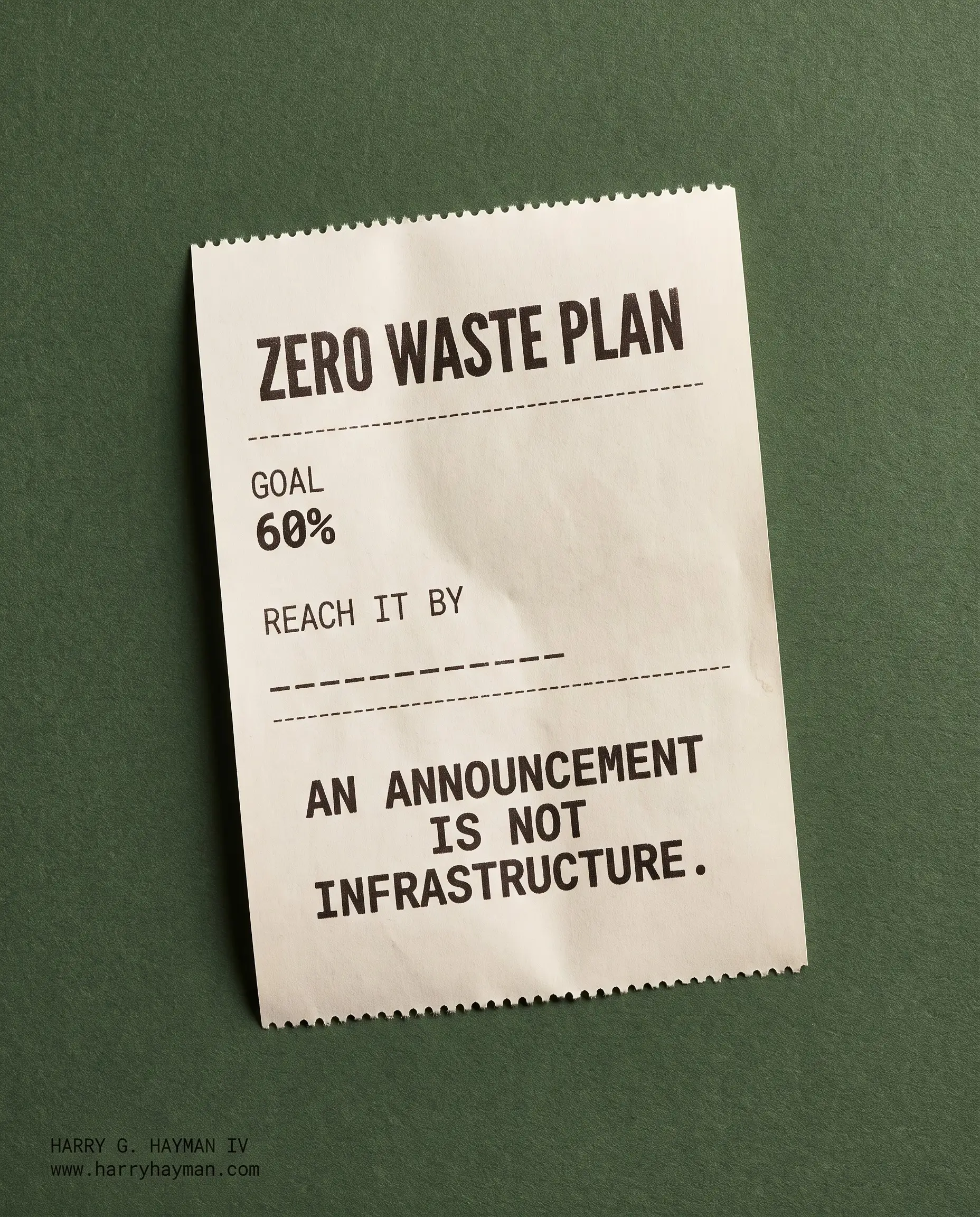
When I looked on October 13, the City’s legislative record for Bill No. 260708 showed one line of history: City Council, Introduced, September 17, 2026. The day before, on a Wednesday, Philadelphia had held a press conference to announce a zero waste initiative, and the City’s release says the bill “builds infrastructure, creates green jobs,” and I wanted to see where. I read the release and the bill side by side and then did something simple: I counted what each one contains. The release has no tonnage, no price, no start date and no mention of a fine. The bill authorizes a plan. I come at this from the restaurant side of the city, where food waste is a bill that arrives every week whether or not a policy has been finished, so I want this plan to work. That is exactly why I want to look closely at what is still blank, and at what happened in New York after it paused most of its compost fines.
What Philadelphia Has Put in Writing
Start with what is there, because it is more than a headline suggests. On Wednesday, September 16, Managing Director Carlton Williams led the press conference, and the release lists strategies for relying less on landfills and waste to energy plants. Among them are “Developing” an organic composting program that uses private investment to build a processing facility, “Investigating” an expansion of municipal food waste reduction, and a plan to “explore” alternative methods like anaerobic digestion. It also says the 2026 waste contracts have been “signed and conformed” and that the ordinances went to City Council for approval.
The bill is where the dates live. Bill No. 260708 was introduced on Thursday, September 17, by Councilmember Mark Squilla, with eight colleagues as cosponsors. The City’s release calls it the Zero Waste and Circular Economy Act, while the Council’s own record calls it the Philadelphia Zero Waste Circular Economy Act. Its title says it would authorize “a plan for evaluation and potential restructuring” of the city’s solid waste and recycling systems, and the text of the bill gives that plan three parts. Part One has a timeline of 24 to 36 months to set the policies and investments needed to reach a 60 percent total waste diversion rate, naming municipal composting networks and anaerobic digestion among the methods. Part Two says requests for proposals for contracts of up to 20 years “shall be duly considered,” and that such contracts “may include” building an anaerobic digestion facility. Part Three is about how to pay for it. The plan must be approved by Council no later than the end of the initial term of the next recycling processing contract.
The reporting adds three more things I want to credit. WHYY’s PlanPhilly report says Squilla expects the 60 percent goal to be reached before the end of the first 20 year contract, which could be around 2050. The Philadelphia Inquirer reports that Williams said the city is looking to build out an anaerobic digestion system within four years. And CBS Philadelphia reports that the city says a contract of up to 20 years could save taxpayers about $8 million in its first year, a figure about the cost of handling waste, not about composting. Each of those comes from a single outlet, so I hold them loosely, and Squilla himself was plain about the pace: “It’s not an overnight change or fix.”
What the Release Leaves Blank
Now the other column. I read the release for numbers, and the only ones in it are dates, the 2025 Clean and Green Report, the first 100 days of the Parker administration and a Council district. There are no tons, no dollars and no percentages, and no schedule. There is no word about a mandate or a fine. It names a composting facility paid for by private investment and does not say where it would go, who would build it, how many tons a year it could take or what it would cost. The verbs are “Developing,” “Investigating” and “explore,” which are honest verbs for an early stage and also not the verbs of a timetable.
The bill leaves blanks of its own. WHYY puts it directly: “The bill does not set a deadline for the 60% waste diversion goal.” I read the text and found the same. The 60 percent is what the plan must work toward, with no date attached, and nowhere in the bill is there a dollar figure, a tonnage, a mandate or a fine. Money is left to Part Three.
None of this means the City lacks numbers. CBS Philadelphia reports that the city says organic waste makes up “about 30% of Philadelphia’s trash.” The Office of Clean and Green Initiatives’ FY27 budget testimony puts the fiscal 2025 recycling rate at 13.4 percent. And a baseline the City built with the Natural Resources Defense Council in late 2019 estimates that Philadelphia generates 214,000 tons of food waste a year, as the City’s Office of Sustainability reported. The numbers exist. They are simply not in the announcement.
A plan is a legitimate first step, and I mean that. I would keep the word infrastructure for the things that move tons: the route, the plant, the contract and the rule.
A Goal With a History
This is not Philadelphia’s first zero waste promise, and the earlier one is easy to find. Mayor Jim Kenney signed an executive order on Tuesday, December 20, 2016, creating a Zero Waste and Litter Cabinet, and WHYY reported at the time that he wanted the city’s waste cut to zero by 2035. In February 2017, WHYY’s report on composting in Philadelphia quoted the city’s Zero Waste and Litter director, Nic Esposito, on food scraps: “So, at least by 2035, we’ll have organics collection in the city of Philadelphia, if we stick to our plan.” The same article reported that citywide collection of food scraps was not possible then mainly because no composting facility in Philadelphia had the capacity to accept tons of food waste. The cabinet’s Zero Waste and Litter Action Plan followed that year and turned the goal into arithmetic: “waste diversion by 90 percent by 2035 (based on 2015 waste totals).”
The cabinet ended in May 2020, when a city spokeswoman told WHYY it “will not continue to exist as a separate entity.” In June 2025 the City’s request for information on solid waste described “its goal of 90% waste diversion by 2045,” and said the Sanitation Department planned a small scale pilot for organics collection. Billy Penn reported in April 2026 that the pilot would take food scraps at 10 drop off locations and would be the first of the city’s residential composting ideas to be put into practice.
So the sequence runs like this: 90 percent by 2035 in 2017, 90 percent by 2045 in a June 2025 City document, and a 60 percent goal with no date in the 2026 bill. The definitions differ, so I am not calling that a retreat, and I could not find a document that explains why 2035 became 2045. What I take from it is simpler. A date is a promise someone can be held to, and I would like the next one written down.
What Happened in New York After the Pause
New York is the useful comparison because it did what Philadelphia has so far only announced. The New York City Independent Budget Office writes that the City Council passed Local Law 85 of 2023 and that mandatory curbside composting began in October 2024, with six months of warnings before any fines. It also says the Adams administration rolled out citywide curbside pickup on time. Fines began on April 1, 2025, and the IBO writes that “less than three weeks later on April 18, the Adams administration suddenly paused most fines.” THE CITY reported that afternoon that tickets would go only to buildings with more than 30 apartments that had already received more than four warnings, which the IBO describes as “effectively turning a mandatory program back into a voluntary one for most properties.”
What happened to the tonnage is the part I keep returning to. The IBO measures weekly organics collection, and it reports: “By December, weekly collections declined below September levels, marking a 43% decrease from May 2025.” That is a fall in weekly tonnage after the pause, measured from May to December, and the IBO says the pattern “suggests” that reducing enforcement stalled the increases and eventually led to a decrease. I will use the same word. It is worth saying what did not happen, too. Total collection in 2025 still rose 68 percent over 2024, so people did not stop composting, and the IBO reads the fact that collections did not fall back to their earlier levels as a sign that most properties kept at it once they had started.
In January 2026 the new administration began fining again, with a lighter hand. Inside Climate News reported on February 3 that the city had “begun issuing summonses to buildings of all types,” according to a Department of Sanitation press secretary. The IBO’s wording is careful: the Mamdani administration “resumed some level of fines in 2026, but it remains well below initial full enforcement levels.” By its count the city issued 415 fines in January and February 2026, against 4,259 in April 2025, which works out to about 3 percent of the April pace.
The agency’s acting commissioner, Javier Lojan, told the City Council in late March 2025, as THE CITY reported, “We have made participation easy” and “now it’s up to New Yorkers to follow the law or face a summons.” By the IBO’s account the pickup half of that sentence was in place. The summons half is what paused.
What I Would Ask Philadelphia to Write Down
I am not asking Philadelphia to start writing fines. The IBO leaves room for more than one tool: it says fines work, “or at least some form of financial incentive.” What I am asking is that the plan say what the consequence is, whether that is a fine or a price that makes the compost bin the cheaper choice. Without one, a rule is a request.
So here is what I would like to see attached to Part One, in plain numbers, before the 24 to 36 months begin to run. A date for the first food scrap collection, even if it is a pilot. The tons a year the facility is meant to process, set against the 30 percent of the city’s trash that the City itself says is organic. The price, and who pays it: the release says private investment, the bill leaves funding to Part Three, and I would ask what the City expects to pay and what it expects others to. A site and a builder, because a processing facility without an address is still a sentence. And the rule, meaning whether anyone is required to separate food scraps and what happens if they do not.
The pieces are already in the record: a 60 percent goal, a policy phase of 24 to 36 months, a four year digestion target in the reporting, a pilot at 10 sites, a baseline of 214,000 tons of food waste. What is left is the receipt. People who run restaurants know how to read one, because every line has a quantity, a price and a date.
I say that food is infrastructure, and I mean it in the plain budget sense. Infrastructure is the route, the plant, the contract and the rule with a consequence. An announcement can be the first step toward any of them, and Philadelphia has taken that step. I think the City can fill in the first line items, because most of the numbers are already in its own documents. If the plan could print one more line tomorrow, which would do the most work: the date, the tons or the price?
Sources and references
- Philadelphia City Council: legislative record for Bill No. 260708
- Philadelphia City Council: text of Bill No. 260708
- City of Philadelphia: release on the zero waste initiative and the municipal solid waste contracts
- WHYY PlanPhilly: Philadelphia zero waste bill aims to cut the city’s trash 60 percent
- The Philadelphia Inquirer: Council returns with dueling plans for the city’s trash
- CBS Philadelphia: councilmember proposes plan to reduce trash sent to landfills and incinerators
- Office of Clean and Green Initiatives: proposed FY27 budget testimony
- City of Philadelphia Office of Sustainability: funding and technical assistance to tackle food waste citywide
- WHYY: Philadelphia aiming to achieve zero waste goal by 2035
- WHYY: Composting in Philadelphia, where we are and where we are going
- City of Philadelphia: Zero Waste and Litter Action Plan, 2017
- WHYY: Philadelphia mayor cuts the anti litter initiative amid the coronavirus budget crunch
- City of Philadelphia: request for information on solid waste management, June 2025
- Billy Penn: Philadelphia weighs continued trash incineration in Chester
- New York City Independent Budget Office: Curbside Composting, Current Trends in New York City’s Organics Collection
- THE CITY via the Upper East Site: composting fines scrapped just weeks after enforcement began
- Inside Climate News: composting fines for buildings are back on in New York City
About the Author
Harry Hayman is a Philadelphia-based entrepreneur, music producer, and cultural advocate. Through his work with the Feed Philly Coalition, he explores and documents the creative, culinary, and civic life of a city he believes is one of the most inspired places in America.