Philadelphia Film Festival 2026: Mapping the City's Film Economy
I went to the 35th Philadelphia Film Festival and came away asking who makes films in Philadelphia, who pays for them, and how we map it all.
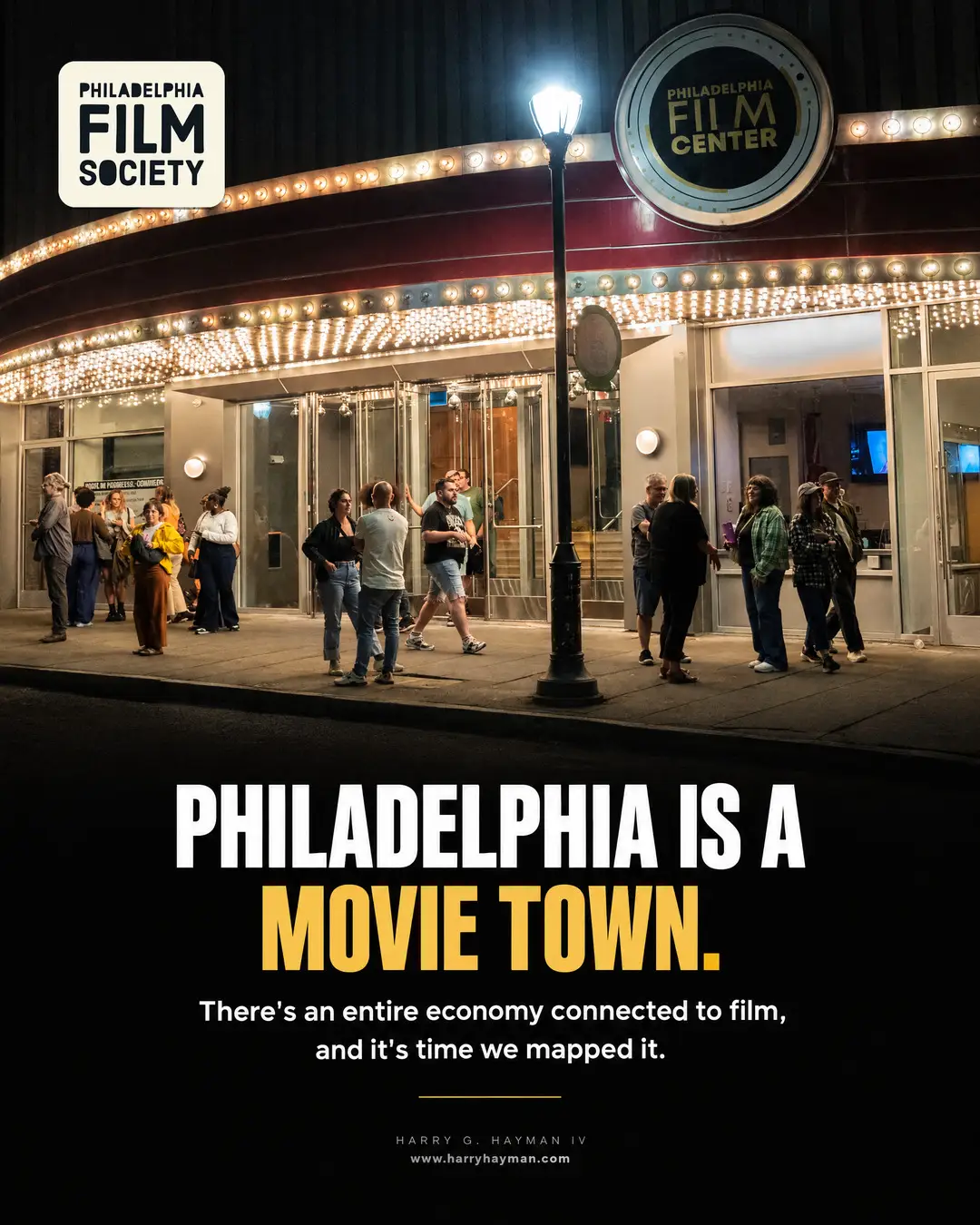
Eleven days, three Film Society theaters across Center City and Old City, and more than 140 screenings: that is the 35th Philadelphia Film Festival, running October 15 through 25, 2026. I’m Harry Hayman, I made my way over to it, and my post opened with a line I would sign again: “PHILADELPHIA, WHAT A DAMN FINE MOVIE TOWN YOU ARE! WHO KNEW?” The films, the people, the conversations and the energy around the whole thing were a great reminder of how much creative talent we have in this city. Then my brain did what it always does. Anybody who knows me knows I have a hard time just enjoying something without immediately starting to think about all the possibilities, so I started thinking about the business of all this. This is the longer version of that post: what the festival is, who builds it, what the public record says about film work in our region, and why I keep saying we need to asset map the whole thing.
The Festival on Paper
The Philadelphia Film Society announced the full lineup in early October, and the scale is easy to state. The Inquirer’s Earl Hopkins reported that the 11 day celebration includes more than 140 screenings, and that early badge sales point to the festival’s largest audience. FOX 29’s rundown lists the three Film Society venues hosting screenings: the Film Society Center at 1412 Chestnut Street, the Film Society Bourse at 400 Ranstead Street, and Film Society East at 125 S. 2nd Street. It also names the two parties that bookend the run, the Opening Night Party at F1 Arcade and the Closing Night Party at Stratus Lounge, both on Chestnut Street, and notes that for the first time individual tickets to both are available without buying a larger festival package.
One slice of the lineup speaks directly to my question. FOX 29 says the Filmadelphia program once again puts locally connected stories and filmmakers in the spotlight, and it points to world premieres in both the feature slate and the shorts program. Locally connected stories and filmmakers: that is the thread I want to pull. Who is making films here, and what does it take to get one made?
The Film Society Behind It
I want to congratulate the Philadelphia Film Society properly, and that starts with how long this has been going. According to the Inquirer, the festival began in 1992 as the Philadelphia Festival of World Cinema at International House Philadelphia, led by Linda Blackaby with support from the former International House president Ellen Davis and others. J. Andrew Greenblatt, the Society’s CEO and executive director, said the founders saw film festivals from around the world and said, “We should bring one to Philly.” In 2001 the TLA Entertainment Group took over management, the festival was later renamed the Philadelphia Film Festival, and TLA established the Philadelphia Film Society that same year to steward it. Greenblatt was appointed in 2008, and the Society began running the festival independently. This year is the festival’s 35th edition and the Society’s 25th anniversary.
The Society’s home page, as archived on October 16, 2026, describes a nonprofit, community supported organization that produces the festival, curates film programming all year, and runs education and outreach programs. The rooms are part of that story. The Film Society Center page traces 1412 Chestnut Street from the Karlton Theater in 1921 to the Prince Theater in 1999 and calls it a home for arts and culture for over 100 years. The Film Society Bourse page says the Society took over operation of that Old City theater in 2021 and renovated all five of its rooms before reopening it.
The Economy in the Room
Here is the list from my post, the way I wrote it: filmmakers, writers, actors, production crews, theaters, restaurants, hotels, local businesses, and of course the people buying tickets and filling those seats. YES, THE CUSTOMERS! Each name on that list is somebody’s paycheck, rent, supply order or night out, and most of them never show up in a credit roll.
Some of it is visible if you look. The Film Society Center page described a $4 million capital campaign for a new entrance and box office, an expanded lobby with new public amenities, better accessibility and upgraded systems behind the scenes, timed for a fall 2025 reopening. The Bourse page lists new projectors and sound in all five of its rooms. Two Chestnut Street businesses are hosting the festival’s parties. None of that is a finished economic study, and I am not claiming it is. It is a handful of receipts, and receipts are where a map starts.
Zoom out to the region and the film office has numbers. Axios reported in March that the Greater Philadelphia Film Office counted 391 productions in the region in 2025, including 18 feature films, and the figures Axios printed show $109 million in production spending and $229 million in economic impact. Most of that filming was television, and the region has also seen more independent filmmakers, which means more shooting in neighborhoods with smaller crews and trucks. On the jobs side, the Inquirer reported that through the film office, 777 Pennsylvanians were hired on the sets of HBO’s Task, and Axios says that show earned a nearly $50 million tax credit for its second season. Erin Wagner, one of the film office’s two executive directors, told Axios, “The world has its eyes on Philadelphia this year.”
What I Mean by Asset Mapping
When I say asset map, I mean something plain. Before anybody asks what a place is missing, you write down what it already has. The ABCD Institute, a nonprofit membership organization, treats local assets as the primary building blocks of sustainable community development and says the approach builds on the skills of residents, the power of local groups and the supportive functions of organizations. Point that at film and the questions come almost by themselves. Who is making films here? Where are they finding crews, equipment, financing and distribution? How are our theaters building audiences? Are local businesses benefiting? What would make it easier for somebody with a great idea and a little ambition to actually get a film made in Philadelphia? And how do we make sure the people doing the creative work have opportunities to make a decent living doing it?
I said it louder in my post: “WE NEED TO ASSET MAP THE HELL OUT OF THIS THING!” I stand by the volume and the verb. We already have so much of what we need. Talented people, interesting neighborhoods, incredible locations, a rich cultural history, and a city with more stories than we could possibly tell in a lifetime. We have Philadelphia, which is a pretty good starting point.
The Pieces That Already Exist
I am not starting from a blank page, and neither is anyone else. The Greater Philadelphia Film Office calls itself a film commission for southeastern Pennsylvania, serving Bucks, Chester, Delaware, Montgomery and Philadelphia counties. It is a 501(c)(3) that can act as a fiscal sponsor, and its site carries a crew directory, a vendor directory, a Job Hotline for cast, crew, staff and interns, and a Filmmakers Program of seminars and training. On the money side, Pennsylvania’s Department of Community and Economic Development describes its Film Production Tax Credit as 25 percent for productions that spend at least 60 percent of their total budget in the Commonwealth, and a November 2024 announcement included the Pennsylvania Film Producer Reserve, ten projects by small producers that received a combined $1,076,889 in credits.
The rest of the map is growing from the ground up. PhillyVoice Media Events described a free Philly Industry Meetup at Old City Kava during the Society’s SpringFest in April, geared toward filmmakers, artists and other creatives looking to connect. Broad Street Review reports that Rough Cuts, a monthly meetup for filmmakers in the Philadelphia area, gathers on the first Wednesday of each month at Huddle in Fishtown, and its emcee, Nic Justice, says the point is to “stop trying to make movies by yourself.” A second Broad Street Review piece says dozens of microcinemas and movie appreciation clubs have sprung up since the pandemic, people “building a film scene from the ground up.” 34th Street Magazine supplies the history and the grit: Philadelphia had 275 active movie theatres in 1932, The Secret Cinema has run a floating repertory series since 1992, and Jesse Pires, who runs Lightbox, told the magazine he is always impressed by the resilience of Philadelphia’s art scene to make cool things happen without a lot of resources.
What I Would Like to See
So here is the version I would put my name to. I’d love to see Philadelphia become a place where filmmakers can find what they need, businesses understand how to participate, audiences have more opportunities to discover great work, and the whole creative community benefits from one another’s success. There’s a lot of potential here, and I would like us to get more intentional about turning it into opportunity.
I come at this with a personal stake. With some of the film projects we’re working on ourselves, I’ve got an even greater appreciation for how many moving parts there are and how important the right relationships can be. I wrote about one of them, the horror film we are getting ready to make, The Ninth Floor, in my post on the Exhumed Films horror marathon.
Huge congratulations to the Philadelphia Film Society and everyone involved in putting on the Philadelphia Film Festival. What a terrific thing you’ve built. Thank you, too, for the roughly 47 new ideas you handed me for a list that was already ridiculous. If you work in Philadelphia’s film community, I’d love to hear what you think we’re missing and where the opportunities are. If you don’t, the Society programs film all year, so go see one, bring a friend, have dinner somewhere nearby and talk to the people making the movies. A good place to start is filmadelphia.org. Acta non verba: deeds, not words.
Sources and references
- The Philadelphia Inquirer: In its 35th year, Philadelphia Film Festival is set to be its biggest edition ever (Earl Hopkins, October 7, 2026)
- FOX 29 Philadelphia: Philadelphia Film Festival 2026 lineup: Eisenberg, DuVernay, Gray films lead 35th edition (Kamryn Scrivens, October 7, 2026)
- Philadelphia Film Society: home page (Internet Archive capture, October 16, 2026)
- Philadelphia Film Society: Film Society Center (Internet Archive capture, October 10, 2025)
- Philadelphia Film Society: Film Society Bourse (Internet Archive capture, May 8, 2026)
- Philadelphia Film Society (filmadelphia.org)
- Axios Philadelphia: Film production in Philadelphia region poised for big year (Mike D’Onofrio, March 3, 2026)
- The Philadelphia Inquirer: A year of leadership shifts later, the Greater Philadelphia Film Office is charting new successes (Earl Hopkins, November 3, 2025)
- Greater Philadelphia Film Office
- Pennsylvania Department of Community and Economic Development: Shapiro Administration Invests in TV and Film Projects (November 14, 2024)
- PhillyVoice Media Events: SpringFest brings a week of films, Q&As and events to Old City (April 12, 2026)
- Broad Street Review: Rough Cuts builds new community as Philly’s only open mic for filmmakers (Elijah Fischer, July 21, 2026)
- Broad Street Review: Meet 10 Philly film clubs welcoming cinephiles from across the region (Elijah Fischer, March 24, 2026)
- 34th Street Magazine: And Action! The People Behind Independent Cinema in Philly (Melody Cao, February 26, 2026)
- ABCD Institute: Asset-Based Community Development Institute
- Exhumed Films 24 Hour Horror-Thon at the Colonial Theatre