Lauren Henderson at SOUTH: A Philadelphia Jazz Room Goes Quiet
Vocalist Lauren Henderson and a piano trio at SOUTH in Philadelphia, and moments so quiet you could practically hear somebody thinking.
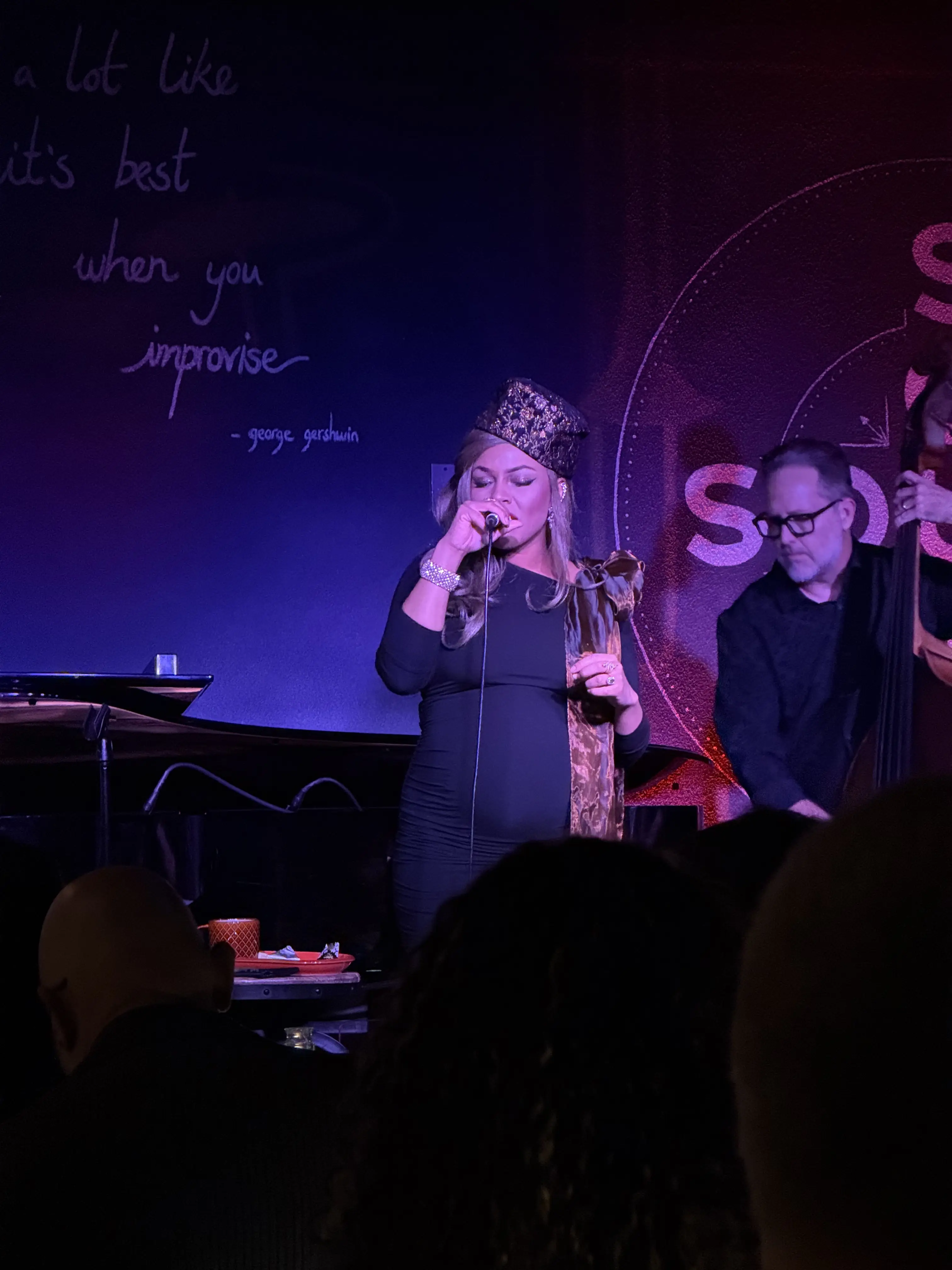
On Sunday night, October 18, Lauren Henderson stood at a microphone in the Jazz Club at SOUTH on North Broad Street in Philadelphia, with a piano, an upright bass and a drum kit on the bandstand around her, and there were moments when the room got so quiet you could practically hear somebody thinking. I’m Harry Hayman, and I put that line in my post about the night because it was the truest thing I had. I wrote ABSOLUTELY SUBLIME at the top, and I would write it again. João Bueno on piano, Madison Rast on bass and Dan Monaghan on drums gave her room to tell her stories. This is the longer version of that post: who was on the bandstand, what the room was built to do, and where it came from.
Sunday Night on North Broad Street
The public record of the night is short and plain. The Philly Jazz Scene calendar lists Lauren Henderson at SOUTH Restaurant & Jazz Club on October 18, 2026, with Lauren on vocals, João Bueno on piano, Madison Rast on bass and Dan Monaghan on drums, at 600 N Broad St, with shows at 6pm and 8:30pm, and the flyer posted with that listing agrees. SOUTH’s own page for guests gives the same two Sunday set times and says most sets run 75 minutes. I wrote about Sandy Eldred and his calendar in September, and it is good to see our night on it.
My post carries three photos. In the first, Lauren has her eyes closed and the microphone held close, a gold patterned hat on her head and part of a line lettered by hand on the wall behind her. The second pulls back to put her beside Madison and his upright bass, under the SOUTH mark. The third takes in the room: João at the piano on the left, Lauren in the center, Madison at the bass, Dan at the drums on the right, candle lanterns hanging overhead, the outline of an upright bass painted on the wall, and in the foreground the backs of the audience’s heads, pointed at the stage. A photograph cannot carry sound, but that last one comes close.
A Singer Who Never Had to Demand the Room
I called Lauren elegant, soulful and sophisticated, and completely comfortable letting the music do the talking. The line I would defend hardest is the next one: she has a rare ability to make an entire room pay attention without ever having to demand it. Plenty of singers command a room. They do it with volume, with banter, with a hand in the air, and sometimes it works. Others simply trust the song, and the room comes to them. Lauren is the second kind.
Look at the first photo again. Her eyes are closed. The wall behind her is washed in blue and violet, a bracelet catches the light on the hand that holds the microphone, and the whole frame has the stillness of a room holding its breath. A listing can tell you a name and a lineup. It cannot tell you what a singer does with a room, and I would rather describe what I saw than borrow somebody else’s adjectives. I watched a room full of people get completely absorbed in the music, and that is the whole job.
Three Musicians Who Know When to Play Nothing
João Bueno on piano, Madison Rast on bass, and Dan Monaghan on drums. I called them three terrific musicians who clearly understand that sometimes the most important thing you can play is nothing at all, and I know how that sounds. If you have spent enough time listening to jazz, you know exactly what I mean. A rhythm section with something to prove fills every gap. A rhythm section that is serving a singer leaves the gap open and lets her walk into it. They knew when to push things along, and they seemed to be having a wonderful musical conversation with one another. Nobody tried to steal the spotlight.
The paper trail points the same way. Madison Rast’s profile on the Philly Jazz Scene says he is a North Carolina native who graduated from the North Carolina School of the Arts, received his master’s degree from Virginia Commonwealth University in 1998 and moved to Philadelphia in the fall of 1999. It says he found a home at Ortlieb’s Jazzhaus, became a member of the Bootsie Barnes Sextet there, and has been part of the Captain Black Big Band under Orrin Evans since 2018. Dan Monaghan’s biography at Rowan University calls him one of the busiest drummers in the Philadelphia area. He is a native of Mansfield, Pennsylvania, studied classical percussion for eight years, earned a Bachelor of Music in jazz studies from Temple University, has performed with Eric Alexander, Peter Bernstein, Uri Caine and Randy Brecker, and is on the faculty at both Rowan and Temple. Among the rooms that bio lists is Zanzibar Blue, the club the Bynum brothers ran before SOUTH, so his drums and this family’s rooms have crossed paths before.
João Bueno’s trail is shorter. Temple University’s Boyer College posted the program for his senior jazz piano recital, played on Sunday, March 23, 2025, in Klein Recital Hall. It names him as a student of Bruce Barth, and the composers on it include Antonio Carlos Jobim, João Donato and Djavan, all three Brazilian. A recital program does not explain what I heard on Sunday, but it is a straight answer to the question of where a pianist’s ear has been living.
A Room Built So Everybody Faces the Stage
SOUTH describes its Jazz Club as an intimate space with under 75 seats, the place to see your favorite artists up close and personal. It also says what it expects in return: during the show, it asks that conversation be kept to a strict minimum. Tickets cover one set and reserve a table, and seating begins in the hour before the show, so everyone has time to settle in before the music starts. A rule like that only works if the room agrees to it. On Sunday, people listened. Really listened.
The design does part of that work, and it was meant to. When the Bynum brothers opened SOUTH in 2015, WHYY reported that they split the dining room to include a jazz parlor, added acoustic finishings and carpeting for the sake of sound quality, and set up supper club seating that “ensures there’s not a bad seat in the house.” Robert Bynum told WHYY, “It was also important to us that every seat face the stage. We really tried to get away from the situation where people have their backs to the stage. We think it tends to take away from the focus on the music and the interest in the music.” My third photo shows that design at work. Every head I can see in the foreground is aimed at the same place.
Design only gets a room so far. You can book wonderful musicians, put them in a beautiful room, and do everything possible to create the right atmosphere. But every once in a while, something happens between the artists and the audience that you simply cannot manufacture. Everybody has a phone in hand and a thousand things competing for their attention, and a room full of people still got completely absorbed in the music. That is a pretty beautiful thing, and I wanted to say thank you for it in writing.
Where SOUTH Came From
I should say plainly where I stand. I have been part of SOUTH since the doors opened in 2015, so I am not a neutral critic of this room and I will not pretend to be. WHYY’s report on the opening quoted the general manager talking about the beverage program, and that was me. SOUTH is owned and operated by the brothers Robert and Benjamin Bynum, whom the restaurant’s own history page calls 35 year veterans of Philadelphia’s hospitality community, and Benjamin is the Executive Chef.
The Bynums did not arrive on North Broad Street out of nowhere. When the Philadelphia Inquirer reported in June 2015 that the corner of Broad and Mount Vernon Streets had new tenants, Robert Bynum said, “This will be our return to Broad Street,” a reference to Zanzibar Blue, the jazz club they launched in 1990 on South 11th Street before moving it downstairs at the Bellevue, where it stayed until it closed in 2007. The space at 600 N. Broad had been Route 6, a Stephen Starr seafood restaurant that closed in March 2014. The Temple News, previewing the grand opening on October 15, quoted Robert saying, “We view Broad Street as the center of the city.” A few paragraphs later he says the sentence that explains the room better than I can: “The food is great, but ultimately my passion goes back to the music.”
The Line on the Wall
Behind the band, lettered by hand on the wall, is a line credited to George Gershwin: “Life is a lot like jazz… it’s best when you improvise.” I cannot point you to the page where Gershwin wrote it, and I will not claim he did. I wrote about that wall in a late August post about soundcheck at SOUTH, and I still think whether he said it is a question for someone else to settle. What I can tell you is what the sentence is doing there. A singer and a band in a small club are making something up together in front of people, and the wall says that is the point. On Sunday that meant four people on a small stage listening hard enough to answer each other, which is improvisation in the only sense I fully trust.
Consider what that took. A room with under 75 seats, a ticket for one set, a trio that knows when to lay out, a singer who does not need to be louder than the song. It is modest, and it is what keeps a city’s culture alive on an ordinary Sunday. Culture is infrastructure, and a night like this is what the infrastructure is for.
Lauren, João, Madison, Dan: thank you. What a pleasure. And to everyone who came out to SOUTH, thank you for continuing to support live jazz in Philadelphia. Nights like this are why we keep doing what we do. If you want to hear it for yourself, SOUTH lists its upcoming performances on its Jazz Club page, and the Philly Jazz Scene calendar lists live jazz across the Philadelphia area. Get there in the hour before the set, and keep the conversation to a strict minimum.
BRAVO, LAUREN. BRAVO, GENTLEMEN.
Sources and references
- Philly Jazz Scene: Lauren Henderson at SOUTH Restaurant & Jazz Club, October 18, 2026
- SOUTH: FAQs and what to know before you come
- Harry Hayman: The Calendar Philadelphia’s Jazz Scene Needed
- Philly Jazz Scene: Madison Rast, bassist
- Rowan University: Dan Monaghan, Jazz Studies, Drums
- Wikipedia: Zanzibar Blue
- Temple University Boyer College: João Bueno senior jazz piano recital program, March 23, 2025
- Wikipedia: Antonio Carlos Jobim
- Wikipedia: João Donato
- Wikipedia: Djavan
- SOUTH: The Jazz Club at SOUTH and upcoming performances
- WHYY: Bynum brothers bring jazz tradition to North Broad with SOUTH, October 16, 2015
- SOUTH: our story
- Philadelphia Inquirer: Route 6 on Broad Street getting new tenant, June 16, 2015
- The Temple News: Southern flavors create a familiar atmosphere at new bar, October 13, 2015
- Wikipedia: George Gershwin
- Harry Hayman: Inside a soundcheck at SOUTH, the hour before a Philadelphia jazz room fills
- Philly Jazz Scene: jazz calendar