Philadelphia Showed Out at the 2026 Chinatown Night Market
I spent October 8, 2026 in the packed streets of the Philadelphia Chinatown Night Market. Here is who runs it, what I ate and when to go next.
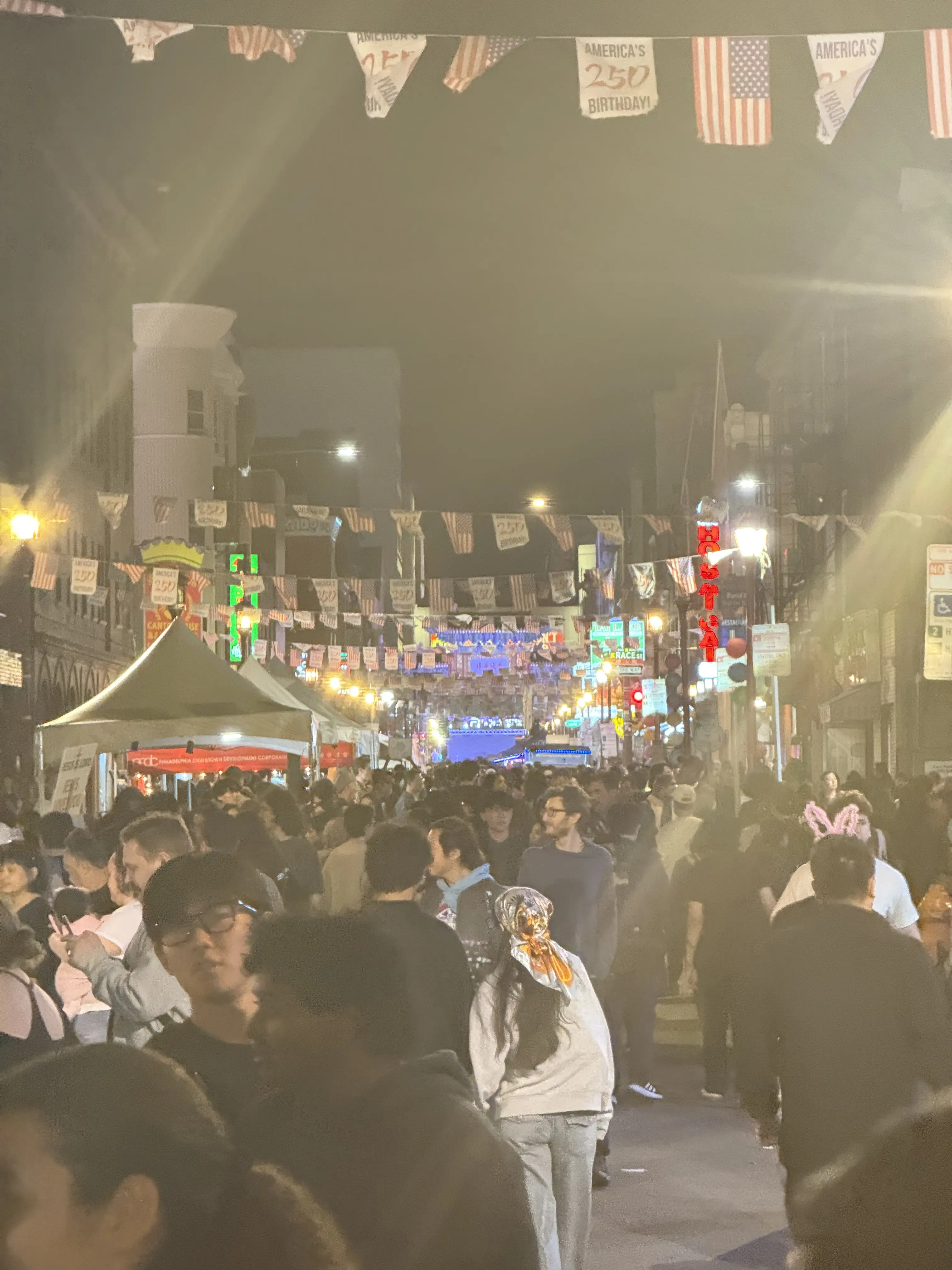
Look at the top of the first photo I posted and you will see the bunting. Flags alternate with little tags reading AMERICA’S 250 BIRTHDAY! all down the street, in a year when, as Visit Philadelphia’s guide to 2026 puts it, the nation celebrates its 250th birthday. Look at the bottom and you will see the crowd, packed shoulder to shoulder, with a pair of pink bunny ears bobbing on the right. Smoke was coming off the grills. Music was playing somewhere in all of it, and everywhere I turned there was something else I wanted to eat. I’m Harry Hayman, I have spent a good chunk of my life in hospitality, and I know what it takes to put this many people in one place on purpose. This was the YèShì Chinatown Night Market on Thursday, October 8, 2026, from 6 to 10 pm, and Philadelphia showed OUT.
What the YèShì Chinatown Night Market is
The Philadelphia Chinatown Development Corporation, PCDC to anyone who knows it, runs the market, and its page for this year’s edition gives the plain facts. Thursday, October 8, 6 to 10 pm, on 10th Street between Arch and Winter streets and on Race Street between 9th and 11th, with entrances at Arch and 10th, Winter and 10th, Race and 9th, and Race and 11th. Rain or shine, and no rain dates. PCDC says that in past years the market has averaged more than 20,000 people and more than 60 vendors. PhillyVoice’s preview expected more than 90 vendors this time and listed admission as free.
It started in 2011. According to PhillyVoice, PCDC created it to bring people into Chinatown and support the neighborhood’s businesses, and the name carries the idea, because YèShì means night market, a nod to the evening markets found across Asia. Haoyi Shang, PCDC’s commercial corridor manager, told the Inquirer in 2023, “The idea of having a night market is something that originates from China.” Shang said Rachel Mak, PCDC’s deputy director, felt inspired to start one after trips to China, where she had seen a lively night market scene in Hong Kong and other places.
Then the pandemic stopped it for four years. Community members decided to bring it back in 2023, the Inquirer reported, and recent editions have all landed on the second Thursday of October: October 12 in 2023, October 10 in 2024, and this year’s October 8.
A neighborhood that learned to organize
The red tent at the left edge of that first photo carries PCDC’s name, and the organization behind it was born in a fight. In 1966, PCDC’s own history explains, the state’s plan for the Vine Street Expressway called for tearing down Holy Redeemer Chinese Catholic Church and School, while city plans for a hospital and for Market Street East threatened to box Chinatown in on every side. Residents decided to fight for their homes, led by Cecilia Moy Yep, a young widow with three small children. The committee they formed was incorporated as PCDC in 1969, with George Moy as its first president.
The neighborhood is older than the organization. PCDC dates Chinatown’s first business, a laundry, to 1871 at 913 Race Street, and its first restaurant to 1880 at the same address. Race Street is one of the two streets the market takes over, and number 913 falls inside that stretch. From 1871 to now is more than 150 years, which means Chinatown has been part of Philadelphia for more than half of the 250 years on that bunting.
The Friendship Gate came later. PCDC says master artisans from Tianjin, Philadelphia’s sister city, handcrafted it, and its history records the dedication in January 1984. Wikipedia places the gate at 10th and Arch, the same corner as one of the market’s entrances.
Then came the arena. PCDC’s history says the Sixers announced a plan in 2023 for a new arena at Market East, next to Chinatown, and that PCDC spent two years on bilingual surveys, studies and advocacy against it. The Inquirer’s 2023 preview said the market would feature a table to discuss the proposal. City Council approved the $1.3 billion plan in December 2024, and then, on January 13, 2025, Mayor Cherelle Parker announced a deal to build a new arena for the Sixers and Flyers at the South Philadelphia sports complex instead, aiming to open it by 2031. People who had fought the Market East plan celebrated, and one opposition group wrote that it hoped officials had learned that the neighborhood’s voice matters.
I will leave the arena argument where the neighbors left it. What stays with me is that the same neighborhood that spent two years on surveys, studies and advocacy also fills its streets, on a Thursday in October, with strangers holding skewers. How does a place find the energy for both? I do not have a tidy answer, and I am glad the question is a happy one.
The street at full volume
The third photo I posted is the stage. A DJ worked behind a table with a screen behind him so bright that the crowd in front of it turned to silhouettes, and a woven conical hat glowed gold among the heads. PCDC’s page promises live performances, and the Inquirer’s 2023 preview described a traditional lion dance, spoken word poetry, cover bands and campus dance groups, so the stage is a program, not just a soundtrack.
Everywhere else it was food. The mix, PhillyVoice reported before the night, ran from Vietnamese and Filipino to lobster rolls, pizza cones and soul food, with sushi, ramen, smoothies and bubble tea alongside the arts and crafts. I ate dumplings, skewers and noodles, plus a few things I could not identify and decided I had better try anyway, which seemed to be the whole point.
One window stopped me. A decal of Caishen, the God of Wealth, rode a golden horse with a red sack of gold ingots in his arms, over a ribbon that said RICH. Wikipedia notes that in southern Chinese and overseas Chinese communities the main day for welcoming him falls on the fifth day of the lunar new year, and that many businesses time their first day of trading after the break to match. I took it as a good omen for every vendor on the street.
I have sat through a lot of meetings about economic development, placemaking and neighborhood vitality. On Thursday I stood inside the thing those meetings are trying to describe. Restaurants and vendors doing business. People coming into the neighborhood and spending money. Strangers walking into places they would never have found on an ordinary Tuesday, which is exactly what PCDC set out to do in 2011. Economic development you can taste, and no PowerPoint required.
Yamitsuki and the plates
The fifth photo I posted is a storefront at 1028 Arch Street. The sign glows red, with the name in Japanese inside a little red bowl and, in English, yamitsuki, ramen, snow ice, tea bar. The red spills onto the pavement, where a sandwich board announces a happy hour every day from 4:00 to 6:30 pm. The Inquirer’s Michael Klein wrote the place up in May 2016, during its soft opening, and noted that the ramen came with chicken as an alternative to pork, that there was a vegetarian version, and that the menu included honey matcha tea, milk bubble tea and snow ice for dessert. That was a decade ago, so check the current menu and hours before you go. What I can tell you is that it sits within a block of the Arch and 10th entrance, an easy place to step out of the crowd.
The plates came next. A bottle of Kirin Ichiban lager stands beside a 300 ml bottle of sake whose label says junmai ginjo, serve chilled, 15 to 17 percent alcohol by volume, with a small white cup painted with bamboo next to it and a plate of sushi rolls in the foreground. Junmai, Difford’s Guide explains, means brewed with only rice, water and koji and no added alcohol, and ginjo means the rice was milled until at most 60 percent of the grain remains. Wine. Women. Song. And more wine. Well…SAKE!
After that, shrimp tangled in a nest of crispy fried noodles with an orange dipping sauce, and then, naturally, more food: a dessert under a drift of whipped cream and rainbow sprinkles. The photos I posted follow that walk, from the street under the bunting to the banner, the DJ, the window, the storefront and the plates.
Next October: Harry Hayman’s short guide
If you missed it, I’m not sure what to tell you. Actually, I am. NEXT TIME, GO FOR IT. Here is how I would do it.
Mark the second Thursday of October. If the pattern holds, that is October 14 in 2027, though only PCDC can make a date official, and PCDC’s own site is where each year’s details appear, as this year’s event page shows. Plan on 6 to 10 pm. It was free this year, per PhillyVoice, and PCDC says it happens rain or shine. Go on foot, by bike or on transit, which is what the organizers recommend, and come in through Arch and 10th if you want to start at the Friendship Gate.
The restaurants and shops do not close when the barricades come down. PCDC says its Main Street Program supports more than 400 Chinatown businesses with help on grants, permits and marketing, which is a good reason to spend money there on an ordinary Tuesday. And a big shout out to everyone who made the night happen, especially the businesses and vendors who made it worth showing up hungry.
Philadelphia has spent all year telling the world it is 250. Chinatown has been part of that story for more than 150 of those years, and it did not need a birthday to throw a party. I keep saying that culture is infrastructure and that 2026 reveals what this city already has rather than creating it. On Thursday you could see it in the street: the organizers, the neighbors, the stalls and the history were all in place long before the bunting went up. I love this city. What. A. Night. See you on 10th Street next October.
Sources and references
- Visit Philadelphia: Your Guide to 2026 and America’s 250th Birthday in Philadelphia
- PCDC: 2026 YèShì Chinatown Night Market
- PhillyVoice: YèShì Chinatown Night Market 2026, 90+ vendors coming to Philadelphia Oct. 8
- The Inquirer: YèShì Night Market returns to Chinatown after pandemic halt
- PhillyVoice: Chinatown Night Market returns Oct. 10 with dumplings, mahjong and karaoke
- PCDC: History and timeline
- PCDC: Welcome to Philadelphia Chinatown
- Wikipedia: Chinatown, Philadelphia
- PhillyVoice: Sixers abandon plans for Center City arena, opponents celebrate
- CBS Philadelphia: Mayor Parker calls deal to build new 76ers arena in South Philadelphia a win for city
- Wikipedia: Caishen
- The Inquirer: Yamitsuki: Ramen (and Iron Man!) in Chinatown
- Difford’s Guide: Sake types and grades
- PCDC: Chinatown commercial corridor and Main Street Program