J’Nelle Clements-Lawrence: You Will Not Be Forgotten
A Philadelphia friend's farewell to J’Nelle, and what a packed church says about showing up for people while they are still here.
The parking lot was the first thing that told me how many people had come. Cars ran in rows past the edge of the lot, and a sign on the brick wall read St. Paul’s Lutheran Church. I was running behind that day, it was a hike to get there, and I almost did not make it. I’m Harry Hayman, and I could not miss seeing my dear friend J’Nelle Clements-Lawrence off one more time. Inside, the church was full. The aisles were full. The foyer was full, and people stood at the back and outside the doors. This was not a small church. There was simply no more room. I have been thinking about that room ever since, and I want to write down what I saw, what I said about it, and why I think the answer to a packed church is a question about the rest of the year.
The Room That Ran Out of Space
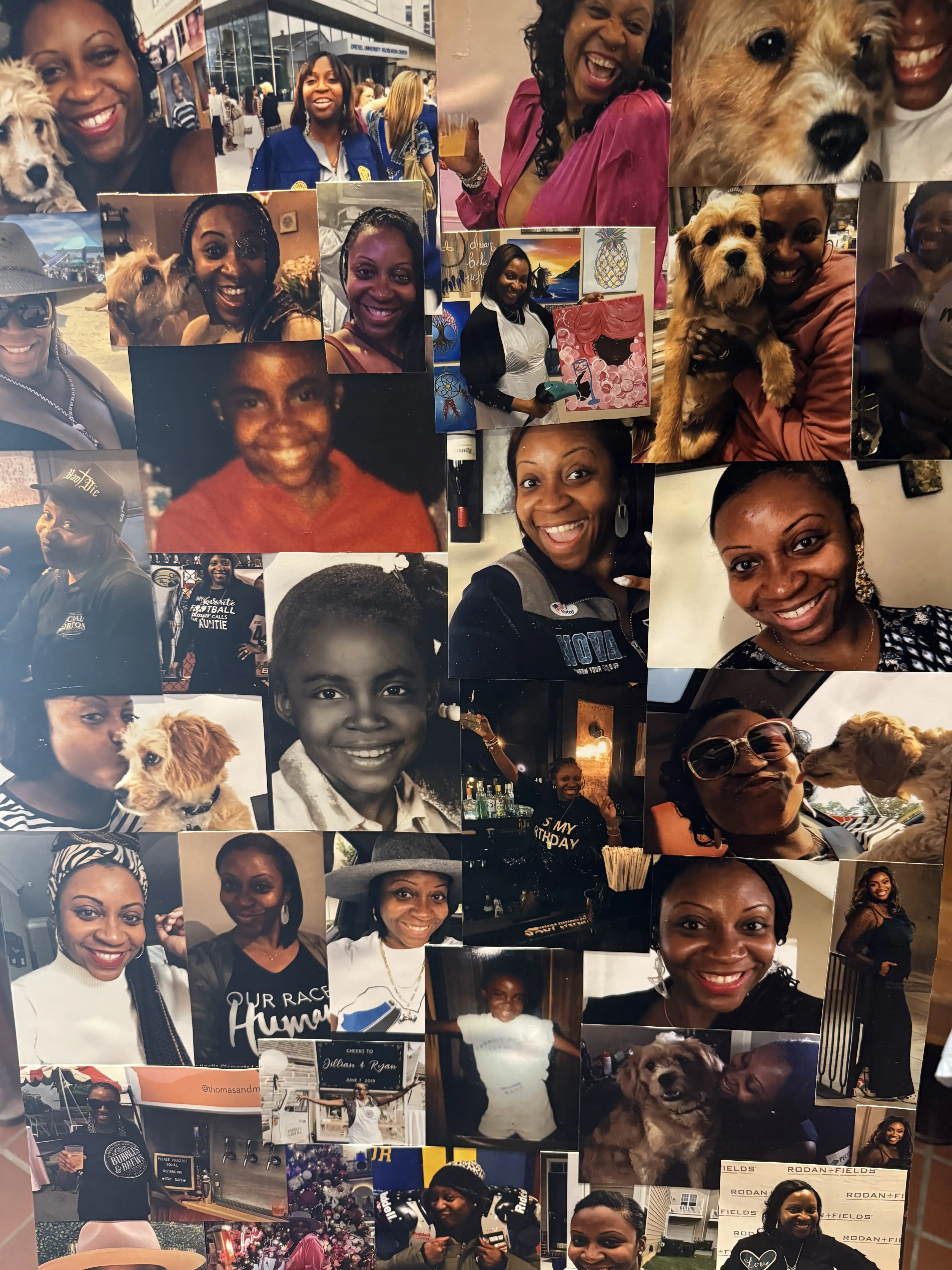
The pictures I took that day tell it plainly. The full parking lot. The packed sanctuary. The memorial table in the foyer, with three bouquets, a collage of pictures of J’Nelle on an easel and a framed portrait of her smiling in a red hat. And the drive itself, my hand on the wheel, because getting there is part of the story.
I do not normally post about something this personal. I did it because I wanted to talk about my friend to the 200,000 of you who may see this, and I hoped for more. I wrote that there isn’t enough room on a post, a page or in my heart for her, because J’Nelle was bigger than that room. She was bigger than any title, school, job, relationship, event or story. She had a laugh, an energy, a hat, a presence. You knew when she entered a room. You could feel it, and it was weird.
What Person After Person Said
Speaker after speaker stood and told stories that, in different ways, all said the same thing. J’Nelle touched us. She mattered to us, and we mattered to her. She mattered to her family, including her mother, whom I was lucky enough to get to know a little. She mattered to her nieces, nephews and cousins, to her friends and her community, and to the people she worked beside. She helped, encouraged, challenged, laughed and prayed with people, fought for them and simply showed up for them.
The number of people who showed up for her was the proof. I keep returning to that sentence because it is the least sentimental thing I can say. A full church is data. Nobody fills an aisle out of obligation to someone who never did anything for them. They come because a long time ago, in some small moment, she turned up when it mattered.
Why Showing Up Is Not a Soft Skill
I am not a researcher, but the people who study this keep landing in the same place as the pews. The Harvard Study of Adult Development, now directed by psychiatrist Robert Waldinger, has followed people since 1938. According to the Harvard Gazette, it began with 268 Harvard sophomores, later added 456 Boston inner city residents, and now includes about 1,300 of their children. Its central finding is that close relationships predict a happy, healthy life better than social class, IQ or even genes. Waldinger said the people most satisfied in their relationships at 50 were the healthiest at 80.
A much larger analysis says something similar. In a 2010 paper in PLoS Medicine, Julianne Holt-Lunstad, Timothy Smith and Bradley Layton pooled 148 studies covering 308,849 participants. Stronger social relationships were linked to better odds of survival, with a pooled odds ratio of 1.50. That is a cold number for a warm subject, but I find it clarifying. Being present for other people is not decoration on a life. By this evidence it is part of what keeps a life going.
So when I look at a lot full of cars, I do not see a crowd. I see a woman who spent years making deposits that other people could draw on, and a community returning them in one afternoon.
Love Requires Honesty Too
Here is the part of my post that was harder to write. I told the truth, because I am not a revisionist. There were people and institutions who did not treat J’Nelle the way she deserved to be treated at the end. People made decisions, stayed silent and looked the other way. I said some of you did her dirty, that you know who you are, and that now, more importantly, I know who you are. I am not going to name anyone here, and I am not going to guess at anything I do not know. That is the point of what I said: I know what I know, and I am saying it plainly instead of pretending.
I did not say it to hijack her memorial. I said it because respecting someone should include being honest about how we treated them while they were alive. If she is not here to say it, I will speak on her behalf. I just asked her, and she said shots up.
Grace and Accountability Can Share a Sentence
I believe deeply in grace. I also believe in accountability. You can forgive people and still tell the truth. You can love people and still demand better. These sound like opposites only if you think forgiveness means forgetting.
The most famous attempt to hold both at once was South Africa’s Truth and Reconciliation Commission, chaired by Archbishop Desmond Tutu. It was set up in 1996 to record human rights violations, offer reparation and rehabilitation to victims and, in some cases, grant amnesty, but only when the applicant made full disclosure. Truth came first. Mercy came second, and it had a condition. Tutu also described the idea of ubuntu, a Zulu saying that translates as a person is a person through people. If that is true, then how we treat someone at their most vulnerable is not a private matter between two people. It says something about all of us.
My situation is nothing like theirs, and I will not pretend otherwise. But the principle scales down. We are very good at giving people their flowers after the fact. The harder test is how we treat them when they are still here, when they are vulnerable, when standing next to them is not convenient, and when doing the right thing might actually cost us something. Some people failed that test. I am not going to forget it or pretend, because J’Nelle mattered too much for that.
What the Pastor Said, and What I Felt
Despite my screed, the overwhelming feeling in that church was not anger. It was love. The pastor spoke about how love conquers all, and looking around, you could see it. The phrase has an old pedigree. It is usually traced to the Latin omnia vincit amor, from Virgil’s Eclogues. I would not claim that the pastor meant it the way a poet two thousand years ago did. I only know that every pew, aisle and hallway was filled, and people were spilling out the front door, and that no argument for the idea has ever been as persuasive as that room.
That is J’Nelle’s real legacy. Not the people who disappointed her. Not the people who failed her. Not the final chapter. Her life. Her laugh, her hats, her energy, her generosity, her humanity, and all those people who showed up because somewhere along the way she had shown up for them.
Where This Leaves Me
I am a Philadelphia guy, and I spend most of my working life arguing that culture is infrastructure, that the connections between people are as real as the roads and buildings. A funeral is where that argument stops being abstract. You find out who built what, and for whom.
Everything I have told you about her comes from me: what I saw, what the speakers said, and what I knew of my friend. She was not a headline. She was a person who was loved by many, and I would rather give you an honest account than one dressed up with details I cannot stand behind.
J’Nelle Clements-Lawrence, you were loved, and you are loved. You mattered, and you still matter. You will not be forgotten. Rest beautifully, my friend.