Philadelphia's SDG Murals, Extreme Heat and FPRI on Broad Street
I went to a panel on Philadelphia's SDG murals and extreme heat at FPRI, and left thinking about trust, neighbors and art on a wall.
The lobby of 123 South Broad Street has a clock with a gold face in an ornate bronze frame, set above a black and gold directory that reads One Two Three So Broad. On Thursday, October 8, I walked into a conversation at the Foreign Policy Research Institute upstairs and found myself wondering how on earth I didn’t know this place existed. FPRI was founded in Philadelphia in 1955. It is a nonpartisan think tank, it began at the University of Pennsylvania, and today it works out of Suite 1920 on Broad Street. Who knew? The evening was a Global Philadelphia Association panel on the city’s SDG murals and extreme weather, and I went to learn. I left with an institution I had missed and a question about heat I still can’t put down. I also left with four words about AI that I keep turning over.
FPRI Was Founded in Philadelphia in 1955
FPRI’s own anniversary history records that Robert Strausz-Hupé founded the institute in Philadelphia in 1955, and Penn’s Almanac, in his 2002 obituary notice, adds that he founded it at Penn and that the institute cut its ties with the university in 1969 and stayed in the city. The same notice gives the institute’s address as 1528 Walnut Street, so the Broad Street address is newer than the institute.
FPRI describes itself as a nonpartisan think tank that produces scholarship and policy analysis on the foreign policy and national security challenges facing the United States, and it aims to educate policymakers and the public through history, geography and culture. In my photos its logo, a navy and red bird, sits over a dotted world map on a wall. Through a glass door beside a Global Philadelphia banner I could see a lounge with a navy sofa, two orange chairs and a rug in rainbow rings. The printed program invited everyone to networking in the FPRI Lounge afterward.
What the Printed Program Said
The program titled the evening Philadelphia’s SDG Mural, Extreme Weather and the SDGs, with the date, October 8, 2026, and the hours, 5 to 7 pm. It described extreme weather and the SDGs as a framing “to advance systemic solution thinking” across four of the United Nations goals: SDG 13, Climate Action; SDG 3, on health; SDG 10, Reduced Inequalities; and SDG 11, Sustainable Cities and Communities. All UN member states adopted the 2030 Agenda and its 17 goals in 2015.
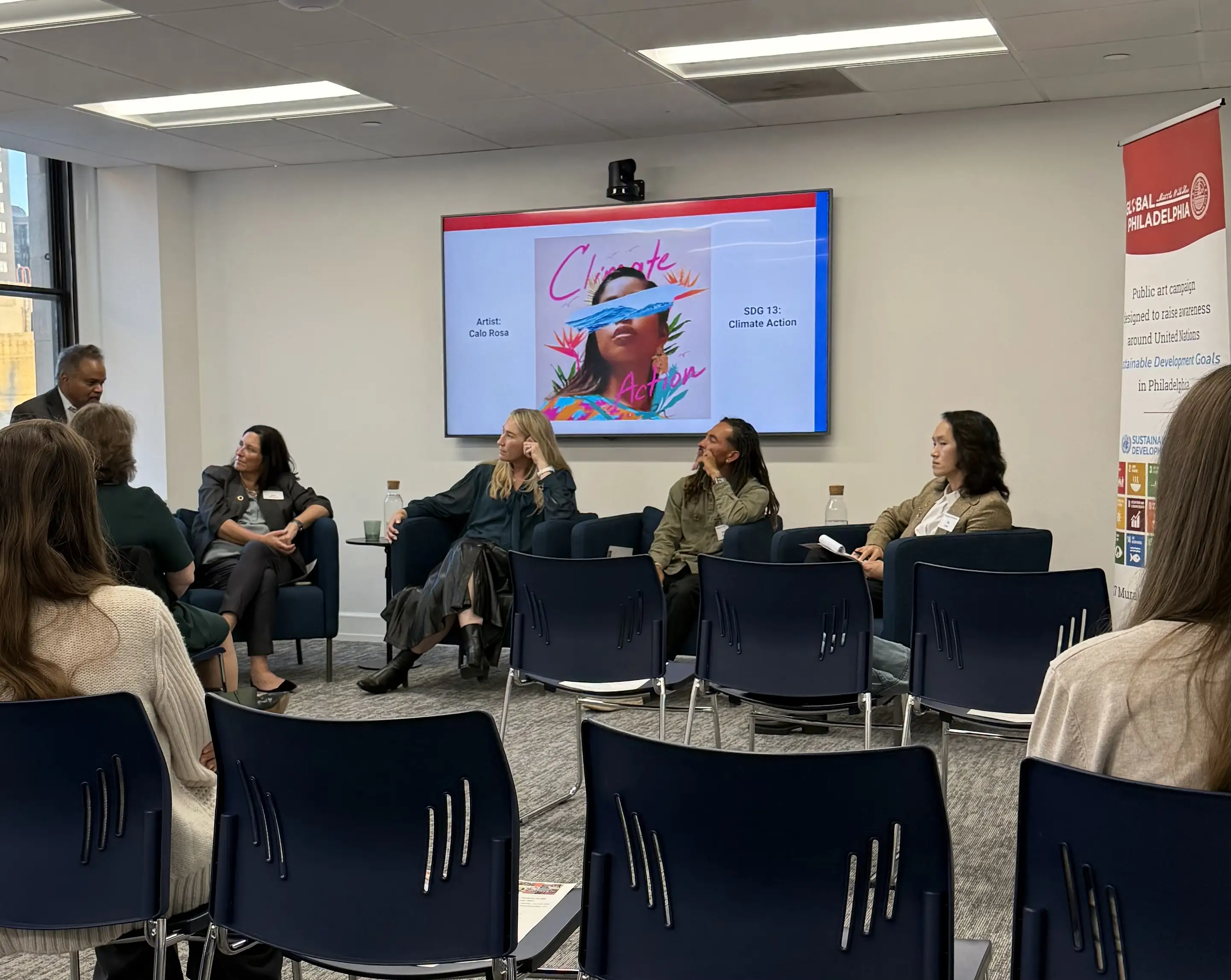
The program also names the people. Zabeth Teelucksingh, president of the Global Philadelphia Association, gave the welcome. Mathy Stanislaus, executive director and vice provost of The Environmental Collaboratory at Drexel University, moderated. The panelists were Alexandra Grubb, corporate communications director for sustainability at Essity; the artist Calo Rosa, listed for SDG 13; Erin Mooney, executive director of the Schuylkill Center for Environmental Education; and Thi Lam, deputy director of SEAMAAC. My own badge, Harry Hayman in thick black type under the Global Philadelphia and Sustainable Development Goals logos, is lying across the program in my photo.
The Mural Behind the Panel
The screen behind the panel showed a slide with the artist’s name, Calo Rosa, and the goal, SDG 13: Climate Action, on either side of a portrait ringed with flowers and the words Climate Action in pink script. A Global Philadelphia banner stood at the edge of the frame, and it called the whole effort a public art campaign designed to raise awareness around the United Nations Sustainable Development Goals in Philadelphia.
Global Philadelphia’s own pages call it the SDG Mural Project: one mural for each of the 17 goals, each by a Philadelphia artist, at sites across the city. The association says it started the program in 2020, finds sponsors for the paintings, and attaches a $3,000 grant to each mural for a local nonprofit or educational institution doing related work. By its count, more than $50,000 in grants has gone out so far.
The SDG 13 mural comes with a traceable cast. Global Philadelphia’s page on the goals lists Calo Rosa as the artist, Disque Hall at Drexel University as the location, Essity as the sponsor and the Schuylkill Center for Environmental Education as the grantee. Essity’s account reports that the company, Global Philadelphia and Drexel unveiled the mural on World Environment Day, June 5, 2024. The company chose the artist and the grantee, and it presented a $3,000 grant to the Schuylkill Center through its executive director, Erin Mooney. Essity’s vice president of communications said the company is calling on everyone who walks by the mural “to take a moment to reflect and act.” Mural Arts Philadelphia describes Calo Rosa as an artist born in San Salvador who lives and works in Philadelphia.
Now put the program next to that page. Global Philadelphia gave the welcome. The artist was on the panel. So was Essity’s sustainability communications director, so was the grantee’s executive director, and the moderator comes from the university where the mural was unveiled. To me that looks like a map of how a mural gets made, and a small model of how a city gets things done: an artist, a company, a nonprofit, a university and a convener at one table.
What Philadelphia Already Does About Heat
Philadelphia is not starting from zero on heat. Its heat health warning system began in 1995, and a study whose authors included the city’s deputy health commissioner estimated that it saved 117 lives between 1995 and 1998.
Today a Heat Health Emergency, issued by the Health Commissioner, switches on a set of programs. The June 2026 emergency was scheduled to run from 11 a.m. on Thursday, June 11, to 8 p.m. on Friday, June 12, and the city’s notice lists what a declaration activates: the Heatline run by the Philadelphia Corporation for Aging, cooling centers, home visits by special field teams, and daytime outreach for people experiencing homelessness. It also repeats the city’s reminder to check on older friends, relatives and neighbors from a distance. Cooling center locations are on a city map or through 311.
The Office of Sustainability has been working neighborhood by neighborhood. Its Beat the Heat pilot began in Hunting Park in 2018 and produced the city’s first community heat resilience plan, and its toolkit page notes that some neighborhoods in Philly can get as much as 22 degrees hotter than others. Twenty two degrees, inside one city. In July 2025 the office announced a heat resilience initiative in Strawberry Mansion, where residents face fewer trees for shade, aging buildings and limited places to cool off. The ten steps in the toolkit for other neighborhoods include establishing a heat team, appointing Beat the Heat ambassadors and building a heat relief network. Read those three again. They describe neighbors.
Then there is the question of how a warning travels. ReadyPhiladelphia, the city’s free mass notification system, now sends initial emergency alerts in 11 languages, including American Sign Language, to the people who enroll.
Here is what we talked about, as I heard it: cooling centers, emergency alerts that don’t always reach the people who need them, language barriers, and what happens when communities don’t necessarily trust the institutions trying to help them. Most items on that list have a city program standing near them, and the programs are real. What kept coming back to me was a question: If we know extreme heat is coming, why are we waiting until people are in trouble to figure out how to help them?
AI Won’t Do That
There was also a comment about AI that stuck with me. AI won’t do that.
Here is how I’d finish the sentence. AI can help us analyze data, identify problems and communicate information. It can’t replace the neighbor checking on somebody during a heat wave or the community organization that already has the trust of the people it’s trying to reach. That’s people taking care of people, and we need more of it.
The city’s heat advice says the same thing in plainer words: check on older friends, relatives and neighbors. The city’s July 2025 Strawberry Mansion announcement added that groups like Esperanza Nueva and Hunting Park CDC were leading heat resilience work in Hunting Park. SEAMAAC’s website describes support for tens of thousands of families in the Greater Philadelphia area since 1984, delivered by a staff that is more than 80 percent bi or multilingual. These are the people who already know whose door to knock on.
Art on a Wall as Connective Tissue
Which got me thinking about Philadelphia, and something I probably talk about way too much. We have so many extraordinary people and organizations doing important work in this city, in food insecurity, healthcare, climate, arts and culture, education, you name it. How many of them actually know what the others are doing? How much more could we accomplish if we spent a little less time operating in our own worlds and a little more time figuring out how to work together? Sound familiar?
That is what I found so interesting about the Global Philadelphia Association’s murals. They get people thinking and talking about issues that can otherwise feel pretty abstract or far removed from everyday life. The association’s stated idea is for residents to take in the goals each time they pass a mural. It reports that its unveilings have brought students reading poetry, public officials talking about the goals, and residents and professionals from different sectors meeting each other. Because sometimes a piece of art on a wall can start a conversation that a report of a hundred pages never will.
The association has been in the connecting business for a while. When Philadelphia became the first World Heritage City in the United States in November 2015, a designation Global Philadelphia worked on, its chair at the time, John F. Smith III, told the Inquirer the association would like nothing better “than to connect people” and “to let people start talking directly to each other”. The banner at the door says it plainly: the first World Heritage City in the United States.
One more photo shows a framed poster with the FPRI logo and a title in heavy black type: The Ties That Bind. FPRI uses that title for a project on how NATO shapes the transatlantic relationship, and I would happily borrow it for the argument I keep making about this city.
So here is a small idea, offered as a question. Global Philadelphia’s unveilings already put an artist, officials, students and residents in front of one wall. The city’s Beat the Heat toolkit already asks neighborhoods to appoint ambassadors, and ReadyPhiladelphia already enrolls people in 11 languages. What would it take to put an ambassador and an enrollment table next to the artist at the next unveiling?
I have more homework to do, and I’m going to try to do my part. How about you?
Sources and references
- Foreign Policy Research Institute: About FPRI
- FPRI: FPRI’s 50th Anniversary
- University of Pennsylvania Almanac: Deaths, March 5, 2002
- FPRI Eurasia Program: The Ties That Bind
- Global Philadelphia Association: Sustainable Development Goals
- Global Philadelphia Association: The 17 SDGs
- Essity: Essity and the Global Philadelphia Association Reveal New Mural
- Mural Arts Philadelphia: Carlos CALO Rosa
- Drexel University: Inaugural Executive Director of The Environmental Collaboratory Named
- SEAMAAC
- United Nations: The 17 Sustainable Development Goals
- City of Philadelphia: Heat Health Emergency, June 2026
- City of Philadelphia: Beat the Heat Community Heat Relief Toolkit
- City of Philadelphia: Strawberry Mansion Joins the City’s Push for Heat Resilience
- City of Philadelphia: ReadyPhiladelphia Alerts Now in Multiple Languages
- Teisberg and others: Heat Watch/Warning Systems Save Lives, Philadelphia 1995 to 1998
- Philadelphia Inquirer: Philadelphia Selected as World Heritage City