Pennsylvania Grows 74 Percent of America's Button Mushrooms Indoors
Pennsylvania grows 74 percent of America's button mushrooms indoors. What a century of indoor farming outside Philadelphia teaches, and what it warns.
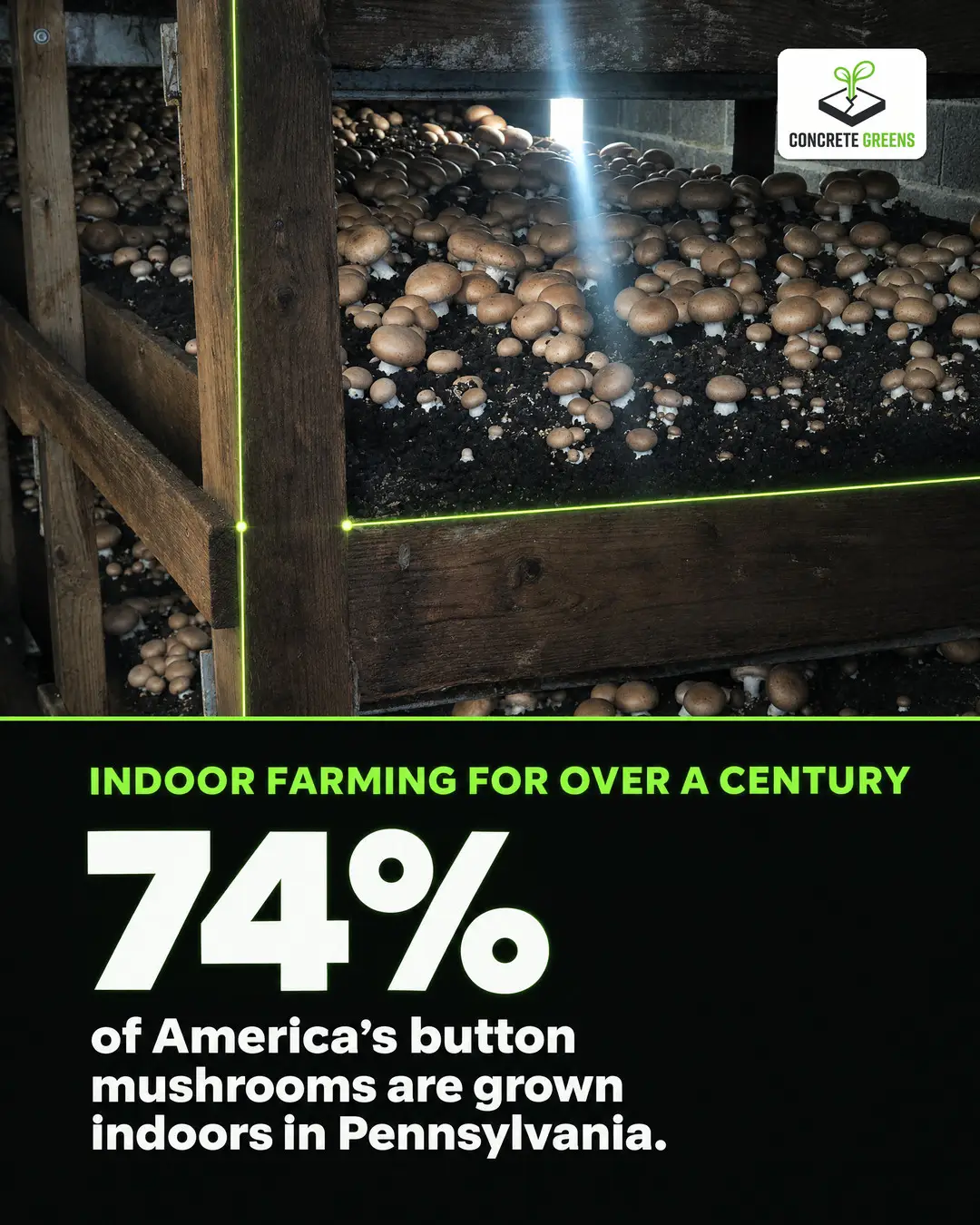
Every few months somebody stands up at a panel in Philadelphia and tells me that indoor farming is the future. I nod, because I want it to be true for this city. Then I think about a number most people in the room have never heard. On 19 August 2026 the USDA’s National Agricultural Statistics Service released its annual Mushrooms report, and it says Pennsylvania accounted for 74 percent of the volume of Agaricus mushroom sales in the United States for 2025 to 2026. Agaricus is the white button, the cremini and the portabella, the mushrooms in almost every supermarket in the country. Nearly three out of four of them were grown in Pennsylvania, indoors, in climate controlled rooms. Indoor farming is not the future here. It is more than a hundred years old, it sits in the counties next door, and it has a lot to teach a city that keeps talking about it in the future tense.
The Numbers in the USDA Report
I read the whole report rather than the headline, because the headline hides as much as it shows. The national Agaricus crop for 2025 to 2026 came to 620 million pounds, down 5 percent, and it sold for 847 million dollars, down 15 percent. Specialty mushrooms, the shiitake and oyster and the rest, added 75.0 million dollars, down 21 percent. All mushrooms together came to 636 million pounds and 922 million dollars, down 16 percent from the year before.
Then I went to the state table, and this is the part I did not expect. My own arithmetic from the NASS rows: Pennsylvania’s Agaricus volume went up, from about 452 million pounds to about 460 million, and its value rose from 535.8 million dollars to 558.8 million. The states outside the named list fell from about 202 million pounds to about 160 million. So the 74 percent is partly Pennsylvania holding steady and partly everyone else shrinking. A year earlier the same share was closer to 69 percent. NASS does not say that in words. The table does.
One more line in the report matters for what comes next. Growers’ filling intentions for the 2026 to 2027 crop, meaning the square feet of beds they plan to fill, are 94.7 million square feet, down 16 percent. Pennsylvania’s own intentions are 86 percent of last year.
Where the Mushrooms Actually Grow
When people picture farmland they picture fields. These mushrooms grow in buildings. The Philadelphia Inquirer’s Joseph N. DiStefano described the industry in a 29 July 2026 report as “Pennsylvania growers, who produce more than two-thirds of the U.S. mushroom crop, mostly in clusters of climate-controlled sheds in northern Berks County and southern Chester County.” Southern Chester County is the country around Kennett Square.
The photograph behind the poster for this post comes from a USDA visit to a working Pennsylvania mushroom house. It shows two stacked wooden beds, the upper one crowded with brown cremini on dark casing soil, a block wall behind, a single shaft of daylight from a gap in the roof. USDA does not name the farm or the town, so I will not claim it is Kennett Square. It does not need to be. It shows exactly what the number means: food grown in tiers, under a roof, a short drive from a large American city.
That cluster is also an economy. A Penn State Extension educator, Maria Gorgo-Simcox, writes for Penn State Extension that southeastern Pennsylvania’s mushroom farms employ nearly 9,300 people with 313 million dollars in compensation, and that the mushroom farming community contributes an estimated 1.2 billion dollars a year to the local economy. That is her estimate, not a USDA figure, and I quote it as hers. Even read cautiously, it is a working indoor food industry with thousands of jobs, right on Philadelphia’s doorstep.
Why Kennett Square, and Why It Matters to Harry Hayman’s Philadelphia
The history is the part I find most useful, because it kills a myth. Pennsylvania did not win mushrooms because of some magic soil. Experience Pennsylvania’s history of the industry says it plainly: “Nothing in Pennsylvania’s ground suits mushrooms better than anyone else’s, and the crops grow indoors anyway. Kennett Square’s real edge was its location. Living near a big city in the early 1900s meant plenty of horse manure.”
The story starts small. A Quaker florist put the empty space under his greenhouse benches to work in the late 1800s; Kennett Township’s own history page names him as William Swayne and dates it to about 1885. By the 1920s, immigrants arriving from Europe had brought their own growing methods. In 1927 a grower named William Phillips experimented with ice to control the temperature in mushroom houses, and that opened the door to growing all year.
Read that sequence again with a Philadelphia lens. The inputs came from the city: the manure from the city’s horses, the labor of newcomers who settled nearby, the customers in the city’s markets. The breakthrough was climate control, a way to make the room do what the weather would not. That is the whole argument for indoor farming, made a century before anyone called it controlled environment agriculture. The edge was never the ground. The edge was being next to a city and learning to run the room.
The Honest Half: A Head Start Is Not a Moat
I would be doing this story a disservice if I stopped at the proud part. The same Inquirer report says United States mushroom production peaked in 2015 at 811 million pounds and has fallen every year since, to 631 million pounds in 2025. Fresh mushroom imports, mostly from Canada, have grown steadily since 2012 and more than doubled to 208 million pounds in 2025. NASS’s own numbers show the value of the crop down 16 percent this year and growers planning 16 percent less space for next year.
Pennsylvania’s share is rising while the national crop is shrinking. Those two facts fit together, and they are not comforting. A cluster can lead for a hundred years and still find itself defending ground. The farms that last are the ones that keep reinvesting in their rooms, their equipment, their people and their buyers. A century long lead is a starting position, not a guarantee.
I think that is the most valuable lesson for anyone planning indoor farms inside Philadelphia. The question is never only whether the technology works. Here it obviously works, at national scale, for generations. The question is who keeps paying to keep it working, and who buys what it grows when cheaper supply shows up.
What Concrete Greens Takes From This
Concrete Greens exists to grow food indoors in the city and to make that pay its own way. The model is a revenue generating, mission driven enterprise that complements traditional agriculture rather than replacing it, grows local food all year, and reinvests its surplus in communities that struggle to get fresh food. Pennsylvania’s mushroom houses are the closest thing we have to proof that the first half of that sentence works at scale.
They also tell us what to build in from the start. Sit close to the buyers, the way Kennett Square sat close to Philadelphia. Treat the room as the product, because climate control is what turned a seasonal crop into a year round business. And plan for reinvestment from the first budget, because the history shows that a lead fades when the reinvestment stops.
I wrote about another side of this same industry last month, the circular economy around these farms, in What If Waste Could Grow Our Food? In Pennsylvania, It Already Does. This piece is about scale and staying power. Together they make the same point from two directions: the region already knows how to farm indoors and close the loop. We just do not talk about it as if it were ours.
So here is my question for anyone who cares about food in this city. If the nation’s mushrooms can grow in rooms outside Philadelphia, what would you want growing inside it?
About the Author
Harry Hayman is a Philadelphia-based entrepreneur, music producer, and cultural advocate. Through his work with the Feed Philly Coalition and Concrete Greens, he explores and documents the creative, culinary, and civic life of a city he believes is one of the most inspired places in America.
Sources and references
- USDA National Agricultural Statistics Service: Mushrooms, released 19 August 2026 (mush0826.pdf)
- The Philadelphia Inquirer, Joseph N. DiStefano: Kennett Square mushroom growers, pricing and grocery stores (29 July 2026)
- Penn State Extension, Maria Gorgo-Simcox: Pennsylvania mushroom farmers lead U.S. in mushroom production
- Experience Pennsylvania: Mushroom production history
- Kennett Township: History of Kennett Township
- What If Waste Could Grow Our Food? In Pennsylvania, It Already Does
- Photograph: Mushroom farming bins, 20260929-USDA-NRCS-PA-MR-0003, by Molly Rose, NRCS Pennsylvania, U.S. Department of Agriculture, Public Domain Mark. The poster at the top of this page is a designed graphic built from this photograph.