One Pennsylvania Data Center Tax Break, Three Cost Estimates for the Same Year
Harry Hayman on one Pennsylvania data center tax break priced at $89M, then $45M, then $188M for the same year, and why the state needs receipts.
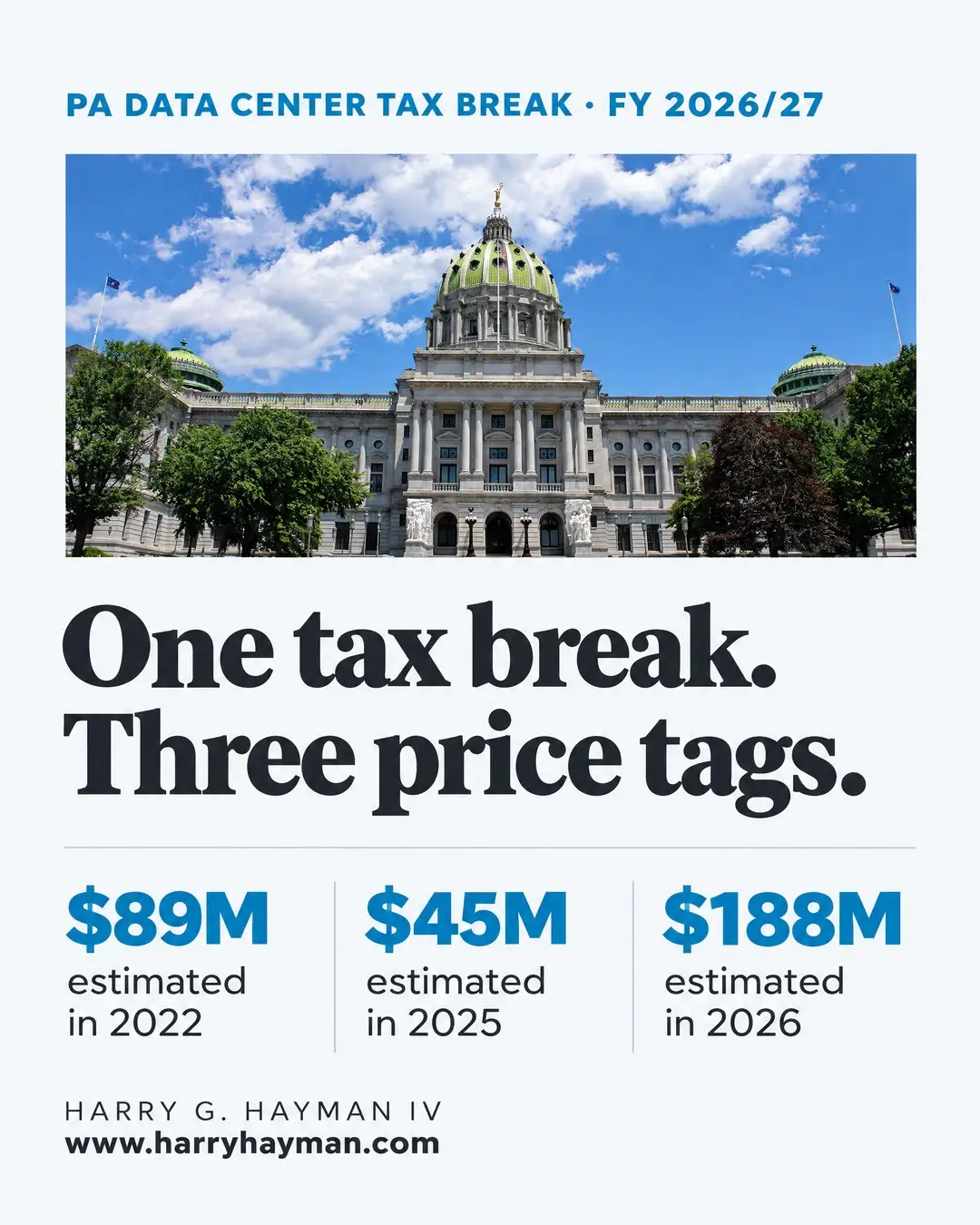
$89 million. Then $45 million. Then $188 million. Those are three official estimates of what ONE Pennsylvania tax break will cost the state in ONE budget year, 2026-27. Same law, same year, three very different numbers. I’m Harry Hayman, I have spent most of my working life in Philadelphia hospitality, restaurants, entertainment and business development, and I have signed enough leases and payroll checks to know that when your own estimate moves like that, the first thing you do is go find the receipts. That is all I am asking Harrisburg to do here.
What the Break Actually Is
The tax break is the sales and use tax exemption on computer data center equipment. In plain words: when a certified data center buys servers and the gear that runs them, it does not pay Pennsylvania’s 6% sales tax on that equipment. The state’s own budget book describes it this way: equipment “used exclusively in a data center certified by the Commonwealth is exempt from sales and use tax,” and certified operators can ask for an exemption certificate every year as long as they meet investment requirements. That description sits in the 2025-26 Governor’s Executive Budget, which estimated that roughly 1,070 data centers may benefit.
The program started small. Spotlight PA reports it began in 2016 as a refund capped at $5 million, the cap went to $7 million in 2019, and the 2021 budget deal rewrote it into the sales tax exemption we have today. The eligibility bar, per the same reporting: in counties with larger populations, a company must eventually reach at least $100 million of new investment and at least 45 new jobs.
I want to be fair about why it exists. States compete hard for data centers, and the people who built this program believed it would bring investment and jobs. Former Gov. Tom Wolf told Spotlight PA he thought the 2021 change was a good idea. That is a legitimate policy bet. My question is simpler: how is the bet doing?
Three Estimates, One Year
Here is the part that stopped me. Every year the Governor’s budget includes a table of tax expenditures, the state’s own estimate of revenue it gives up through exemptions and credits. Look at what those tables have said about this one exemption for the 2026-27 fiscal year. In 2022, the Wolf administration projected $89 million, as Spotlight PA reported. In February 2025, the Shapiro administration’s 2025-26 budget put the same year at $44.9 million. In February 2026, the 2026-27 Governor’s Executive Budget put it at $188.4 million.
Same exemption. Same fiscal year. The estimate fell by half, then roughly quadrupled. And the newest table does not stop there: $41.1 million for 2024-25, $114.8 million for 2025-26, $188.4 million for 2026-27, then $260.3 million, $345.9 million, $431.6 million and $517.2 million by 2030-31. Add those seven years up and you get nearly $1.9 billion, which is why reporters have been rounding it to about $2 billion by mid-2031.
I do not think anybody in the Revenue Department is cooking numbers. Data centers are booming because of artificial intelligence, and it is genuinely hard to forecast an industry growing that fast. But that is exactly my point. When a forecast is that hard, you measure what actually happened.
The State Cannot Say What It Costs
And here is the problem. According to Spotlight PA’s February reporting, the Department of Revenue acknowledged that the actual cost to the commonwealth is unknown. The administration explained that the law “does not include a reporting requirement for either the buyer or seller at the time of purchase.” Companies are required to keep detailed records that the department can examine, but nobody files a number that adds up to a public total.
So the state can tell you what the break MIGHT cost. It cannot tell you what it DID cost. PennLive’s reporting, republished by Governing, adds that the state does not disclose how much each company receives, and that 13 known businesses used the break last year.
Think about that from a restaurant owner’s chair. If my food cost swung between 15% and 60% of sales depending on which spreadsheet I opened, my accountant would not let me buy another case of anything until we figured out why. That is not a political position. That is bookkeeping.
Everybody Voted to Repeal It. It Is Still the Law.
This is where it gets almost funny, LOL. On June 25, 2026, the Pennsylvania House passed House Bill 2198, a clean repeal of the Computer Data Center Equipment Incentive Program, by a vote of 197 to 5. Democrats and Republicans together. City & State Pennsylvania covered it that day. The same afternoon the Senate passed its own version of the repeal inside a much bigger tax bill, House Bill 1667, by 44 to 6.
Then the budget. Gov. Josh Shapiro signed the 2026-27 budget on Sunday, July 12, and as the Philadelphia Inquirer reported, the repeal was absent from the final package. Spotlight PA’s July 20 story summed it up in the headline: lawmakers upped transparency for data centers and left the exemption untouched. The one new rule is a disclosure: data centers above 10 megawatts will report their energy and water use to the Department of Environmental Protection every year, the reports will be public, and a site that does not file faces a $10,000 a day fine.
Energy and water reporting is a real step, and I am glad it is there. But notice what it does not report. It does not report the tax break.
Since then, the Governor issued an executive order setting conditions for data center permits, and a spokesperson told PennLive it was because the Legislature did not enact restrictions or repeal the exemption. The Senate leadership said it was open to more talks this fall. As of today, the General Assembly’s own records show HB 2198 still sitting in the Senate Finance Committee since June 26, and HB 1667 back in the Senate since October 19. The exemption is still on the books.
What I Would Ask Before the Next Incentive
I am not here to say data centers are bad, or that every incentive is a giveaway. Some incentives pay for themselves many times over, and in hospitality we feel it when a big project fills the restaurants around it. My point is that incentives are public investments, and public investments get measured like any other: what did it cost, what did we get, and was it worth it.
So here are the receipts I would want on the table, from the state and from every company that uses the break. First, the actual sales tax exempted each year, as a total, reported by the Department of Revenue. Second, the investment each certified site actually made, measured against the $100 million threshold. Third, the jobs each site actually created and kept, and how many of them are permanent. Fourth, what the host county and school district got back in local revenue.
None of that is radical. A data center using more than 10 megawatts now has to tell the public how much water it drinks. It can tell the public how much sales tax it did not pay.
And to my friends who want the data centers: you should want this too. If the break is working, the receipts will prove it and the repeal fight goes away. If it is not working, better to know now, while the estimate is $188 million a year and not $517 million.
Why I Care About This in Philadelphia
This is the AI story told through a ledger, not a headline. Every dollar the state does not collect is a dollar it does not spend on schools, transit, or the small business programs that keep neighborhood corridors alive. Community groups in this city fight hard over a few hundred thousand dollars for a commercial corridor or a food program. When a single exemption can swing by $143 million in one year’s estimate, the people in those rooms deserve to know why.
I will keep watching what the Senate does with these bills. Before the next incentive gets voted on, for data centers or anything else, I want one question answered first: who reports the jobs?
Sources and references
- 2026-27 Governor’s Executive Budget, General Fund Tax Expenditures table, Pennsylvania Office of the Budget, February 2026
- 2025-26 Governor’s Executive Budget, Computer Data Center Equipment Exemption entry, Pennsylvania Office of the Budget, February 2025 (copy hosted by Penn State Center for Agricultural and Shale Law)
- Data center tax break created to boost economy, add jobs in Pa. could cost state billions in revenue, Kate Huangpu and Stephen Caruso, Spotlight PA, February 19, 2026
- In bipartisan fashion, PA lawmakers vote to repeal tax incentives for data centers, Justin Sweitzer, City & State Pennsylvania, June 25, 2026
- House Bill 2198, bill history, Pennsylvania General Assembly
- House Bill 1667, bill history, Pennsylvania General Assembly
- Pennsylvania budget 2026 coverage, the Philadelphia Inquirer, July 13, 2026
- Lawmakers up transparency for data centers, leave $2B tax exemption untouched in Pa. budget, Kate Huangpu, Spotlight PA, July 20, 2026
- Pennsylvania lawmakers regret data center tax break, but they won’t kill it, Tirzah Christopher, PennLive via Governing, September 4, 2026
- Photo credit: Pennsylvania State Capitol, Harrisburg by Farragutful, June 17, 2022, licensed CC BY-SA 4.0. The poster at the top of this page is a designed graphic built from this photograph.
