LOVE Park Wedding Wednesdays Pass 1,000 Ceremonies
Philadelphia's Wedding Wednesdays began with two weddings in 2018 and passed 1,000 on Nov. 4. How a $250 ceremony under LOVE works, and who gets the money.
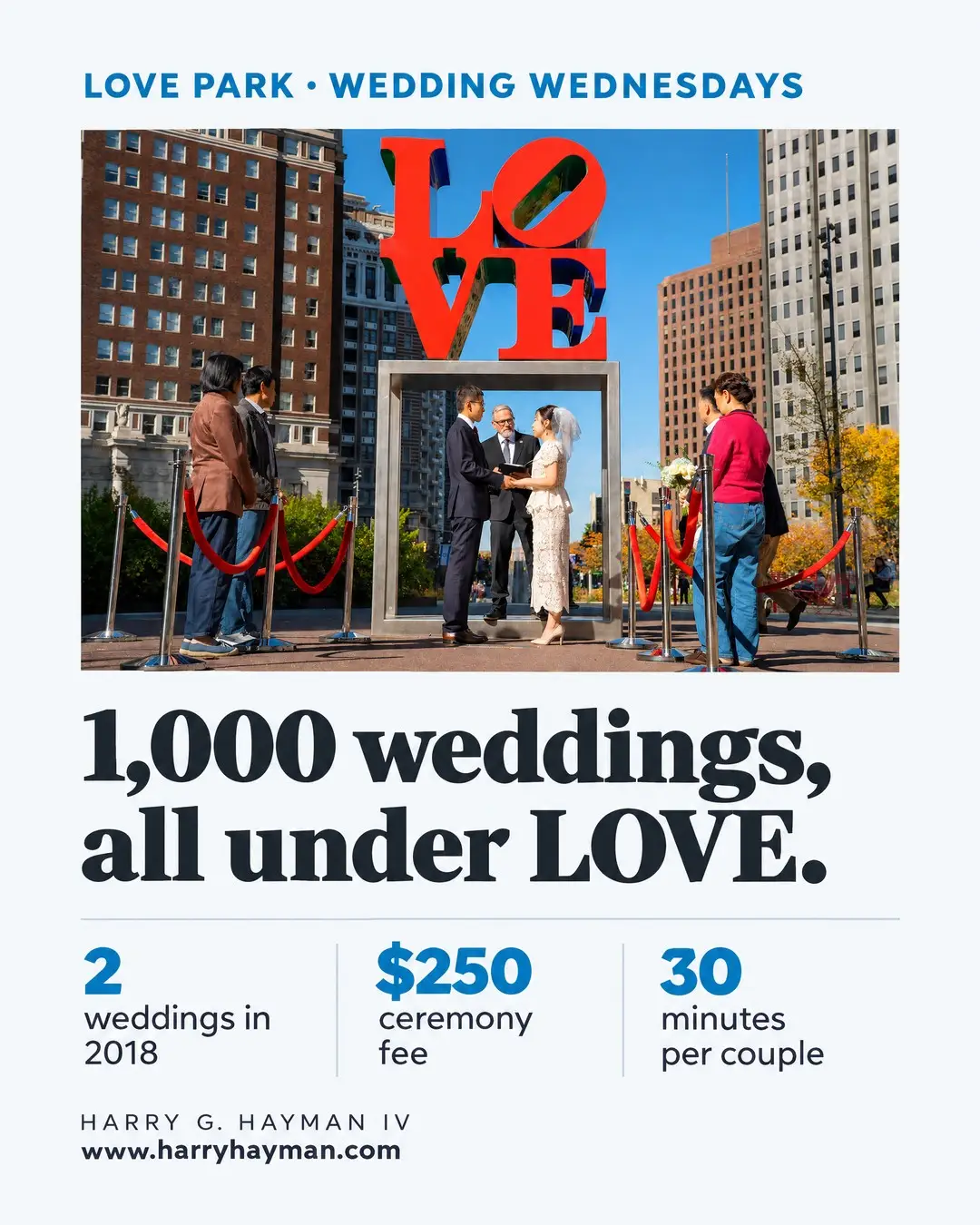
Two weddings. That is how Wedding Wednesdays at LOVE Park began in 2018, according to NBC10. On Wednesday, November 4, 2026, eight couples said their vows under Robert Indiana’s sculpture, and the count passed its 1,000th ceremony. I keep turning the arithmetic over. Nobody built a wedding venue here. The city took a plaza it had just rebuilt, roped off a square of pavement in red velvet, found an officiant, set a fee of $250 and opened a calendar. Eight years later a thousand couples have stood in that square while office workers, tourists and the occasional cyclist went past shouting congratulations. That is the part I want to understand, because it is a small program with a big lesson about how a city can get its people to love a public space again.
What $250 buys you under LOVE
The rules sit on one plain page at phila.gov, and they are refreshingly short. Philadelphia Parks and Recreation gives you a half hour slot, an area of 20 by 20 feet in front of the sculpture, separated from the rest of the park by red velvet ropes, and an officiant from Journeys of the Heart. You can bring your own officiant instead, but the fee stays the same. The ceremony happens rain or shine, and if it rains there are umbrellas for the couple.
The fee is $250, paid to the Fairmount Park Conservancy, and it sits on top of the marriage license, which Billy Penn puts at $90. Ceremonies run on Wednesdays from March through November at the corner of the park closest to City Hall. You pick a slot on the city’s calendar, email the park to hold it, pay the Conservancy, and talk the details through with your officiant: the procession, the guests, the vows, the rings. Then you show up half an hour early with your license.
Billy Penn set that price next to The Knot’s latest wedding study, which puts the median American wedding at $24,000 in 2025. The paper was careful to say the numbers are not directly comparable, and they are not. A half hour on a plaza is not a reception. Still, I think the gap says something about how many people simply want the vows, the place and their people, without the rest.
It started with two
In August 2018, WHYY reported the city’s plan. Starting that October, couples could marry in front of the sculpture on two Wednesdays a month, in a half hour ceremony inside the same 20 by 20 foot square. The ceremony fee then was $50. LOVE itself had only been back on the plaza for about six months.
PhillyVoice describes those first ceremonies as a promotional activity for a park that reopened in 2018 after a $26 million renovation, and Billy Penn calls it a celebration meant for a single occasion that grew into a weekly tradition. Two weddings that first year. Then a weekly fixture. Then a thousand.
I like knowing the sculpture’s own story while I think about this. The Association for Public Art tells it well. Indiana lent the city LOVE for the bicentennial in 1976, and after two years his gallery had it trucked to New York when a sale fell through. There was an uproar, and F. Eugene Dixon, then chairman of the Philadelphia Art Commission, bought it and gave it to Philadelphia. When it came back in February 2018 after conservation, it wore its original red, green and purple, not the blue that earlier restorations had painted on by mistake. So the backdrop for a thousand weddings is a sculpture this city nearly lost once. That feels right to me.
A rebuilt park needed a reason to be loved
Andrew Emma, LOVE Park’s manager, told Billy Penn the weddings helped give the renovated park a new identity after its redesign drew criticism at first. His read on who comes is plain: “A lot of it is folks that would probably be doing City Hall weddings, and I think the option to go outside and do it with such an iconic sculpture is a really amazing plus.” He estimates that tens of thousands of guests have watched friends and relatives marry there over the eight years.
Here is what I find quietly smart about it. The money from the ceremonies goes back into LOVE Park and pays the officiants, Billy Penn reports. So the program brings people to the plaza, gives them a day they will remember there, and covers part of its own cost while doing it. In hospitality we talk about giving people a reason to come back. A wedding is about the strongest reason I can think of. Every one of those couples now has a photo under LOVE, and so do the people who came to watch them.
The setting is the point, too. Billy Penn’s account opens on the honking, the foot traffic and the cyclist who shouts congratulations, and says that for the couples it is part of the charm. In July, Emma told PhillyVoice the ceremonies are “a very Philly thing to do,” and that the noise of the city around them is “99% positive.” I agree with him. We are a city that yells at strangers, and on a Wednesday under LOVE we yell good things.
One hundred guests, and the teachers who set the limit
Guest lists are capped at 100. PhillyVoice reports that a park official traced the rule to a wedding several years ago where two teachers married and brought their entire classes, and about 300 people turned up. It is a funny story, and then I thought about it again. Those two teachers did not break the program. They proved the demand. A rule like that is what success looks like when it outgrows a 20 by 20 foot square.
The couples come for all kinds of reasons, Billy Penn found. Some need a legal ceremony before a bigger party somewhere else. Some want something small with a few friends and relatives. Some are renewing vows after decades together. On the milestone day, the second wedding drew a crowd of about 80 people.
Then there is Susan Harte, an officiant with Journeys of the Heart. She estimates she has personally married about a third of the 1,000 couples, and she has helped coordinate nearly all of them. She gets to know couples beforehand, sometimes by phone or Zoom, learning how they met and why they chose this spot. Her line to them is one I will remember: “I always say to our couples that they come here to publicly affirm their love, and I challenge them to find a more public place than right here in the middle of the city of love under the shadow of love itself.” About a third of a thousand weddings, by one person. That is a career inside a public program that most of us walk past without noticing.
What other places could borrow from it
I do not think the lesson here is about weddings. I think it is about what happens when a city treats a landmark as something people can use, not just photograph. The pieces are simple. A place everyone already knows. A fee small enough that nobody is priced out and big enough to help pay for the park. A partner who handles the officiants. A conservancy that collects the money. And rules that protect the moment: a rope, a half hour, a guest limit that came from real life.
The city’s own page already notes that you can marry or take wedding photos at other Parks and Recreation venues, so the idea is not limited to one plaza. I keep asking myself which other Philadelphia places could carry a small, cheap, public ritual of their own and pay a little of their way while doing it. If you married under LOVE, or stood behind the rope while a friend did, I would love to hear what that afternoon felt like. And if you are thinking about it, the city says the full Wedding Wednesday calendar opens on Valentine’s Day.
You can see the milestone day the way the city saw it in Philadelphia Parks and Recreation’s photo album from November 4, and the program itself is run with Journeys of the Heart.
About the Author
Harry Hayman is a Philadelphia-based entrepreneur, music producer, and cultural advocate. Through his work with the Feed Philly Coalition, he explores and documents the creative, culinary, and civic life of a city he believes is one of the most inspired places in America.
Sources and references
- City of Philadelphia: Get married in LOVE Park (Wedding Wednesdays)
- Billy Penn at WHYY: Philly’s LOVE Park celebrates 1,000 Wedding Wednesday ceremonies (Nov 4, 2026)
- NBC10 Philadelphia: Philadelphia’s LOVE Park reaches milestone with 1,000th wedding (Nov 5, 2026)
- PhillyVoice: Nearly 1,000 couples have exchanged vows in LOVE Park since 2018 (Jul 29, 2026)
- WHYY: Starting this fall, LOVE Park will be open for wedding ceremonies (Aug 16, 2018)
- Association for Public Art: LOVE by Robert Indiana
- Fairmount Park Conservancy
- The Knot Real Weddings Study 2026 data read out
- Journeys of the Heart
- Philadelphia Parks and Recreation on Flickr: 26.11.04 Wedding Wednesday in Love Park, photos by Joe O’Connor, Public Domain Mark. The poster at the top of this page is a designed graphic built from one of these photographs.