Immanuel Wilkins Puts a Chef on the Bandstand
Upper Darby saxophonist Immanuel Wilkins, the youngest 2026 MacArthur Fellow, cooks stew on stage at Blues Blood shows. A Philadelphia idea worth stealing.
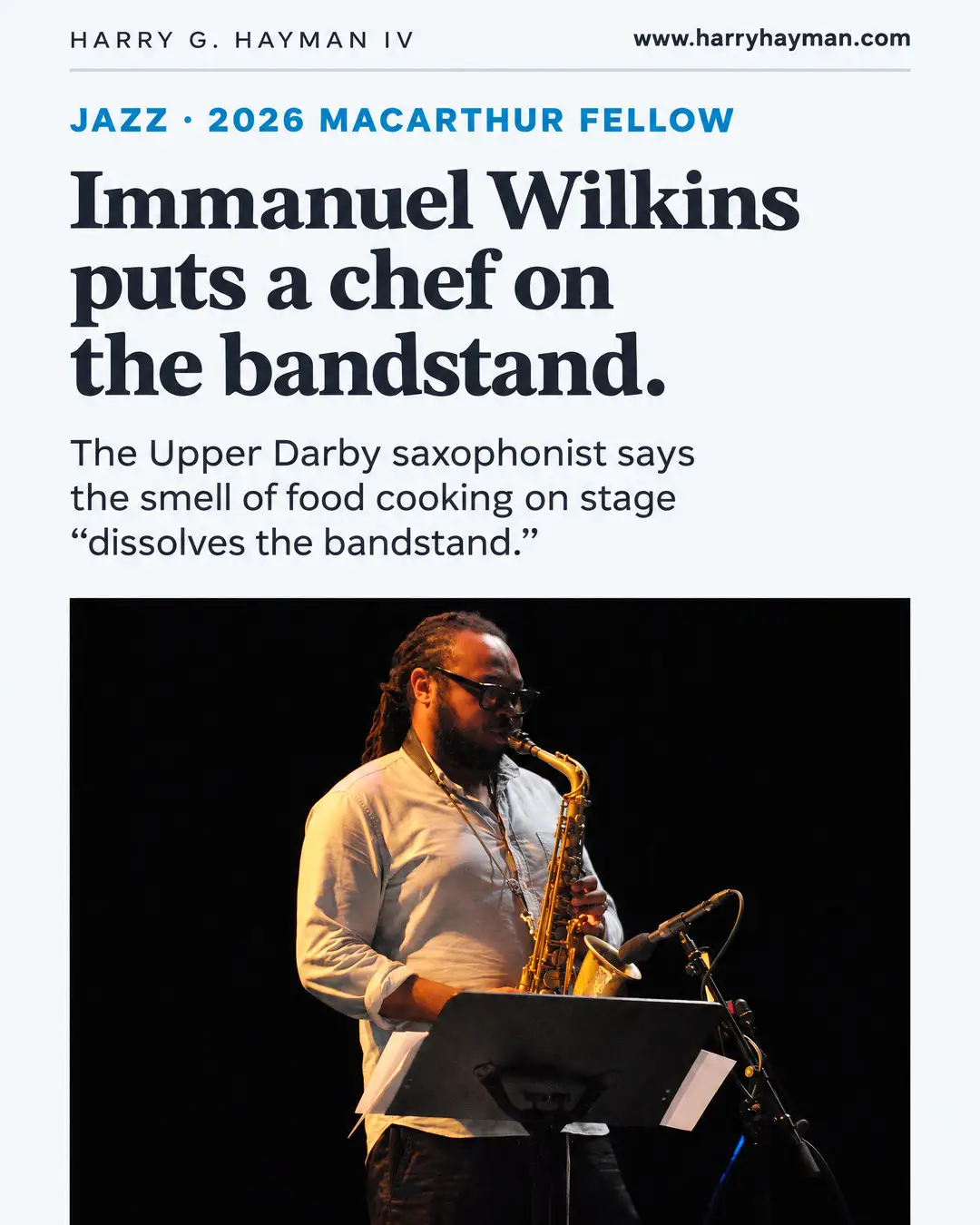
Somewhere behind the saxophone, a knife is working through onions on a cutting board. A pot is coming up to heat. The band is playing, and the smell of stew is drifting out over the first rows. I’m Harry Hayman, and I have spent most of my working life in rooms where a kitchen and a bandstand share the same air, so when I read that Immanuel Wilkins puts a chef on stage during his Blues Blood performances, I stopped what I was doing and read it twice. Wilkins grew up in Upper Darby, learned his craft in Philadelphia programs as a teenager, and on September 29 was named a 2026 MacArthur Fellow. He is 29, the youngest person in this year’s class. And the idea he brought to the stage is one I think our city should take seriously.
A Pot of Stew in the Middle of the Music
The MacArthur Foundation’s page on Wilkins puts it plainly: for several live performances of the album Blues Blood, he and his ensemble were joined by a chef who prepared a meal on stage. The audience heard the chopping. They smelled the cooking. It was part of the piece, not a reception before it.
This goes back to the first staging. When Blues Blood premiered at Roulette in Brooklyn on March 27, 2021, the personnel list ran saxophone, piano, bass, drums, three voices, and one more line: Sekai Abeni, cooking. I love that credit. A cook listed with the band, same font, same page.
It came back in 2025. The Philadelphia Inquirer’s Shaun Brady reported that in performances of Blues Blood that year, a chef prepared an Afro Caribbean stew live on stage. Not every show. Several. That matters to me, because it tells me this was a choice he kept making, not a stunt he tried once.
Why Food Belongs in This Piece
It would be easy to read this as a gimmick. It is not, and Wilkins explained why when he spoke with Joel Rose on NPR’s All Things Considered on October 10. Blues Blood deals with ancestral memory and with historical violence against Black people. He told Rose he wanted to write about the things that get passed down through the bloodline without any physical form, thinking of the Africans who could carry almost nothing with them across the Atlantic.
Then he said this: “And I think about food as another one of those kind of immaterial archives and one of those cultural heirlooms that gets passed down generationally.”
An archive you can smell. A recipe is exactly that. The recipes that matter most in most families were never written down; you learn them by standing next to someone at the stove. Wilkins took that kind of knowledge and put it under the stage lights, next to the music that carries the same weight.
What the Smell Does to a Room
Rose asked him what it was actually like on stage. “Really strange,” Wilkins said. When he is that close to food, he is usually in his mother’s kitchen or cooking at home. Then he described what changed:
“And that kind of multisensorial experience of, you know, being able to smell food being made on stage, I think it really, like, dissolves the bandstand in a beautiful way where it’s not about performance anymore.”
Dissolves the bandstand. I keep coming back to that phrase. Every club, every concert hall, has a line between the people making the music and the people receiving it. Usually that line is a riser, a few feet of light, a velvet rope of habit. Wilkins found that a pot of stew could erase it. He said the band played differently, that it felt like no one was watching, like being with friends.
He went further. “There’s something about food that kind of removes the veil in a lot of ways,” he told NPR. He talked about sharing plates at dinner, where the question stops being whether you have enough and becomes whether the person next to you has enough, “or who wants the last bite.” And he connected that courtesy straight to improvising: did the pianist get enough time to solo, has the bass player, the quietest instrument on the stage, had a turn yet.
That is the best description of a good band I have heard in a long time. It is also the best description of a good dinner table. I don’t think he means those as two separate ideas.
Philadelphia Made Him, and He Keeps Building Here
Wilkins lives in New York now. But the record on where he came from is clear. The Inquirer calls him an Upper Darby native. Nate Chinen at WRTI wrote that in 2011, in his early teens, he was taking part in programs at Settlement Music School and the Philadelphia Clef Club of Jazz and Performing Arts under the guidance of Lovett Hines. The MacArthur page lists the Clef Club and then a degree from Juilliard in 2019. And the Roulette biography says he honed his playing in the church.
Church, community music school, Clef Club. That is a Philadelphia pipeline, and it worked. I want everyone who has ever written a check to either of those programs to know that one of their kids just became the youngest 2026 MacArthur Fellow.
He keeps coming back, too. WRTI notes he presented Blues Blood at the Penn Museum in 2025. This past May, the Inquirer reported, he and the Brooklyn artist Rachael Elliott built a playground inside the Power Market, a former PECO station on West Oxford Street, for a piece called RECESS. The playground was the set and the score at the same time: an industrial jungle gym of pipes and ramps that served as both the environment and the graphic score for his improvised composition. And on October 18, according to the WHYY lineup for Philly Music Fest, the Immanuel Wilkins Quartet played Solar Myth on the festival’s last night.
What $800,000 Buys an Artist Like This
The MacArthur Fellowship is an $800,000 award with no strings attached. When Rose asked what he hoped to do with it, Wilkins did not talk about recording sessions. He talked about building things.
He makes graphic scores, he said, some on paper and some as sculpture. The playground was about 20 feet by 20 feet. His team has also been making megaphones about 6 feet by 12 feet. “And so, you know, those things cost a whole lot of money to make,” he said.
I appreciate the honesty in that. People picture a genius grant as freedom from worry. For an artist who designs whole environments, a lot of it is lumber, steel, transport and storage. The art is in the room, and the room costs money. Anyone who has ever produced a show knows exactly what he means.
The Menu Is Part of the Score
Here is where I land, and it is a question for Philadelphia more than a conclusion. We are a food city. We are a jazz city. We have more empty industrial rooms than we know what to do with, old substations and warehouses and mill floors waiting for a second life, and the Power Market just proved one of them can hold a piece of music. We also have cooks whose family recipes carry exactly the kind of memory Wilkins is writing about.
So why is the kitchen always behind a wall? Why does the meal happen before the show, or after it, but almost never inside it? I am not suggesting every concert needs a stove. I am suggesting that a few of ours could treat the menu as part of the score, with the cook credited on the program the way Sekai Abeni was credited in 2021. Settlement and the Clef Club already train the players. Our restaurants already train the cooks. The missing piece is a presenter willing to put them on the same stage and let the smell do what Wilkins says it does.
Who in this city wants to try that first?
Sources and references
- MacArthur Foundation: Immanuel Wilkins, Class of 2026
- MacArthur Foundation: About the MacArthur Fellows Program
- NPR All Things Considered: Genius grant winner Immanuel Wilkins explains how he weaves Black history into his music (Oct. 10, 2026)
- Roulette: Immanuel Wilkins, Blues Blood / Black Future (March 27, 2021)
- The Philadelphia Inquirer: Shaun Brady on Immanuel Wilkins, Odean Pope and RECESS (May 1, 2026)
- WRTI: Saxophonist Immanuel Wilkins, Philly’s own, is a MacArthur Fellow (Sept. 29, 2026)
- WHYY: Philly Music Fest 2026 lineup
- Wikimedia Commons: Immanuel Wilkins at Moldejazz 2024, photo by Løken, CC BY 4.0

The poster at the top of this page is a designed graphic built from the photograph of Immanuel Wilkins at Moldejazz 2024 by Løken, licensed under CC BY 4.0.