Philadelphia's H.O.M.E. Plan: $278 Million Approved, $38 Million Spent
Philadelphia approved $278 million for the first phase of H.O.M.E. and has spent $38 million. Why bond money lags, and what to watch next.
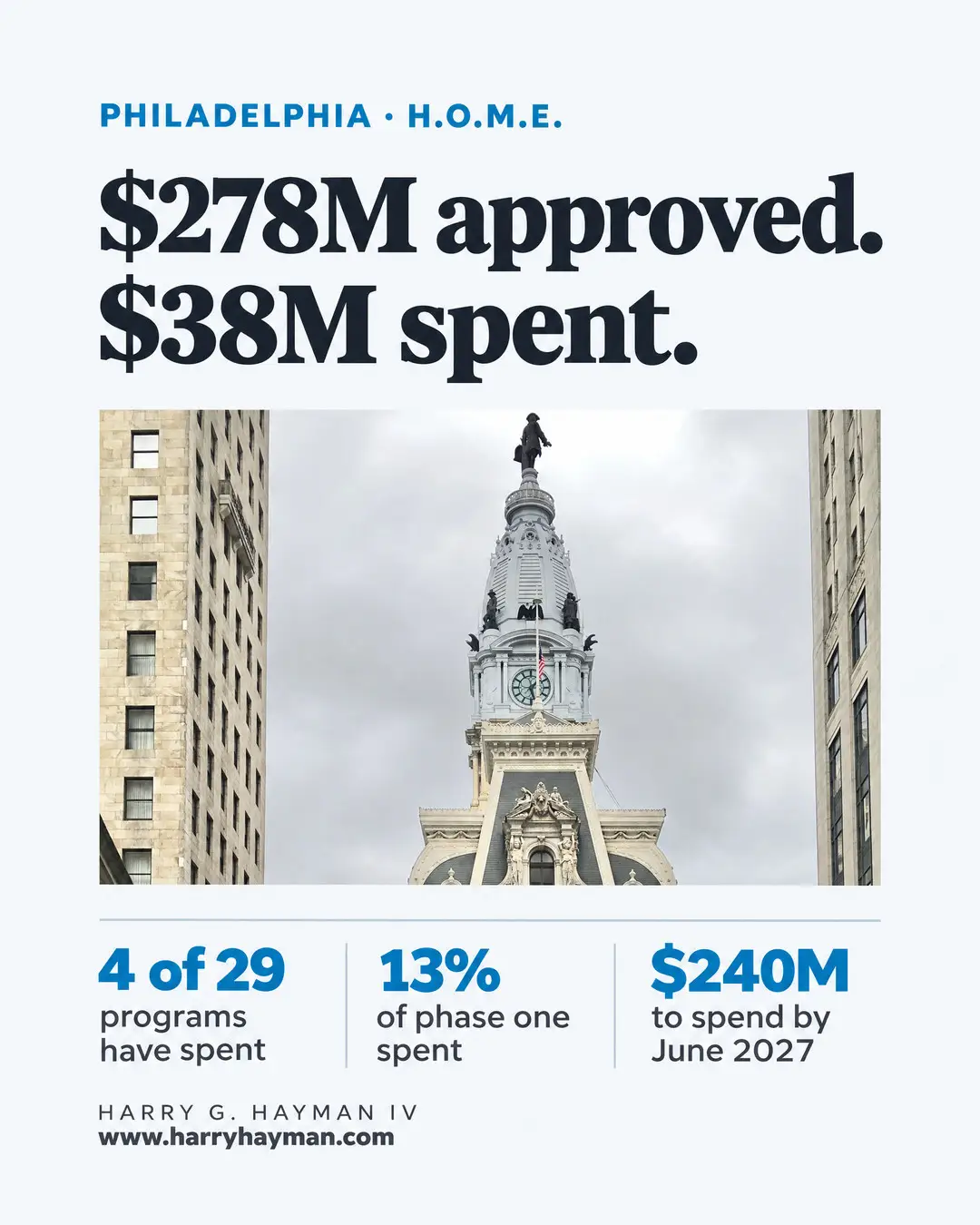
City Council approved $277.5 million for the first phase of H.O.M.E., Philadelphia’s housing plan, in January 2026. By September 30, the city had spent $37.7 million of it. Round those and you get the line everyone is repeating: $278 million approved, $38 million spent. The City Controller’s office counted it, and its press release puts the share at slightly more than 13 percent of what Council approved for the first 16 months. Four of the 29 programs in the plan have recorded any spending so far. I’m Harry Hayman, and I read a number like that the way I read a kitchen ticket rail at 6:15 on a Saturday. Approved is not spent. Spent is not built. And none of that, by itself, is a scandal. It’s how borrowed money moves through a city, and it’s worth understanding before anyone starts yelling.
What the Controller actually counted
The report is short, which I appreciate. H.O.M.E. stands for Housing Opportunities Made Easy, and the city describes it as a $2 billion push to create and preserve 30,000 homes. Mayor Parker unveiled the plan in March 2025. The first phase runs from March 2026 through June 30, 2027, so September was roughly the halfway mark, with nine months left in the budgeted year.
Here is where the $37.7 million went, according to the Controller. Basic Systems Repair, which fixes heating, plumbing, electrical and roofing emergencies in owner occupied homes, spent $25,955,912. Adaptive Modification, which pays for accessibility changes for people with physical disabilities, spent $6,512,928. Eviction Diversion, which helps landlords and tenants settle disputes before court, spent $5,118,518. Built to Last, a deeper repair program with energy and healthy housing work, spent $64,274.
Now the detail that changed how I read the whole thing. All four of those programs existed before H.O.M.E. and were reclassified under it. They already had staff, contractors, forms and waiting lists. So of course they spent first. The other 25 are mostly new programs, according to the Inquirer’s reporting, and the Controller found no expenditures for them yet. A brand new program has to be designed, staffed, put out to bid and opened to applicants before a single dollar leaves the building.
And where the dollars did leave, they went where the need is. The Controller’s map shows $3.5 million in 19140, $3.1 million in 19143, $2.4 million in 19132, $2.3 million in 19120 and $2.1 million in 19124. Zero in 19103 and 19118. Hunting Park and Kingsessing, not Rittenhouse and Chestnut Hill. That part I like a lot.
Why bond money is slow almost every time
Most of H.O.M.E. runs on borrowed money. The Inquirer reports the plan is primarily funded by $800 million in city bonds, with the first of two planned $400 million issues sold in early 2026. A bond is a promise to spend on a schedule. Its whole point is speed: you borrow now so the repairs and the new homes happen now, instead of waiting a decade for cash to pile up.
Philadelphia has run this play before, and the Inquirer said so. Mayor Street’s Neighborhood Transformation Initiative and Mayor Kenney’s Rebuild both borrowed, and both spent slower than planned, for different reasons.
The Neighborhood Transformation Initiative started in 2001 on nearly $300 million in bonds. WHYY’s look back in 2015 found it had run for almost 15 years, and its last $37 million had to be spent by March 2016 or go back to bondholders. Fifteen years. For money borrowed to move fast.
Rebuild, the parks, rec centers and libraries program, is the more recent example. In October 2024 the Controller reported that Rebuild had secured $355 million and spent about $150 million, less than half. Two months later the office counted 23 of 72 proposed projects complete since 2018. Those are real playgrounds and real rec centers, and they took years.
So the pattern isn’t new. Borrowing is the fast part. Spending is the slow part. Every time.
The housing office has a point
I want to give the other side its full weight, because it’s a fair side. Angela Brooks, the city’s Chief Housing and Urban Development Officer, told the Inquirer that “The programs the Controller reviewed are on pace to use their full budgets and then some,” because demand for home repairs and accessibility work is strong. She also said, “Based on current projections, we expect to spend at a faster pace for the rest of the fiscal year.” And she made the point I keep coming back to: the first phase funds new construction, preservation, homeownership and land work, and that work is “designed to spend on project milestones, not on a calendar.”
That’s true. Nobody pays a builder for a building that isn’t framed yet. You pay at the foundation, at the frame, at the roof. A construction budget that looks 13 percent spent at the halfway point of a year can be perfectly healthy if the big milestones fall in the spring.
The Controller isn’t calling the plan a failure either. Christy Brady told the Inquirer, “We do want to see more spending, because it is important. It is a great program.” Her release says the monitoring is about keeping the initiative financially sustainable while helping residents stay in their homes. Both of these things can be true at once. The repair programs are moving. The new programs haven’t started spending. That’s the actual story.
Why the lag still costs something
Here is the part that keeps me from shrugging. The Inquirer makes the point plainly: as delays in spending bond proceeds drag on, the real value of the borrowed money goes down because of inflation. A dollar borrowed in early 2026 buys less lumber, less copper pipe and fewer hours of a roofer’s time in 2028. The interest bill doesn’t shrink while you wait.
The money doesn’t vanish, to be clear. The Inquirer reports that anything unspent at the end of June stays available for H.O.M.E. in the next fiscal year. So the remaining $240 million is budgeted to move by June 30, 2027, and it rolls forward if it doesn’t. Good. But rolling forward is exactly how a three year plan becomes a fifteen year one.
And then there’s the scoreboard. The goal is 30,000 homes. The city’s Philly Stat 360 site showed 16,394 units built or preserved under H.O.M.E. as of late October, according to the Inquirer, but the administration didn’t say how many of those came directly from H.O.M.E. dollars. I’d love to know. That number is the one that matters to a family in 19140 with a furnace that quit last winter.
A milestone date for every program
So what would I actually ask for? Not a hearing. Not a headline. A calendar.
Brooks says the work spends on milestones. Great. Publish them. For each of the 25 programs that hasn’t spent yet, give us the date it opens to applicants, the date the first contract is signed and the date the first dollar goes out the door. One page. Updated every quarter.
Philadelphia already has a model for this. Rebuild files regular progress reports to City Council that list sites under construction and sites finished. It isn’t glamorous. It works, because anybody can open the document and see what moved. Eva Gladstein, who ran the Neighborhood Transformation Initiative late in Street’s term, told WHYY that success was never clearly defined for the public. A milestone sheet is how you define it before the money is spent, not fifteen years after.
I’m optimistic about H.O.M.E. The repair money is going exactly where it should, into rowhouses in neighborhoods that have waited a long time. The borrowing was smart. Now the city has to prove the speed it borrowed for.
The next thing I’m watching is the Controller’s next quarterly count. If more of those 25 programs show their first dollar by then, great. If not, I want to see the milestone dates, and I want them on one page.
Sources and references
- City Controller, Municipal Money Matters, October 2026: Philadelphia’s H.O.M.E. Spending (PDF): $277.5 million approved, $37,651,632 spent as of September 30, 2026, the four programs and the ZIP code map.
- City Controller press release, October 27, 2026: 4 of 29 programs, slightly more than 13 percent, the 16 month first phase.
- The Philadelphia Inquirer, October 27, 2026: the bonds, Angela Brooks’s statement, Christy Brady’s comments, inflation, rollover, the NTI and Rebuild comparison and the Philly Stat 360 count.
- City of Philadelphia, H.O.M.E. initiative: the plan and its 30,000 home goal.
- City of Philadelphia, March 25, 2025 release: the $2 billion plan unveiled.
- WHYY, July 20, 2015: the Neighborhood Transformation Initiative’s 15 years and its last $37 million.
- City Controller, October 1, 2024: Rebuild funding and spending.
- City Controller, December 18, 2024: Rebuild projects completed.
- Rebuild progress report to City Council, July 2026 (PDF): the reporting model.
- Photograph: Philadelphia City Hall from South Broad Street, Bmzuckerman, December 21, 2018, licensed CC BY 4.0. The poster at the top of this page is a designed graphic built from this photograph.
