How Pennsylvania Financed 88 Grocery Stores Without Owning One
Philadelphia is debating a city supported grocery store. I look at the 2004 Pennsylvania program that financed 88 stores and never owned one.
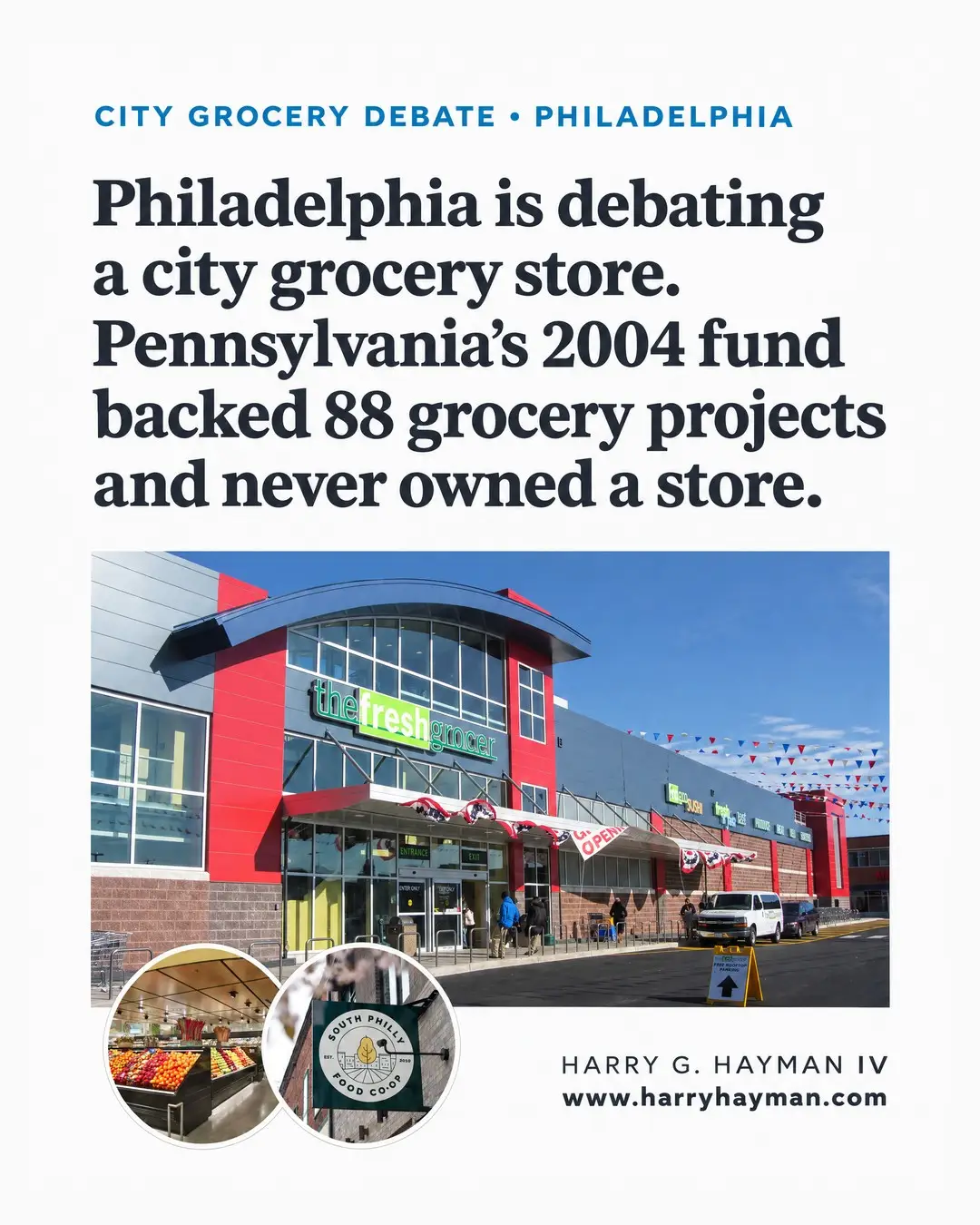
Everybody seems to be asking the same question this fall: should a city run its own grocery store? Philadelphia is asking it too. Council President Kenyatta Johnson’s Philly Food Affordability Act calls for City Council hearings on whether the city should back a grocery store of its own. I think that’s a fair question to debate. But I keep wanting to raise my hand and say: Pennsylvania already ran a very large experiment on this, and it started here, in 2004.
It was called the Fresh Food Financing Initiative. The state put up $30 million. The money went into grants and loans for private grocers willing to open in neighborhoods the industry had written off. The state never owned a single store. And by The Food Trust’s count, the program approved 88 projects. That’s the story I want to walk through, in order, because I think the order matters.
Where it started: a map and a Council hearing
In 2001, The Food Trust published a report that mapped supermarket access in Philadelphia. The finding was blunt. The city’s lower income neighborhoods had the fewest supermarkets and the highest rates of diet related deaths. According to The Food Trust’s history of the program, that report led to City Council hearings, and Council asked The Food Trust to pull together a task force of people from public health, economic development and the grocery business itself.
I love that detail. The answer did not come from one agency or one big idea. It came from a room full of people whose job was to name the challenges of running a supermarket in those neighborhoods and propose policy answers. With the support of State Representative Dwight Evans, the state then funded what they proposed.
So the first lesson is almost boring. Philadelphia’s Council asked the right question twenty five years ago, and the answer came out of hearings. That’s worth remembering now that Council is holding hearings again.
How the money actually worked
Here’s the part I find most interesting as someone who has spent a lot of years around restaurants and food businesses. The state did not try to become a grocer. It put up the seed money, $30 million over three years, and let two Philadelphia organizations do what they were good at. The Reinvestment Fund, a community development lender, handled the financing. The Food Trust handled outreach, site eligibility and the community side.
The $30 million was never meant to pay for the stores by itself. A 2016 working paper published by the Federal Reserve Bank of San Francisco says the program drew in nearly $150 million from other sources of capital, building a fund of grants and low interest loans. Do the arithmetic and every state dollar pulled in roughly five more dollars from other sources. That’s the whole trick. State money went in first, other capital followed, and private operators ran the stores.
The results, as The Food Trust reports them: 88 projects approved for funding, 1.67 million square feet of retail space, 5,000 jobs created or retained, and healthier food made easier to reach for an estimated 400,000 Pennsylvanians who had little of it nearby. Harvard’s Kennedy School named it one of the top government innovations in the country.
Financing, not owning. I say that as a description, not as a jab at anyone. It’s simply how this model was built.
One store on North Broad Street
Numbers like 88 projects can float away from you, so let me put one on the map. In December 2009, The Fresh Grocer opened at Progress Plaza on North Broad Street. The Inquirer reported that the store filled a gap left when the plaza’s last supermarket closed in 1998, and that 73 percent of its employees came from within two miles of the plaza. Progress Plaza is the nation’s oldest African American owned and developed shopping center, which makes the story even richer.
WHYY reported that the store and the Progress Trust, which owns the site, received $1 million in grant support from the Fresh Food Financing Initiative. One million dollars of public grant money, a private grocer running the aisles, a Black owned shopping center getting its anchor back, and neighbors getting jobs. Eleven years without a supermarket, and then one opens. That’s what the model looks like on a street you can walk down.
That’s the photograph at the top of this page. The two small circles show the produce floor inside that store and the sign of the South Philly Food Co-op, which the program funded much more recently.
It never ended, and the federal government copied it
You’ll sometimes read that the Pennsylvania program wrapped up once its first money was spent. The full story is better. The Food Trust says the program was recapitalized in 2018 by the state Department of Community and Economic Development, and its project page counts 78 healthy food retail projects funded since 2018. Those include the South Philly Food Co-op and the Weavers Way Co-op store in Germantown, which opened in May 2024 with help from the program’s predevelopment funds. Applications are expected to reopen in 2027.
There’s also a second state program with the same name, which confuses everybody, me included. The Pennsylvania Department of Agriculture runs its own Fresh Food Financing Initiative, which The Food Trust notes was relaunched in 2024 with a $4 million investment. The two are managed separately, with different rules. Same idea, two doors.
And the idea traveled. The same Federal Reserve working paper traces how programs “following the lead” of the Pennsylvania architects emerged across the country, including the federal Healthy Food Financing Initiative. In April 2026, Reinvestment Fund announced $16.5 million in awards to 62 food retail and supply chain projects in 39 states through the federal program’s 2024 and 2025 rounds: $9 million in grants, $1.5 million in technical assistance and $6 million in loans. A Philadelphia idea, run by a Philadelphia lender, now funding food retail in 39 states.
The honest limit: a store is not a diet
I don’t want to oversell this, because the research doesn’t. A Health Affairs study of a new Philadelphia supermarket opened under the Fresh Food Financing Initiative found that residents felt their food access had improved, but it did not find changes in reported fruit and vegetable intake or body mass index. The San Francisco Fed paper says it plainly too: if new supermarkets alone are insufficient to change health behavior, program designers need to pay attention to what comes with them.
A larger national study by economists Allcott, Diamond, Dubé and colleagues went further. They estimated that giving lower income households the same stores and prices as higher income households would close only about 9 percent of the gap in healthy eating. The other 91 percent came from differences in what households choose to buy.
So what did the stores do? They brought back jobs, foot traffic, tax base and a supermarket within reach. That matters. It’s economic development and it’s dignity. But anyone who promises that one store will fix a neighborhood’s health is promising more than the evidence gives us. I’d rather say that out loud now than have someone say it at a ribbon cutting five years from now.
What I’d bring to the Council hearings
Here is where I land, and I’ll admit I’m still thinking it through. The question in front of Council, according to Council’s own announcement, is the feasibility of a city supported grocery store, and the hearings are meant to look at public and private partnerships, funding models and lessons from other cities. PhillyVoice reported that Council approved the resolutions for those hearings in October.
Good. Because the best lesson from another city may be from this one. Before anyone designs something new, I’d want the hearings to ask three things. What did 88 projects teach us about which stores survived and which ones didn’t? What would it take to put more money behind a program that already exists, already has a lender, already has a pipeline of grocers and cooperatives? And what goes into the store besides groceries, the nutrition education, the SNAP incentives, the local hiring, so the next one does better than the evidence above?
Maybe the answer is a city store somewhere. Maybe it’s a bigger version of what Pennsylvania built in 2004. I honestly don’t know yet. But I know we don’t have to start from zero. We wrote the playbook. Let’s read it before we write a new one.
Sources and references
- Philadelphia City Council: Council President Kenyatta Johnson introduces the Philly Food Affordability Act
- PhillyVoice: Council to explore creating a city run grocery store
- The Food Trust: Food For Every Child, the 2001 supermarket access report
- The Food Trust: Healthy Food Financing Initiatives and the history of the Pennsylvania program
- The Food Trust: Pennsylvania Fresh Food Financing Initiative, recapitalization and the separate Department of Agriculture program
- The Food Trust: projects funded by the Pennsylvania Fresh Food Financing Initiative since 2018
- Federal Reserve Bank of San Francisco: Taking Stock of New Supermarkets in Food Deserts (Chrisinger, 2016)
- The Philadelphia Inquirer: Fresh Grocer well received by North Philly neighbors (2009)
- WHYY: Some neighborhoods struggle to attract markets (2009)
- Reinvestment Fund: Healthy Food Financing Initiative completes its 2024 and 2025 funding cycle with $16.5 million
- Health Affairs via PubMed Central: a new neighborhood grocery store increased awareness of food access but did not alter dietary habits or obesity
- National Bureau of Economic Research: Food Deserts and the Causes of Nutritional Inequality
- Photographs: The Fresh Grocer at Progress Plaza and its produce floor, Progress Plaza; South Philly Food Co-op sign, The Food Trust. The poster at the top of this page is a designed graphic built from these photographs.