Spain Made Taking Restaurant Leftovers Home a Legal Right
Spain's Law 1/2025 gives every diner a right to take uneaten food home. What it requires, what it fines, and what Philadelphia restaurants could copy.
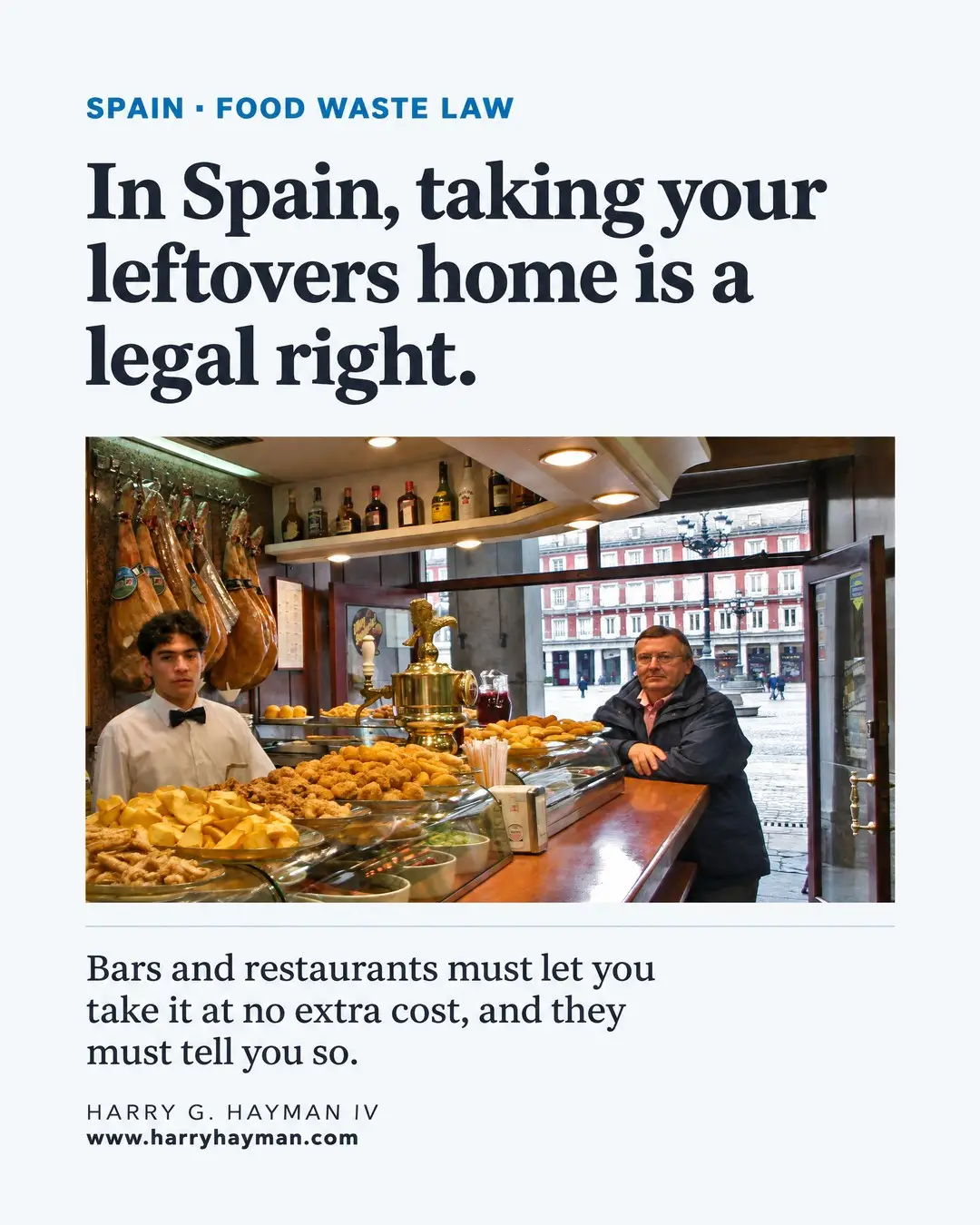
In Spain, the half plate of croquetas you leave on the bar is no longer the restaurant’s to throw away. It is yours to take home. Spain’s national food waste law, Ley 1/2025 in the Boletín Oficial del Estado, lists it among the rights of the consumer: you are entitled to carry off the food you did not eat. The bar or restaurant has to make that possible at no extra cost, and it has to tell you so, clearly and visibly, preferably on the menu. I have spent my working life in restaurants, and that second part is the one I keep turning over. Most of us already ask for the box. What Spain did was move the box from a favor you ask for to a line the house prints for you. Here is what the law actually says, what it fines, what it cannot tell us yet, and the piece of it any Philadelphia dining room could copy tomorrow morning without waiting for a single legislator.
What the law actually says
The duty sits in Article 8 of the law, the article written for hospitality businesses and other food service providers. They must make it easy for the customer to take away the food they did not eat, “sin coste adicional alguno”, without any additional cost, other than the container. Then comes the part I like best: they must inform the customer of that option “de forma clara y visible en el propio establecimiento, preferentemente en la carta o el menú.” Clearly and visibly, in the place itself, preferably on the menu.
There is one exception, and it is a sensible one. Buffets are out. The text excludes “bufé libre” and similar formats, where the amount of food is not limited. If you could take home whatever you can carry from an all you can eat line, every buffet in the country would close by summer.
The container has rules too. It has to be safe for food and reusable or easily recyclable. Single use plastic falls under Spain’s separate packaging law, which pushes businesses to cut it and to charge for it. So the honest version of “free” is this: the restaurant cannot charge you for taking your food, and the only thing that may carry a price is the box.
And then Article 10 turns the duty around and states it from the diner’s side. Among the rights of consumers, letter c: to take from hospitality businesses the food they have not eaten. That is why I keep saying right and not courtesy. It is written in the law as something you are owed.
The fines, read properly
You will see headlines about 500,000 euro fines. The numbers are real, and they need reading with some care.
Article 21 sets three bands. Minor infractions bring a warning or a fine of up to 2,000 euros. Serious ones run from 2,001 to 60,000 euros. Very serious ones run from 60,001 to 500,000 euros, and Spain’s regions may raise those ceilings in their own laws.
Now look at what Article 20 actually lists as an infraction. Not applying the waste hierarchy. Not donating unsold food that is still fit to eat when a business is obliged to and has the means. Blocking donation in a contract. Having no prevention plan when one is required. Destroying good food on purpose. The very serious band is reserved for a second serious infraction inside two years. So the 500,000 figure is the top of the law’s scale for repeat offenders on the big duties, not the price of refusing someone a box of patatas bravas. I would rather tell you that plainly than oversell it, because the real story does not need the inflation.
The bigger duties belong to the bigger players. Under Article 6, food businesses need a written plan to prevent waste and must set up agreements to donate surplus food, with donation the first destination for anything they could not avoid wasting. Microenterprises, those with fewer than ten staff and no more than two million euros in turnover, are exempt from those two duties, and so are sites of 1,300 square meters or less. The take home rule in Article 8 carries no such size exemption. The corner bar and the hotel dining room owe the diner the same thing.
When it started, and what we do not know yet
The law was signed on 1 April 2025 and published the next day. The text dates its own entry into force to 2 January 2025, and the final provision gave the obligations in Article 6 a full year from publication. The law firm Garrigues summarised it as obligations applying from 2 April 2026, and Hogan Lovells described the law that week as in force for businesses, with restaurants and bars required to let customers take leftovers away. The English language press in Spain ran it as compulsory doggie bags.
So the business duties are about seven months old. Nobody has measured what they did. The most recent national figures, from Spain’s agriculture ministry, cover 2024, the year before any of this applied. Anyone quoting a percentage cut for Spain’s law today is ahead of the data. It is simply too early to know.
Where Spain’s waste actually is
Those 2024 figures are still worth a look, because they change how I read the law. The ministry’s annual consumer waste report found that Spaniards threw away 1,125 million kilos or litres of food and drink in 2024, down 4.4 percent on 2023. Households were 97.5 percent of it, 1,097 million. Eating and drinking out of home was 28.03 million, about 2.5 percent. That survey counts what consumers throw away themselves, not what a restaurant kitchen bins, so it is not the whole picture. But it tells you something.
Here is my read. A box of leftovers moves food from the restaurant’s bin to your refrigerator, and the refrigerator is where most of the waste already happens. The law gives the food a second chance. It does not eat the food for you. If the container sits on the bottom shelf for six days, nothing has been saved, it has just been relocated. So the rule works only if the second meal happens, which is a very different kind of policy problem: part restaurant duty, part habit at home.
That is also why I think the menu line matters more than the fine. A fine changes what a business is afraid of. A printed line changes what a guest expects. Once the menu tells you the leftovers are yours, asking stops feeling like a small embarrassment, and taking the box home starts to feel normal.
What a Philadelphia dining room could copy tomorrow
This matters at home because the American number is enormous. ReFED, the national food waste nonprofit, estimates that restaurants and foodservice businesses in the United States generated 12.5 million tons of surplus food in 2024. Nearly 70 percent of it was plate waste, food that reached a guest and came back. More than 85 percent of the surplus went to landfill or was burned.
Plate waste is the part a dining room controls least and influences most. You cannot make anyone finish a plate. You can make taking it home the obvious thing to do.
None of what follows needs Harrisburg or City Council. One line on the menu, in the operator’s own voice, that says whatever you do not finish is yours to take, and the box is on us or costs whatever it costs. Servers who offer the box before they are asked, the way Article 8 asks the house to speak first. Containers that are good enough that people carry them home and actually open them the next day. And portions honest enough that the box is a bonus, not a rescue.
Would a city rule help? Maybe, someday, and I would want the Spanish numbers first. Spain will publish data for 2026 and beyond, and that is when we will learn whether the right moved anything. In the meantime the cheapest part of the law is a sentence, and any owner in this city can print it on Monday. If you run a restaurant here, I would genuinely like to know whether you would put that line on your menu, and what it would cost you to do it.
Sources and references
- Ley 1/2025, de 1 de abril, de prevención de las pérdidas y el desperdicio alimentario, BOE-A-2025-6597: the consolidated text.
- Article 8, obligations for hospitality businesses: the take home duty, the menu notice, the buffet exception and the container rules.
- Article 10, consumer rights: the right to take uneaten food from hospitality businesses.
- Article 20, infractions: what the law lists as minor, serious and very serious.
- Article 21, sanctions: the 2,000, 60,000 and 500,000 euro bands.
- Final provision on entry into force: the one year delay for the Article 6 obligations.
- Garrigues, Spain passes law to prevent food loss and waste: obligations applying from 2 April 2026, the buffet exception, the fine bands and the microenterprise exemption.
- Hogan Lovells, Spain’s new food waste law: key obligations for businesses, April 2026.
- Euro Weekly News, compulsory doggie bags: press coverage in Spain, April 2026.
- Spanish Ministry of Agriculture, Fisheries and Food, 2024 food waste figures: 1,125 million kilos or litres, 97.5 percent in households, 28.03 million out of home.
- ReFED, restaurants and foodservice: 12.5 million tons of surplus food in 2024, nearly 70 percent plate waste.
- Photograph: a tapas bar on the Plaza Mayor, Madrid, by Brian Snelson, via Wikimedia Commons, licensed CC BY 2.0. The poster at the top of this page is a designed graphic built from a crop of this photograph.
