Paris grew mushrooms in an empty car park and rented space to small businesses
A Paris company grows organic mushrooms in an empty car park and rents space to small firms. Philadelphia should study its landlord model.
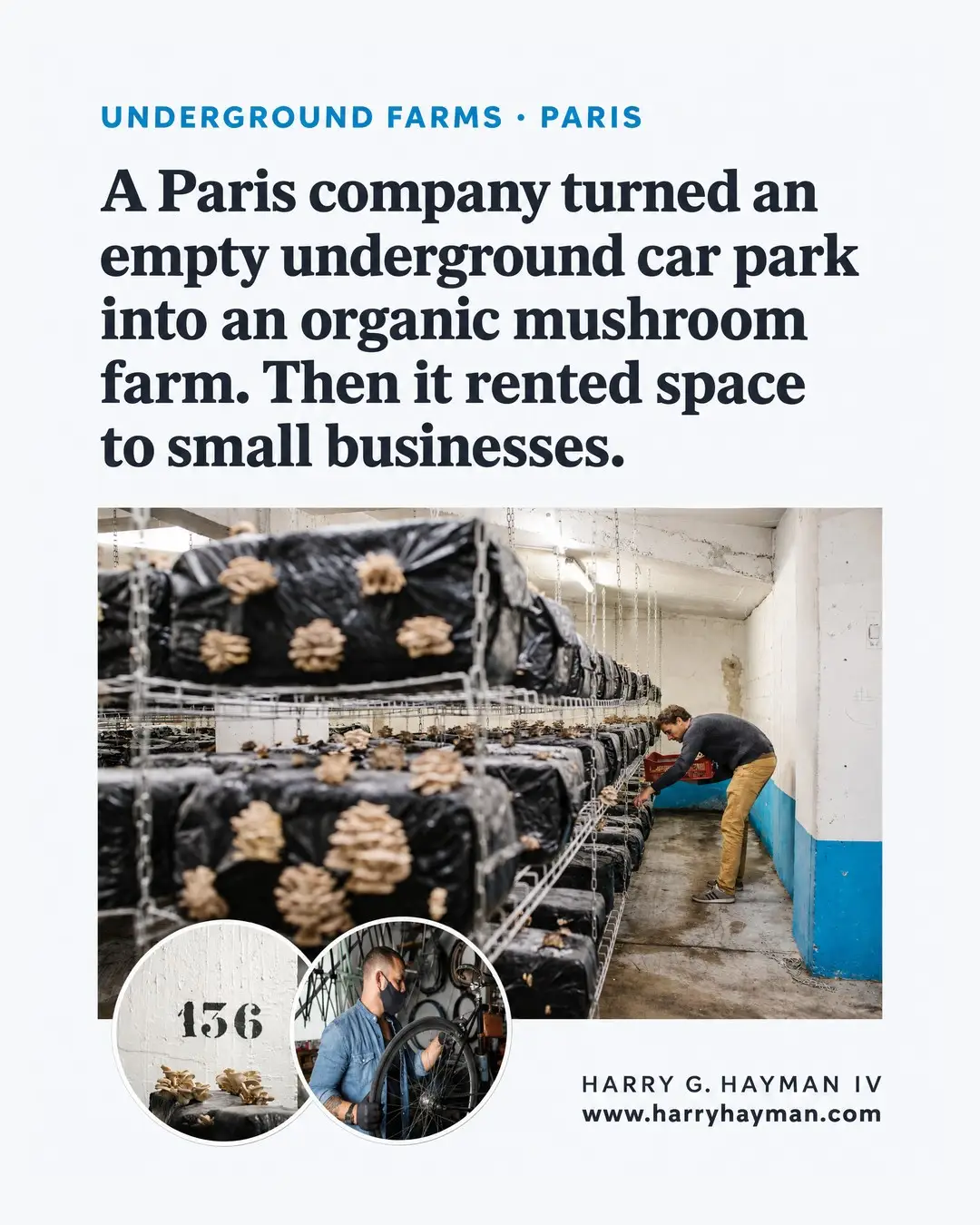
In March I wrote about dead malls and the farms that could live inside them. That post drew more response than anything I had written before, and it left an obvious question hanging: has anybody actually made this pay? Paris has an answer, and it sits two floors underground in the 18th arrondissement, in a car park that nobody wanted to park in.
The company is called Cycloponics, and the farm is called La Caverne. It grows organic oyster mushrooms, shiitake and button mushrooms in the dark, on concrete, in parking bays that still carry their painted numbers. The part that interests me most is not the mushrooms. It is the lease. Cycloponics found a way to make a building type the city had written off useful to the person who owns it, and that is the piece I think Philadelphia should study.
A car park nobody parked in
Paris built a great deal of underground parking in the 1960s and 70s. The BBC’s report from La Chapelle in north Paris put it simply: the city built too many car parks, falling car ownership left many of them standing empty, and some are finding new and surprising uses. One of the founders, Jean-Noël Gertz, has estimated that Paris alone built about six million square meters of parking, roughly 600 hectares, in an interview with France.fr. That is his estimate, and I treat it as one, but even a fraction of it is a lot of dark, dry, temperature stable floor.
La Caverne sits in the old Raymond Queneau car park, which belongs to the social housing landlord ICF Habitat La Sablière. According to the City of Paris, the site covers about 3,500 square meters and became the first urban farm in the capital to go underground. Cycloponics won a place in the city’s Parisculteurs call for projects, cleaned out the car park and moved in during 2017, and the mayor opened the farm in April 2018.
Gertz described level minus two, a few hundred meters from the ring road, where the temperature holds between 10 and 21 degrees Celsius. Oyster mushrooms grow on bags of straw that hang from racks. The customers, he said, are mainly organic shops in Paris. The farm is not open to the public, which tells you this is a business first and a showpiece second.
Why mushrooms fit a garage
Mushrooms are one of the few crops that do not need daylight. They want darkness, steady humidity and a cool, even temperature, which is close to a description of a buried concrete box. A tomato would need lamps, and lamps are where indoor farms usually lose money. Gertz was blunt about that in the same interview: growing potatoes or carrots in the capital, he said, cannot be profitable. So the company picked a crop that suits the room instead of forcing the room to suit the crop.
That choice matters to me because it is the opposite of how a lot of indoor farming pitches go. The pitch usually starts with the technology and then goes looking for a building. Cycloponics started with the building it could get cheaply, asked what would grow there without much help, and built the business around the answer. The sortiraparis visit to La Caverne describes shiitake and oyster mushrooms coming out of the same underground rooms, and calls it the largest organic urban farm in Paris.
The company also says that 80 percent of its mushrooms leave by bicycle or electric vehicle, according to its own website. When your farm is under the neighborhood it sells to, the delivery route is short.
The landlord model is the real idea
Here is the part I keep turning over. Cycloponics does not only farm the space. It rents some of it out. In the France.fr interview, Gertz said that in Paris the company used about 3,500 square meters for its own production and rented around 500 to other businesses. He called it a kind of urban tenant farming. In the car park you would find a company that packs honey, one that delivers meals to offices without a canteen, and a third that grows micro shoots. The sortiraparis piece names two of those neighbors, Wesh Grow and Aura.
Now look at it from the owner’s side. On its services page, Cycloponics speaks directly to car park owners, and the list of problems it says an empty car park brings will sound familiar to anyone who has walked past a dead mall: lost revenue, insecurity, illegal activity, squatting. The company offers to handle the feasibility study, the permits, the works and the management of the site. The owner gets a tenant who is there every day, a reason for the lights to be on, and rent from a floor that was producing nothing.
That is the same problem I described in March with shopping centers. The structure is sound, the location is fine, and the old use is gone. What is missing is an operator willing to take the whole space and make it earn. Cycloponics is that operator for car parks, and the small businesses renting space below market are part of what makes the arithmetic close.
What the company says it has built
The company now reports seven active sites in France. On its website, it says it has turned 25,000 square meters of underground car parks into urban farms, grows more than 100 metric tons of organic mushrooms a year, hosts more than 65 businesses, supports more than 150 indirect jobs and rents space for about 30 percent less than the market. It also says it employs more than twenty people directly. Those are the company’s own numbers. Nobody has audited them in public that I can find, but the shape of the business matches what the City of Paris and the BBC reported years earlier.
The model has travelled beyond Paris. In Lyon, the company says it opened La Tanière des Gones in the 8th arrondissement in 2022 on about 2,500 square meters, and added a second site in Villeurbanne in 2024. Around Bordeaux, it lists old stone caves in Floirac and a car park in Lormont, each about 3,000 square meters, run with two social housing landlords, Aquitanis and Domofrance. Notice who keeps showing up on the other side of these deals: housing landlords with buildings they need to keep safe and useful.
What I want Philadelphia to ask
I am not suggesting Philadelphia copy La Caverne bay for bay. Our garages, our codes and our landlords are different, and mushrooms will not save a block on their own. What I take from Paris is a way to frame the conversation.
When a building type stops working, we tend to ask what single new use can replace the old one. Paris asked a better question: who could run the whole space, earn from part of it and rent the rest to people who need a cheap, secure room to start something? A garage level becomes a farm and a small business incubator at the same time, and the owner stops paying to guard an empty floor.
We have underused structured parking, and we have a public housing authority, a land bank and private owners carrying space that earns little. I would like to know how many of those floors sit dark today, and what it would take for an operator to lease one, grow food on part of it and sublet the rest at a fair rate. If you manage a garage, a basement or a dead retail floor in this city, ask yourself the question Cycloponics asks its landlords: what does this empty space cost you every month, and what would you accept to let somebody make it earn?
Sources and references
- BBC News: Turning Paris’s underground car parks into mushroom farms.
- City of Paris: La Caverne grows mushrooms and endives underground.
- France.fr: interview with Jean-Noël Gertz on La Caverne.
- Sortiraparis: a visit to the largest organic urban farm in Paris.
- Cycloponics and La Caverne, company website.
- Cycloponics services for car park owners.
- Cycloponics in Lyon.
- Cycloponics around Bordeaux.
- My March post on dead malls and farms.
- Photographs: Cycloponics, La Caverne. The poster at the top of this page is a designed graphic built from this photograph.