The Netherlands Exports More Farm Goods Than Anyone but the US
The Netherlands sold 137.5 billion euros of farm goods abroad in 2025, second only to the US. What the numbers show and what Philadelphia can learn.
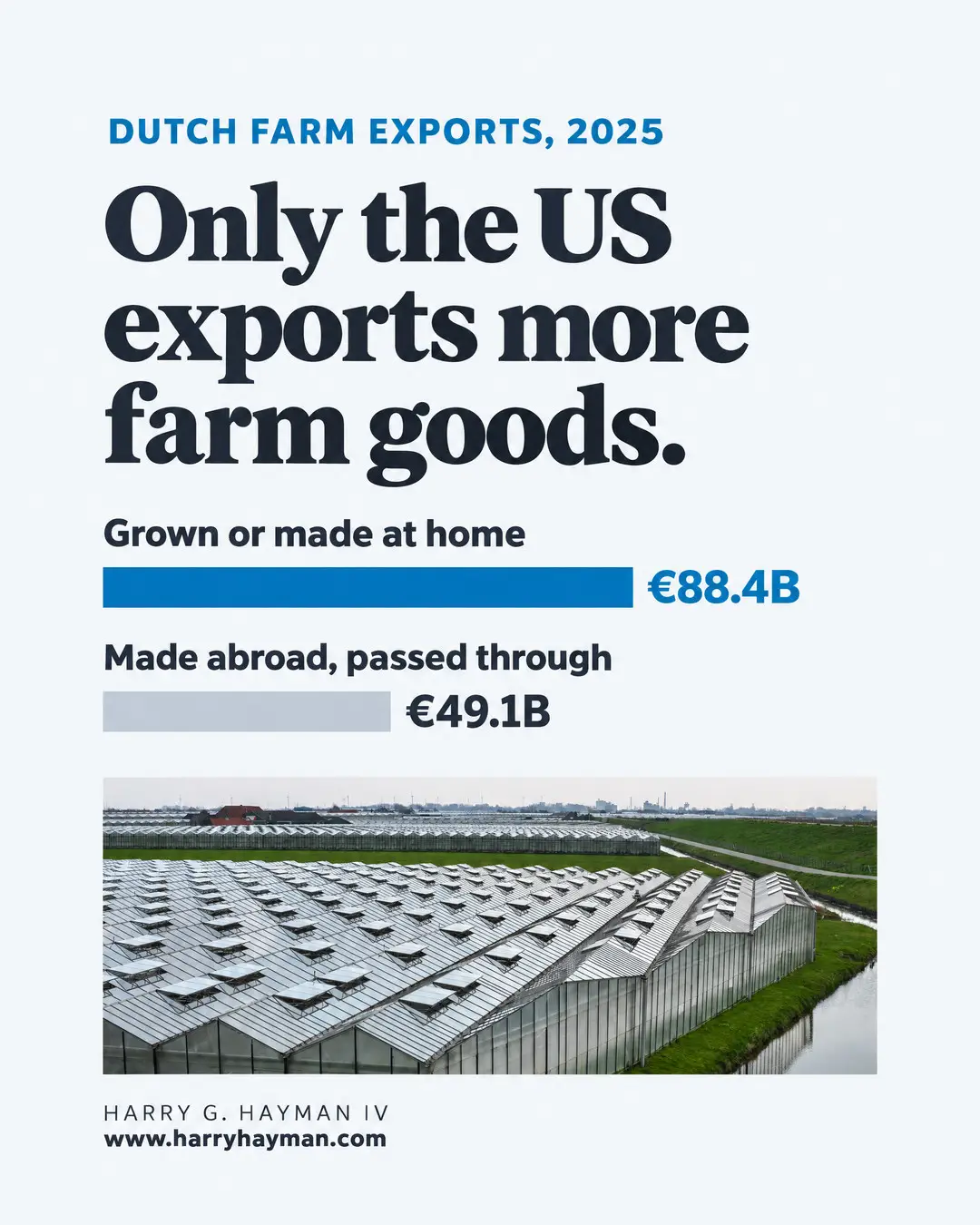
The Netherlands exported 137.5 billion euros of farm and food goods in 2025. That is the figure Statistics Netherlands (CBS) published in January, up 8.4 percent on the year before. Of that, 88.4 billion euros was grown or made in the Netherlands, and 49.1 billion was made somewhere else and passed through. I’m Harry Hayman, and I write about food, hospitality and the economy of Philadelphia, so a number like that stops me. The United States Department of Agriculture ranks the Netherlands as the second largest farm exporter in the world, after the United States. The whole country is about a third the size of Pennsylvania. I wanted to know what sits inside that number, and what it does and does not prove.
The number, and who says it ranks second
Start with the ranking, because it is the part people repeat. The USDA Foreign Agricultural Service office in The Hague wrote in its June 2026 Exporter Guide for the Netherlands that the country is “the second largest exporter of agricultural products in the world, after the United States and before Brazil and Germany.” The US International Trade Administration says the same in its Netherlands country guide on agriculture: “The Netherlands is the world’s second largest exporter of agricultural products after the United States.”
That ranking counts re-exports, goods that land in Dutch ports and leave again. Rankings that leave re-exports out can put Brazil ahead. So the honest version of the claim is the one I use: the USDA and the Trade Administration rank the Netherlands second. On their count, only the United States sells more food and farm goods abroad.
Now the size. CBS puts the total area of the Netherlands at 41,543 square kilometers, water included. The US Census Bureau puts Pennsylvania at 46,054 square miles, which is 119,280 square kilometers. Divide one by the other and you get 34.8 percent. About a third of Pennsylvania, selling more farm goods abroad than every country on earth except ours.
Grown here, made here, passed through
The split on the poster is the part I find most useful. Of the 137.5 billion euros, CBS counts 88.4 billion as goods produced in the Netherlands and 49.1 billion as re-exports. So almost two thirds of the export value was Dutch.
”Produced in the Netherlands” needs one more sentence, and Wageningen Economic Research, which built the numbers with CBS, gives it. Dutch origin means goods “produced in the Netherlands or substantially processed there, such as chocolate made from imported cocoa beans.” That is why I say grown or made. A bar of chocolate made in the Netherlands from West African beans counts as Dutch. A crate of Spanish oranges that only changes trucks there does not.
The money tells the same story more sharply. CBS estimates the Dutch economy earned over 49 billion euros from these exports in 2025. Of that, 43.5 billion came from Dutch goods and only 5.7 billion from re-exports. Re-exports are about a third of the value that crosses the border, yet they leave behind about a ninth of the earnings. Passing goods through pays for ports, trucks and warehouses. Growing and making them is where the country actually earns.
Wageningen adds a detail I did not expect. Around 72 percent of the farm goods the Netherlands imports are destined for further processing and export. The country buys raw material, processes much of it, and sells it on. That is a kitchen, not a farm stand.
Cocoa did a lot of the lifting in 2025
Here is the part a headline will skip. CBS says over two thirds of the increase in export value in 2025 came from higher prices, and the rest from higher volume. The biggest single price story was cocoa.
In the words of CBS, “a very sharp increase in the price of cocoa led to an increase in the export value of cocoa and cocoa preparations.” Cocoa butter, paste, powder and chocolate reached 12.4 billion euros, up 35 percent on 2024. In 2023 cocoa ranked eleventh among Dutch farm exports. In 2025 it ranked second. CBS puts the cause plainly: several years of poor harvests in West Africa.
So 2025 is a flattering year. The Dutch did not suddenly grind a third more cocoa; the beans got expensive and the value of everything made from them rose with them. Take cocoa out and the order looks more familiar. Dairy and eggs led at 13.3 billion euros, horticulture (bulbs, cut flowers, plants and nursery stock) came in at 12.3 billion, and meat at 12.1 billion. Fruits added 9.6 billion and vegetables 9.4 billion.
I think that matters for anyone who quotes the 137.5 billion figure next year. If cocoa prices fall, the total can drop without a single Dutch farm doing worse. Read the volume, not only the value.
How a country that size does it
The photograph on the poster is part of the answer. It shows glasshouses in ‘s-Gravenzande, in the Westland district of South Holland, with a polder canal running beside them. Greenhouses let a small northern country control light, heat and water in a way an open field never allows.
The Dutch also sell the tools. Wageningen counts a separate category of agriculture related goods, things like farm machinery and greenhouse materials, at 14.0 billion euros in 2025, up 14 percent. Add those and the total earnings from farm exports reach 54.6 billion euros. The know how is an export product in its own right.
Then there is the neighborhood. CBS says 25 percent of Dutch farm exports, 34.0 billion euros, went to Germany, and Wageningen says almost 73 percent went to the European Union. A short drive to hundreds of millions of customers is a geographic advantage no greenhouse can build. The Netherlands also imported 95.1 billion euros of farm goods, so it runs a farm trade surplus of 42.4 billion. By Wageningen’s count, 2025 was the tenth year in a row that farm exports grew.
What I take back to Philadelphia
Exports from the Netherlands to the United States came to 3.8 billion euros in 2025, up 3 percent, according to CBS. That is small next to Germany, but some of it ends up very close to home. The Port of Philadelphia calls its Pier 84 the premier cocoa import facility in the USA, and the same cocoa price spike that lifted Dutch export values hit American buyers too. The USDA Economic Research Service found that high cocoa prices cut US cocoa imports in 2023 and 2024. The bean that flatters one country’s export total is a cost line on a Philadelphia candy maker’s books.
The bigger lesson for me is about where value gets made. Of every euro the Dutch earn from farm exports, the large majority comes from goods they grew or worked on themselves, not from goods they moved. Pennsylvania has farmland the Netherlands could only dream about, three times the area, and a food processing tradition of its own. The Dutch model says the money is in what happens between the field and the plate: processing, packing, breeding, the greenhouse, the brand on the box.
That is also how a good restaurant works. The produce matters, but the margin lives in what the kitchen does with it. A country a third the size of my state has built a 137.5 billion euro export trade on that idea, and I think it is worth studying before we assume size is what wins.
Sources and references
- CBS, Value of agricultural exports up by over 8 percent in 2025 (16 January 2026)
- Wageningen University and Research, Agricultural exports continue to grow, imports grow faster (16 January 2026)
- USDA Foreign Agricultural Service, Netherlands Exporter Guide Annual, GAIN NL2026-0014 (30 June 2026), mirror copy
- US International Trade Administration, Netherlands Country Commercial Guide: Agriculture
- CBS StatLine table 86242ENG, ecosystem extent of the Netherlands
- US Census Bureau, State Area Measurements
- Philadelphia Regional Port Authority, Pier 84
- USDA Economic Research Service, Chart of Note on cocoa imports
- Photograph: Green houses ‘s-Gravenzande 2019, by Steven Lek, CC BY-SA 4.0, Wikimedia Commons. The poster at the top of this page is a designed graphic built from this photograph.
