Japan's Rest Stops Sell the Harvest. Interstate Rest Areas Can't.
Japan has 1,234 roadside stations, many with farmers' markets. Federal law keeps Interstate rest areas to vending machines. What Philadelphia could borrow.
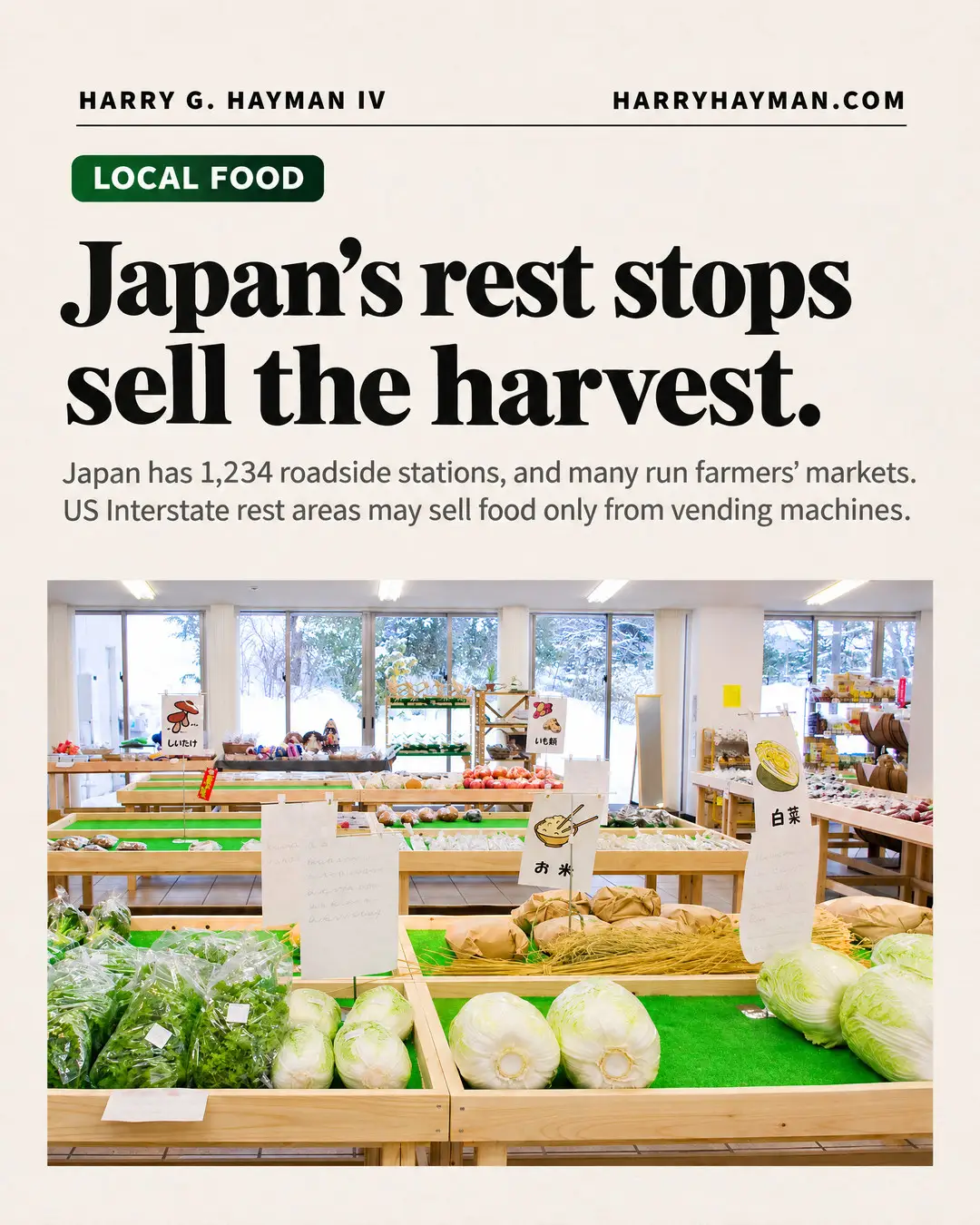
The photograph inside the poster at the top of this page was taken on a January day in 2010 at a roadside station called Kannabe Kogen, in the mountains of Hyogo Prefecture, Japan. Snow is banked against the windows. Inside, napa cabbages lie on green mats on plain wooden tables, next to paper sacks of rice tied with straw, bags of greens, shiitake and potatoes, each table marked with a hand drawn card. It is a farmers’ market. It is also a highway rest stop, with free parking and toilets that stay open all night. I’m Harry Hayman, and I can’t stop thinking about that pairing, because on an American Interstate the same building would be against federal law. Not frowned upon. Written out of the statute. Japan decided its rest stops should help the towns around them earn a living. We decided ours should sell nothing but what comes out of a vending machine. Both choices made sense to someone once. Only one of them puts a farmer’s cabbage in front of a hungry driver.
What a michi no eki actually is
Japan calls these places michi no eki, which translates as road stations, the way a train has stations. Japan’s transport ministry, MLIT, registers them, and on September 4, 2026 it announced its 65th registration round, bringing the national total to 1,234. The ministry’s own regional index breaks that down, from 128 in Hokkaido to 10 in Okinawa.
The rules for getting registered are short and telling. In a 2023 interview with the government’s Highlighting Japan magazine, the head of MLIT’s Road Bureau, Niwa Katsuhiko, explained that a station must provide 24 hour free parking and restrooms, road and tourist information, and “amenities for regional promotion”. Rest, information and the local economy, written into the job description of a rest stop. That third function is the one that matters here. The same interview lists what towns tend to build to meet it: local specialty shops, markets for agricultural produce, restaurants, hot springs, parks and services for older residents.
The program began small. The first round of registrations, in April 1993, created 103 stations. One honest detail before I go further: these stations sit on ordinary national and prefectural roads, not on Japan’s toll expressways, which run their own service areas. So the fair comparison is not Japanese freeway against American freeway. It’s a public rest stop against a public rest stop, and what each country lets that stop do.
The farmer’s tray
What I love most about the model is how plain the mechanics are. MLIT publishes English explanations of Japanese places for visitors, and its text on a station called Kaze no Ie, in Okayama Prefecture, describes the system better than I could. Any resident can take home a green display tray, fill it with produce, and bring it back. Each seller has a registered barcode that labels the items they supply, and a scan at the register sends a portion of the sale to that producer. Professional farmers sell there. So do older neighbors supplementing their pensions, some with mushrooms and berries foraged in the mountains.
Think about what that does. The grower sets out the goods, the station handles the traffic, the parking and the checkout, and the money traces back to a person by name. A 2019 profile on nippon.com describes the same pull at stations across the country: locals and visitors coming to buy fruit, vegetables and seafood direct from producers, and the shops becoming a source of pride for the older farmers who supply them. Not every station runs a market, and there’s no official share to quote. But the design invites one, and many towns took the invitation.
The rule on our side of the Pacific
Now the American version. Title 23 of the United States Code, section 111, says every agreement to build an Interstate must include a promise that the state will not permit service stations or “other commercial establishments for serving motor vehicle users” on the Interstate right of way. The same section then lists the narrow things a state may allow inside a rest area: advertising inside the building, books and DVDs that promote tourism in the state, tickets to historical attractions, maps and travel booklets, and lottery machines. Vending machines are allowed too, operated by the state, with priority for vending run by blind vendors under a 1936 federal program. That priority is a good thing, by the way, and any change would need to protect it.
The federal regulation is blunter. 23 CFR 752.5 says no charge may be made to the public for goods and services at safety rest areas, except for telephones and articles dispensed by vending machines. So a Pennsylvania grower cannot set a table of apples inside an Interstate welcome center. The machine can sell you chips. The farmer cannot sell you the apple.
There is one old exception. Section 111 does not force the removal of state owned establishments that existed before January 1, 1960, which is why some older toll roads that became Interstates still carry full service plazas. The Reason Foundation’s Robert Poole points to the New York Thruway, the Ohio Turnpike and the Indiana Toll Road as examples, while arguing the wider ban should go.
Why the ban stays, and the case for it
Here is the part I want to be fair about. The people who defend this rule are not villains. NATSO, the trade group for travel plazas and truck stops, says its members run more than 5,000 travel plazas and truck stops. On May 19, 2026 it wrote to the House Transportation and Infrastructure Committee about H.R. 8870, the five year highway bill called the BUILD America 250 Act, and commended the committee “for preserving the longstanding federal prohibition on commercial activities at Interstate rest areas”. Its argument: commercial rest areas would compete with businesses at the exits, undercut local sales tax and cut the fuel tax receipts that pay for road maintenance.
I read the bill as introduced, and NATSO is right about what it does. It doesn’t touch section 111. The only rest area language I found is in a new grant program for truck parking. The committee advanced the bill 62 to 2 in May, and the committee’s own release describes a five year reauthorization. The ban is not going anywhere this cycle.
And the truck stop point has weight. A diner and a gas station at an exit in central Pennsylvania are local businesses too. Travel plazas off the Interstate can sell whatever they like, and they do. Nobody should want a state agency undercutting them with a subsidized food court.
What Japan got right, and what Philadelphia could borrow
But look at what Japan actually built. Not a food court. Not a chain franchise on public land. A place where the people who live along the road get a shelf. That is a different idea from the commercialization fight we keep having in Washington, and I think it gets lost in it.
So here is my question for Pennsylvania, and for the Philadelphia region in particular. The ban covers the Interstate right of way. It does not cover a state road a few hundred feet past the ramp. What if PennDOT, a county and a farm group built one michi no eki style stop just off an exit, on a state road: free parking, clean restrooms open around the clock, travel information, and a growers’ market run on the tray and barcode model, where every farmer within an hour’s drive can bring a tray and the register sends the money back to them by name? It doesn’t need Congress. It doesn’t compete with the truck stop on the other side of the exit, because it isn’t selling diesel or burgers. It sells the harvest of the counties we drive through without stopping.
Japan started with 103 of these in 1993. We could start with one.
I keep coming back to that photo from Kannabe Kogen. Snow outside, cabbages inside, a hand drawn card over the rice. Somebody in that town decided the road running past them was an opportunity, not just traffic. If you’ve driven Interstate 76 or Interstate 78 out past the farms and wondered where all that food goes, that’s the question. And if you run a farm, a county office or a regional market and want to sketch what the first one would look like, I’d love to hear from you.
Sources and references
- MLIT press release, September 4, 2026: the 65th michi no eki registration, 1,234 stations nationwide (Japanese)
- MLIT michi no eki index with registered counts by region (Japanese)
- Highlighting Japan, August 2023: interview with MLIT Road Bureau Director General Niwa Katsuhiko on the roles of michi no eki (PDF)
- MLIT multilingual explanation text: Kaze no Ie Produce Market (DOCX)
- nippon.com, September 27, 2019: roadside rest stops evolve to serve as community hubs
- 23 U.S.C. 111, agreements relating to use of and access to rights of way on the Interstate System (govinfo)
- 23 CFR 752.5, safety rest areas (eCFR)
- H.R. 8870, BUILD America 250 Act, as introduced May 19, 2026 (govinfo)
- NATSO letter to the House Transportation and Infrastructure Committee, May 19, 2026 (PDF)
- Roll Call, May 22, 2026: surface transportation bill approved by House committee
- House Transportation and Infrastructure Committee Democrats: committee approves the BUILD America 250 Act
- Reason Foundation, Robert Poole, April 8, 2021: Rethinking Interstate Rest Areas
- Photograph: highland vegetables at Michinoeki Kannabe Kogen, Toyooka, Hyogo, by hashi photo, January 14, 2010, licensed CC BY 3.0. The poster at the top of this page is a designed graphic built from this photograph, cropped and colour corrected.
