Neighborhood Film Co. and One Apprentice a Year in Philadelphia
A Philadelphia production company hires one formerly incarcerated adult a year as an apprentice. I look at how it is built and what it does not claim.
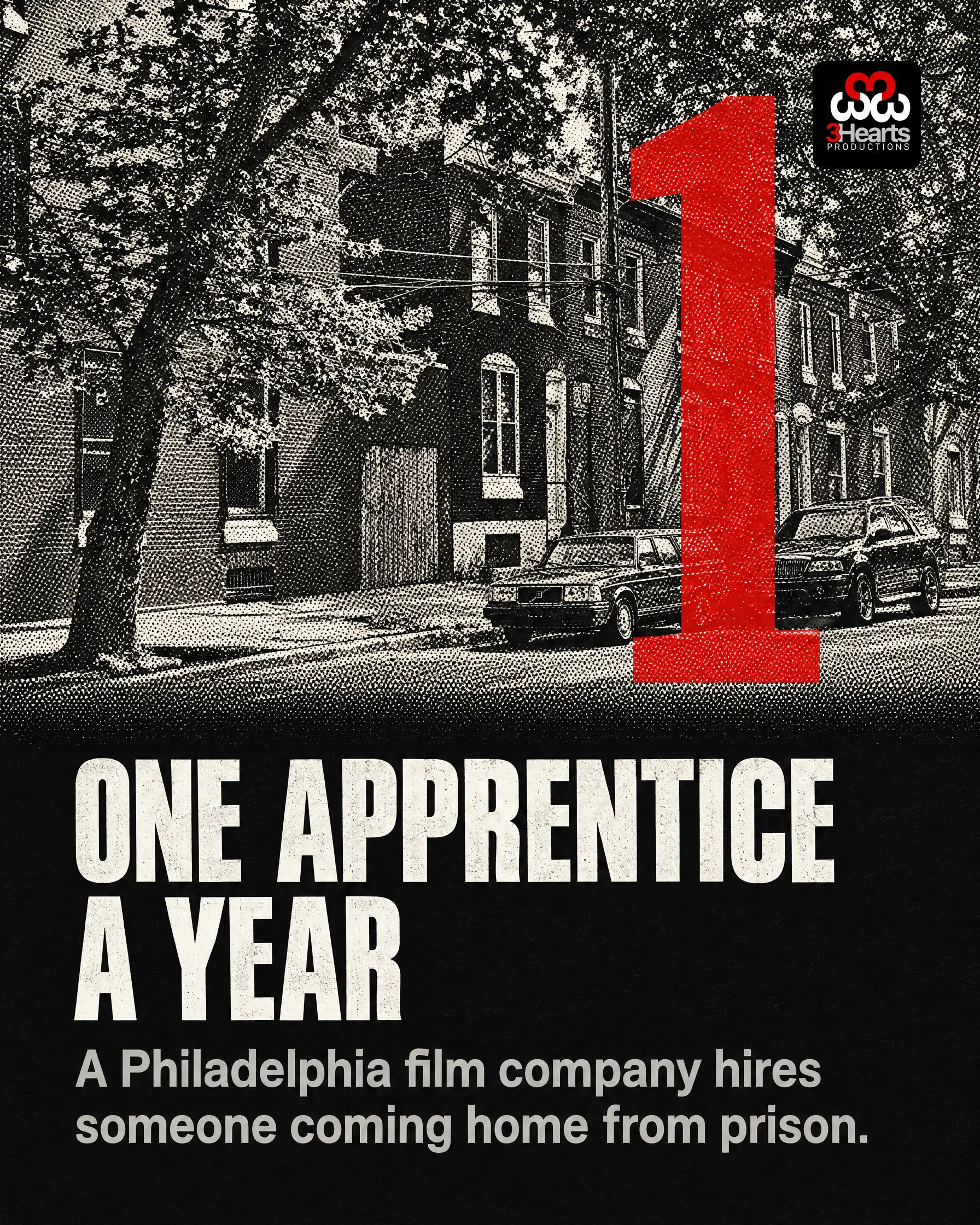
I keep coming back to a red numeral 1. Neighborhood Film Co., a Philadelphia production company, hires one formerly incarcerated adult every year as a full-time apprentice. One person, trained on real projects as a project coordinator, with the business paying the overhead so the donations behind the program reach that person. I am a film producer, writing from Philadelphia through Another 3 Hearts, and we are writing THE NINTH FLOOR around a table of friends right now. When I look for structures I would want to learn from, this is the one that keeps pulling me back. It is small, it is specific, and it is built like a production, not like a charity appeal.
Where it started: a block in Brewerytown
The poster for this post is a halftone of the north side of the 3000 block of Stiles Street in the Brewerytown Historic District, a public domain photograph taken in 2010. I chose a street instead of a person on purpose, and I will come back to why. To be clear, it is a picture of the neighborhood, not of the company’s office.

The neighborhood matters because the company started there. Interviewed by Philadelphia Magazine in 2018, founder Ricky Staub said he came to Philadelphia to work on M. Night Shyamalan’s The Last Airbender, which came out in 2010, and launched Neighborhood Film Company in Brewerytown a year later. He said he wanted to train adults coming out of incarceration or homelessness, and that “Everybody told me it wouldn’t work.” About the neighborhood he said he was “completely embraced by the community,” and that the architecture and history “really spoke to me.” The Philadelphia Citizen described the company as still based in Brewerytown in 2021, which is the most recent location I could source.
What the apprenticeship actually is
The company’s own apprenticeship page is plain about it: every year Neighborhood recruits and employs one formerly incarcerated adult to work full time at the company as an apprentice, on real projects with real risk and reward. The same page says the goal is not to develop directors or editors but high-level project coordinators, with a versatile skill set that can translate into many different work environments.
I find that choice smart. Anyone who has worked on a set knows the coordinator is the person who keeps fifty moving parts moving: the schedule, the permits, the call sheets, the calls that fix the problem before it reaches the director. It is a job that exists on every production and in many industries outside film. The company is not promising an apprentice a career in a famous chair. It is training a skill that travels. In 2018 Staub told Philadelphia Magazine the apprentice is paid full time, and the company then had four full-time employees plus that one apprentice each year.
The business side is real work. The company’s home page lists clients and projects including Pepsi, Xfinity, the 76ers, Apple TV’s Servant and Universal’s Glass. Variety reported in 2021 that Staub’s feature Concrete Cowboy debuted at the Toronto film festival and was picked up by Netflix. So the apprentice is learning inside a company that has to deliver for paying clients, which is a different thing from a classroom program.
Reading the money from the filing
This is the part that made me want to write the post. According to the apprenticeship page, the program runs through The Working Film Establishment, a Pennsylvania 501(c)(3) nonprofit, and Neighborhood absorbs the big administrative costs: the executive director’s salary, rent, accounting and other ancillary costs. The stated reason is that donations then go directly to the apprentice’s salary, counseling and career development.
The public record is consistent with a very lean nonprofit. ProPublica’s Nonprofit Explorer shows the organization has been tax exempt since February 2013, classed as employment and vocational rehabilitation. For the fiscal year ending December 2024, on a 990-EZ filed on November 17, 2025, it shows $45,692 in revenue, all of it contributions, $39,914 in expenses, and its director paid $0. I will say “its director” and leave it there, because the filing lists a name and I would rather not assume more than the page gives me.
I want to be careful about what that does and does not show. It does not show that the commercials pay the apprentice, and I am not saying they do. The nonprofit’s contributions cover the program; the business covers the overhead that would otherwise eat into them. That split is the whole idea, and it is something a production company can copy without inventing anything new.
Where the apprentices come from, and where some went
Variety wrote in 2021 that for ten years Staub had hired and trained adults returning home from incarceration, identifying candidates through two Philadelphia-based federal judges with their own reentry program. That is a Philadelphia institution doing the referral work, which means the company is not asking strangers to apply from nowhere. In March 2021 The Philadelphia Citizen reported that the company was training its 11th apprentice. I have no number for the years since, and I will not guess one.
The same article quotes Staub on a former apprentice who worked on Concrete Cowboy and The Cage and then finished Season 2 of Servant with Shyamalan. In 2018 he said another graduate was running a property for the Philadelphia Housing Authority. That graduate, Marvin Robinson, wrote in his own words in November 2018 that he is a certified property specialist at the Philadelphia Housing Authority and a proud graduate of the company. He also wrote this, which I cannot improve: “When I was sentenced to seven years in federal prison, I didn’t realize that I would actually be serving two sentences: one on the inside and one on the outside.”
That sentence is the reason the structure exists. I am quoting what he published under his own name in 2018. I have not used his photograph, because that needs his permission and the company’s, and I have not named or shown anyone currently in the program.
What it does not claim
Staub is candid about the limits. In the same 2018 interview he said, “I don’t think we’ve cracked the code on anti-recidivism. It’s a unique effort producing unique results.” I take him at his word, and I want this post to do the same. One apprenticeship a year is a model, not a cure, and I have no outcome numbers to offer, because I could not find any I would trust.
The scale problem is real. The City of Philadelphia has estimated that about 30,000 people return to the city from jail and prison each year. That figure is from a 2017 press release, so I label the year. Against it, one a year is a rounding error, and anyone who tells you this solves the problem is selling something. I also want to keep this apart from exoneration stories. These apprentices are people returning from incarceration, a different group with a different story.
What I would borrow
I am writing a film with friends, and when a project like THE NINTH FLOOR grows into a real production, I want to build the structure in from day one. I wrote about the writing days around that table on October 31. Three things from Neighborhood stay with me.
First, train for the job every set needs. Coordinators are in demand and the skill is portable. Second, let the business carry the overhead, so the donation line is as short as it can be and every dollar reaches the person it was meant for. Third, use an existing referral path. Neighborhood leans on a reentry program run by two federal judges instead of building its own.
The question I cannot stop asking is a simple one. If one company can carry one apprentice a year, what happens if ten Philadelphia production companies each carry one? I do not know. I would like to find out, and the people at Neighborhood are the ones I would ask first.
Sources and references
- Brewerytown Historic District photograph, Stiles Street, Philadelphia, 2010, by Smallbones on Wikimedia Commons, public domain. The poster at the top of this page is a designed graphic built from this photograph.
- Neighborhood Film Co., apprenticeship page.
- Neighborhood Film Co., home page.
- ProPublica Nonprofit Explorer, The Working Film Establishment (IRS Form 990-EZ data).
- Philadelphia Magazine, Victor Fiorillo interview with Ricky Staub, August 14, 2018.
- Variety, Peter Debruge, 10 Directors to Watch: Ricky Staub, February 25, 2021.
- The Philadelphia Citizen, Roxanne Patel Shepelavy, March 29, 2021.
- American (In)Justice, Marvin Robinson, November 10, 2018.
- City of Philadelphia, Office of the Mayor, press release, May 25, 2017.
- THE NINTH FLOOR: Writing a Psychological Thriller With Friends.