Lee W. Smith, the Bassist Christian McBride Calls His First Bass Hero
Christian McBride calls his father Lee W. Smith his very first bass hero. On Saturday, November 14, Lee plays a West Philadelphia church for ten dollars.
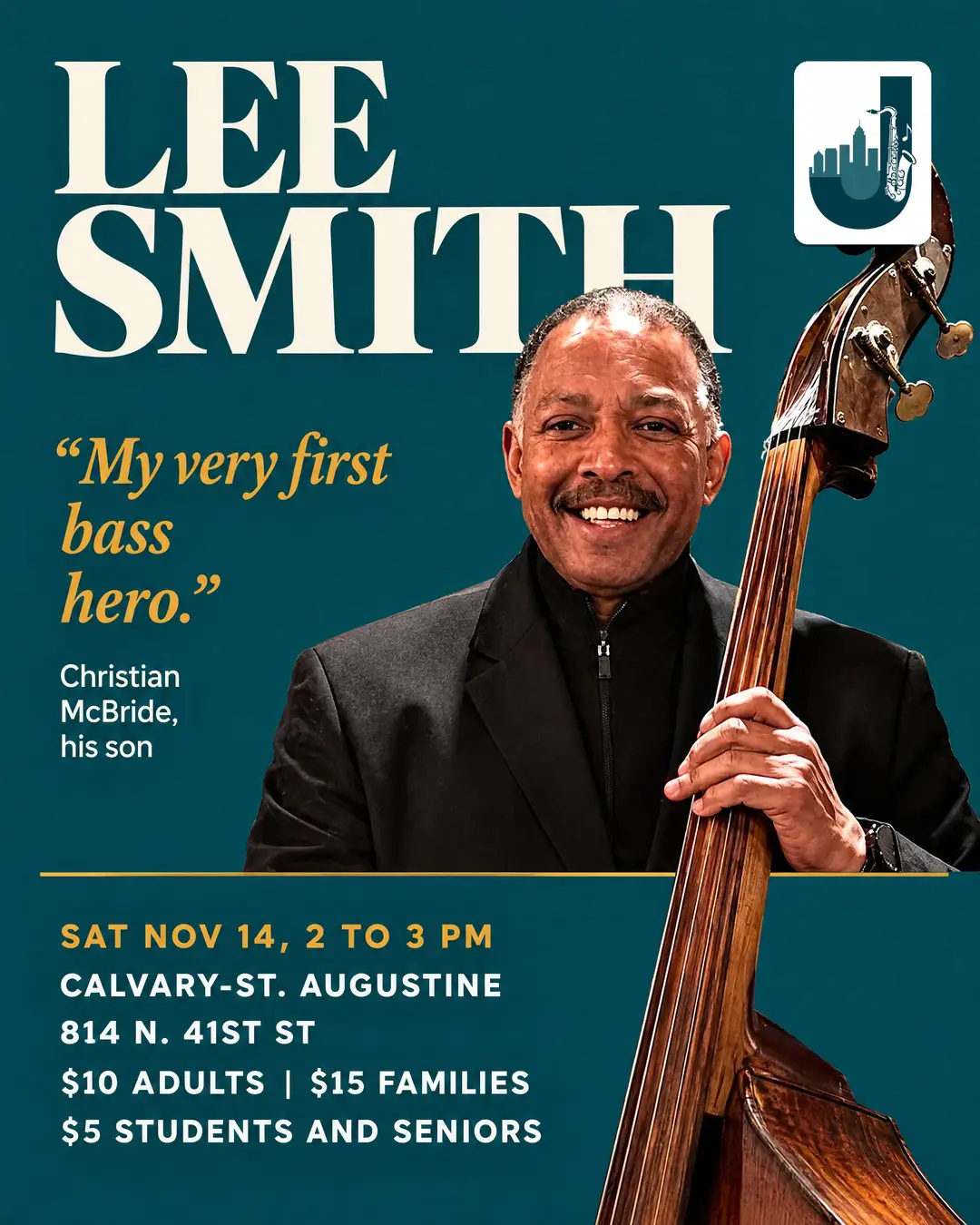
Everybody in jazz knows Christian McBride. Ask him where it started and he does not name a school or a record. He told Local 802’s Allegro magazine that his journey in music started after watching his father perform one night. I’m Harry Hayman, writing from Philadelphia, and this week I want to put that father in front of you, because he is still playing and he is playing close to home. On Saturday, November 14, from 2 to 3 PM, you can sit in a West Philadelphia church and hear him for ten dollars. That is what jazz appreciation looks like when it is built into a neighborhood instead of sold back to it.
The sentence that started this
On Father’s Day in 2018, McBride posted a line on X: “Happy Father’s Day to my very first bass hero, MY dad, Lee Smith, and all you wonderful fathers out there!” I read it more than once. A bassist with McBride’s reputation could name any of the giants of the instrument. He named his dad first.
In the Local 802 interview he put the scene plainly. In his words, “My father, Lee Smith, is a bassist in the Philadelphia area, and when I was a kid, he was working with Mongo Santamaria.” I am staying inside what McBride himself has said, and he has said enough: he watched his father play, and that night is where he places the start of his own music. I am not going to retell his schooling here. Jazz Philadelphia has told that story, including his mother enrolling him in every music program in the city. This post is about the man on the bandstand.
Who Lee W. Smith is
Lee’s own biography says he was born and raised in Philadelphia. At Overbrook High School he got his first bass guitar and started learning songs from the radio by ear. What pulled him toward the instrument was hearing James Jamerson on Motown records. Think about that for a moment. A teenager in West Philadelphia, a radio, and the bass lines of Motown. That was the classroom.
From there the work spread out. The biography lists tours and recordings with Philadelphia R&B acts including the Delfonics, Blue Magic, Brenda and the Tabulations, Major Harris and Billy Paul. In the summer of 1977 he joined Mongo Santamaria, moved to New York, and stayed with Mongo for five years. Lee appears on six of Mongo’s albums: Images, Red Hot, Summertime, A La Carte, Montreux Heat, and the Grammy-winning Dawn (Amanecer). That is the band McBride was describing when he said his father was working with Mongo Santamaria.
The jazz side of the resume is long. For more than 30 years, the same biography says, Lee has worked with Cab Calloway, Lionel Hampton, Dizzy Gillespie, Benny Golson, Roberta Flack, Cedar Walton, Rahsaan Roland Kirk and many others. He worked with Philadelphia pianist Trudy Pitts for almost a decade, and he performs with the Jazz Orchestra of Philadelphia under the direction of Terell Stafford.
There is one more detail I like. Around 1986, Lee bought his first upright bass from the drummer Wilby Fletcher. It had belonged to Wilby’s late uncle. According to the biography, that bass is still Lee’s main bass today. About 40 years with one instrument, and it came to him through another Philadelphia musician’s family. That is how this city passes things along.
A moment on the radio
In June 2023, WRTI’s J. Michael Harrison wrote about a conversation between McBride and his father, staged in part to support an installment of NPR’s City Scenes series called Philadelphia’s Best Of The Bass. Harrison describes a moment I keep returning to: “I was touched when Christian paused to alert Lee that the late Philadelphia bassist Victor Bailey cited him as a primary influence.”
Read that again. The son, one of the best-known bassists alive, stops to tell his father that another Philadelphia bassist named him as an influence. The lineage here does not run in one direction. It loops back through the city, from a Motown radio signal to a Latin band to a church stage, and the people in it keep telling each other what they heard.
The show
On Saturday, November 14, 2026, from 2 to 3 PM, Artcinia presents Lee W. Smith and Friends at Calvary-St. Augustine Episcopal Church, 814 N. 41st Street, Philadelphia. The Eventbrite listing from Artcinia calls it “Sharing a Labor of Love” and says the show will feature music of many genres, including jazz, R&B, Latin and gospel. The official flyer bills the group as the Lee Smith Quartet and bills Denise King on vocals.
Philly Jazz Scene’s event page lists the prices: $10 for adults, $15 for families and $5 for students and seniors. Eventbrite adds its own fees on top of the ticket price, so check the final total at checkout.
Why a church on a Saturday afternoon matters
Artcinia is the reason this is easy to attend. Its own description of its work says that since June 2021 it has reached over 20 neighborhoods, fairly compensated over 350 professional musicians and welcomed nearly 9,000 people to live performance. I like both halves of that sentence. Musicians get paid, and neighbors get a room within walking distance.
Philadelphia’s jazz education is not only in classrooms. McBride’s own account points to something simpler, watching a working Philadelphia bassist up close on a night when that bassist was doing his job. A family can now put a child in the same room as a man playing the upright bass he has owned since the mid-1980s, for a total of $15. That child gets a view much like the one McBride describes, a Philadelphia bassist at work up close.
I do not want to oversell it. It is one hour on one Saturday. But I have come to think that the cheap, local, in-person hour is the unit that keeps this music alive. A recording lets you hear a bassist. A church lets you watch his hands.
What I’d do with this
If you already know Christian McBride’s records, go hear where he says it started. If you do not, go anyway. Bring a student, a parent or a neighbor. The Artcinia listing and the Philly Jazz Scene page both have the details, and the show runs just an hour, so it fits into a Saturday without taking the whole day.
Lee has no Instagram that I could find, so the best way to say thank you is to show up. Sit where you can see the bass. Listen for the Motown in it, and for the five years with Mongo, and for whatever a son heard one night as a kid. Then tell someone else the story.
Sources and references
- Lee Smith Music, Biography. Lee’s family, Overbrook High School, James Jamerson, five years and six albums with Mongo Santamaria, collaborators, Trudy Pitts, the Jazz Orchestra of Philadelphia and the upright bass bought around 1986.
- Local 802 AFM, Allegro: The Musical Vision of Christian McBride. McBride on his journey in music starting after watching his father perform.
- Christian McBride on X, Father’s Day post, 17 June 2018. “My very first bass hero.”
- WRTI, Christian McBride and Lee Smith cover the basses in conversation. Victor Bailey’s citation of Lee as a primary influence and the NPR City Scenes project.
- Jazz Philadelphia, Hometown Hero: Christian McBride. McBride’s Philadelphia upbringing, which this post deliberately does not retell.
- Eventbrite, Legendary Bassist, Lee W. Smith and Friends. Official listing from Artcinia: date, time, venue and genres.
- Philly Jazz Scene, event page. Ticket prices of $10 adults, $15 families and $5 students and seniors.
- Artcinia, What We Do. Neighborhoods reached, musicians compensated and attendance since June 2021.
About the Author
Harry Hayman is a Philadelphia-based entrepreneur, music producer, and cultural advocate. Through his work with the Feed Philly Coalition, he explores and documents the creative, culinary, and civic life of a city he believes is one of the most inspired places in America.