THE NINTH FLOOR: Writing a Psychological Thriller With Friends
A long writing day on THE NINTH FLOOR, our psychological thriller, with David, Ian and Amy, and the Philadelphia film community around it.
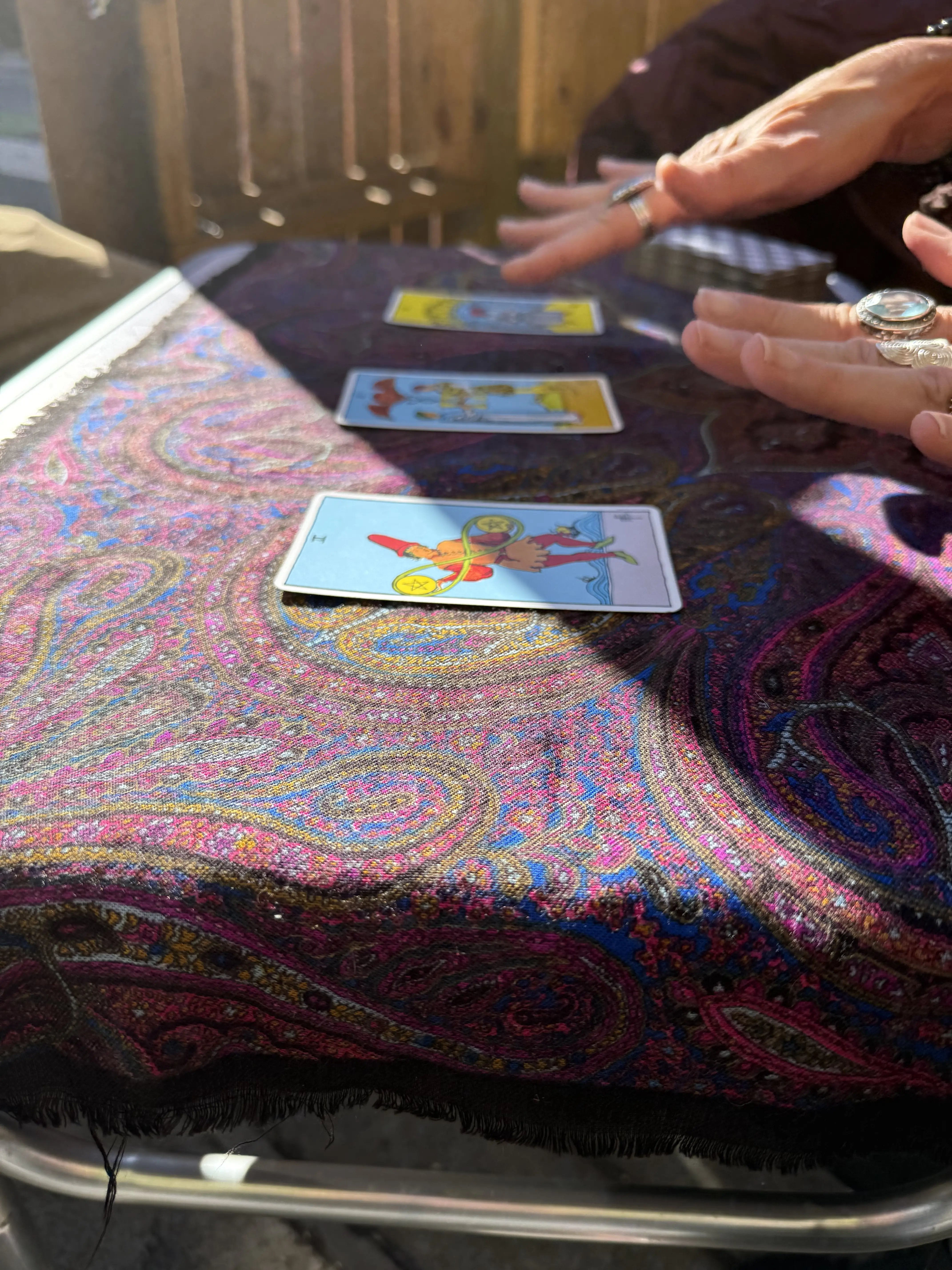
A laptop sits open on a table in the second photo of my post, and the page on its screen is the title page of a script: THE NINTH FLOOR, with Yet Another 3-Hearts Experience printed at the bottom. The first photo shows a pair of hands laying out tarot cards on a paisley cloth in afternoon light. Those two pictures hold most of the day. I’m Harry Hayman, and I spent hours that day working on THE NINTH FLOOR, our psychological thriller, with David, Ian and Amy. We read, we wrote, we rewrote, and we argued about scenes. This is the longer version of that post: what the day was, why a table of friends is a serious way to write, what a psychological thriller asks of the people making one, and the Philadelphia film community we are working inside.
A Long Day Inside THE NINTH FLOOR
The plain account of the day is the one in my post. We read. We wrote. We rewrote. We argued about scenes, threw ideas around, and talked about the movies we have seen over the years, trying to work out what works, what does not, and what might make this thing even better. You know how it goes. Somebody has an idea, somebody else takes it in a completely different direction, and before you know it we are all sitting there wondering how we ever got from point A to point Z.
I am not going to summarize the story. Nothing is quite settled yet, everybody has an opinion, and sometimes the craziest suggestion turns out to be the one worth exploring. What I can say is that the characters are getting more interesting, the story is taking shape, and we are starting to really dig into what makes a good psychological thriller. What made the day even better was getting to do it with David, Ian and Amy. We have plenty of work ahead of us, and that is half the fun.
Why a Room Full of Friends Is a Serious Way to Write
A writers’ room is a television tradition. Wikipedia’s article on the writers’ room describes a space where writers, usually of a television series, gather to write and refine scripts, a common method in the US and much less widespread in countries like the UK. The Writers Guild of America West gives the early stage a formal definition in its guide to the 2023 writers’ room provisions: a development room is three or more writers, the showrunner included, convened before a series or production order.
What we had was smaller and looser, a table of friends and a laptop. The habit underneath is the same. Put the people who care about a script in one place and let the ideas collide. Rosamund Davies, in a chapter of The Palgrave Handbook of Screenwriting Studies, looks at how collaborative idea and script development connects to authorship, and at how conventions and prior relationships shape the way that collaborative work is organized. Prior relationships are what I had around the table. Friends working together, bouncing ideas around, challenging each other.
Another 3 Hearts has run rooms before. The company launched its Writing Rooms in June 2025, a Tuesday night space for storytellers, writers and creative minds from across Philadelphia to connect and collaborate. This one was smaller, and it was friends, but the rule is the one I gave this site in October 2025, in a post about writing and friendship: “These things take time.”
What a Psychological Thriller Asks of Us
Three questions sit at the center of what we are digging into, and they are the ones in my post. What makes people uncomfortable? What keeps them guessing? And how do you tell a story that sticks with somebody after the credits roll?
Wikipedia’s article on the psychological thriller calls it a genre combining the thriller and psychological fiction genres, and names its distinguishing characteristic: an emphasis on the mental states of its characters, their perceptions, thoughts, distortions and general struggle to grasp reality. It says these stories build suspense from uncertainty over characters’ motives, honesty and how they see the world, and that a film can also make an audience uncomfortable by giving it information it wishes it could share with the characters.
That last idea turns up on the British Film Institute’s list of 100 essential thrillers. Of George Sluizer’s The Vanishing (1988), the BFI writes: “With the audience knowing more than the characters, this is a fascinating psychological puzzle with a terrifying twist.” Roman Polanski’s Knife in the Water (1962) is, in the BFI’s words, a “disconcerting psychological thriller,” and Alfred Hitchcock’s Vertigo (1958) is “the most dizzyingly rich thriller ever made.” Those are three different ways to work on an audience, and each one starts as a choice on the page, which is a good reason to argue about scenes.
The American Film Institute’s 100 Years…100 Thrills names the 100 most thrilling American films, and AFI says its lists reflect the collective opinion of a wide range of scholars, artists and experts. Psycho (1960) is number one, The Silence of the Lambs (1991) is number five, and Rosemary’s Baby (1968) is number nine. My post says we talked about movies we have seen over the years, and I will leave our titles out of it, but that is the kind of list everybody carries into a room like ours.
I did a different kind of homework at the Colonial Theatre in Phoenixville, and I wrote about it in my post on the Exhumed Films 24 Hour Horror-thon. I went to see how the audience responded: when people laughed, when they got uncomfortable, when a little silence did more than any special effect could. That day was a horror marathon in a theater full of strangers, and this one was a writing table, but the question underneath is the same. What does a room full of people do when the story gets uncomfortable?
The Cards, the Chalkboard and the Open Door
The six photos in my post are the rest of the day. In the first, a pair of hands lays out tarot cards on a paisley cloth, sunlight cutting across the table. In the third, one card fills the frame: the Two of Pentacles, a figure in a tall red hat keeping two coins moving along a looping ribbon, with ships riding waves behind. The fourth is a wooden chalkboard sign on a sidewalk that advertised Full Moon inspired Tarot Readings that afternoon, from 2 to 6 pm.
Tarot has a plainer history than its reputation. Wikipedia’s article on tarot says the cards were invented in northern Italy in the middle of the 15th century as playing cards, and that there is no historical evidence of any significant use of tarot cards for divination until the late 18th century. The suit of coins that the Two of Pentacles belongs to is the one many decks call pentacles or disks. The pictures show what that afternoon looked like, and you can read the cards however you like.
The fifth photo is a wall that mixes beer signs with cut paper hands, feathers, tinsel and pink tissue flowers, with a television above it showing a dance number with hula hoops. The sixth is the street: a pale teal mural of a face beside an open wooden door, a yellow sunflower above it, string lights overhead. I like how strange and warm those frames feel next to a script.
Harry Hayman, Another 3 Hearts and the Film Work So Far
On the Another 3 Hearts Experience site, the company describes itself as a production company based in Philadelphia, telling profoundly honest real life stories that move the heart and touch the soul. THE NINTH FLOOR comes from Yet Another 3-Hearts Experience, the line at the foot of that title page, and it is a very different kind of picture from the documentary I produced, I Am Hungry in Philadelphia. The I Am Hungry in Philadelphia site calls that film “A documentary exploring hunger in one of America’s largest cities,” and says it works through interviews and first person accounts. THE NINTH FLOOR, for now, is built on friends, a laptop and a long day.
Scripts are not new to me. A post on this site from October 2025 noted that I had been developing scripts for various films over the past several years, and that many of my projects are rooted in Philadelphia.
Writing Into Philadelphia’s Film Community
The hashtags on my post call this an independent film and a Philadelphia film, and I take both words seriously. Anyone making an independent film in this region works inside a community that already exists, and some of its institutions are easy to name. The Greater Philadelphia Film Office says it was first established in 1985 as an office within the City of Philadelphia and became a regional economic development agency in 1992. Today it supports filmmakers across Bucks, Chester, Delaware, Montgomery and Philadelphia counties, helps with government permits, keeps a free online database of local crew and vendors, and runs Greater Philadelphia Filmmakers, a program for the regional independent media community with educational programming, industry workshops and networking.
The Philadelphia Film Festival, founded in 1991 by the Philadelphia Film Society, is held each year at theaters across the Philadelphia area, and its Filmadelphia category promotes local filmmakers. Scribe Video Center calls itself a nonprofit media arts center in West Philadelphia, founded in 1982, with a focus on participatory community filmmaking. In August I wrote about the fifteenth BlackStar Film Festival, which brought 91 films and 22 world premieres to three Philadelphia theaters.
The audience side needs the same care. 34th Street Magazine reported in February that Philadelphia had 275 active movie theatres in 1932 and only five historic theaters still screening films by 2019, and that independent screeners such as The Secret Cinema, a floating repertory series established in 1992, have “carved out an important role.” I keep saying culture is infrastructure. A free list of local crew, a festival category for local filmmakers, a media arts center working since 1982 and a few people carrying film from room to room are the roads an independent film drives on.
More to come, folks. If we can get half the stuff we are talking about onto the screen, this is going to be quite a ride.
Sources and references
- Writers’ room (Wikipedia)
- Writers Guild of America West: Showrunners’ Guide to 2023 MBA Writers’ Room Provisions
- Rosamund Davies, Collaboration, cooperation and authorship in screenwriting, in The Palgrave Handbook of Screenwriting Studies
- Three Hearts Experience Writing Rooms announcement, harryhayman.com
- Writing, Friendship, and the Stories That Matter, harryhayman.com
- Psychological thriller (Wikipedia)
- British Film Institute: 100 essential thrillers
- American Film Institute: AFI’s 100 Years…100 Thrills
- Exhumed Films 24 Hour Horror-thon at the Colonial Theatre, harryhayman.com
- Tarot (Wikipedia)
- Another 3 Hearts Experience
- I Am Hungry in Philadelphia
- Greater Philadelphia Film Office: About GPFO
- Philadelphia Film Festival (Wikipedia)
- Scribe Video Center
- Twenty Two World Premieres on South Broad Street, harryhayman.com
- 34th Street Magazine: The People Behind Independent Cinema in Philly