Native Food Insecurity Is a Federal Policy Question
Native food insecurity demands a policy answer. From Philadelphia, I examine one national household estimate and the federal rules behind food access.
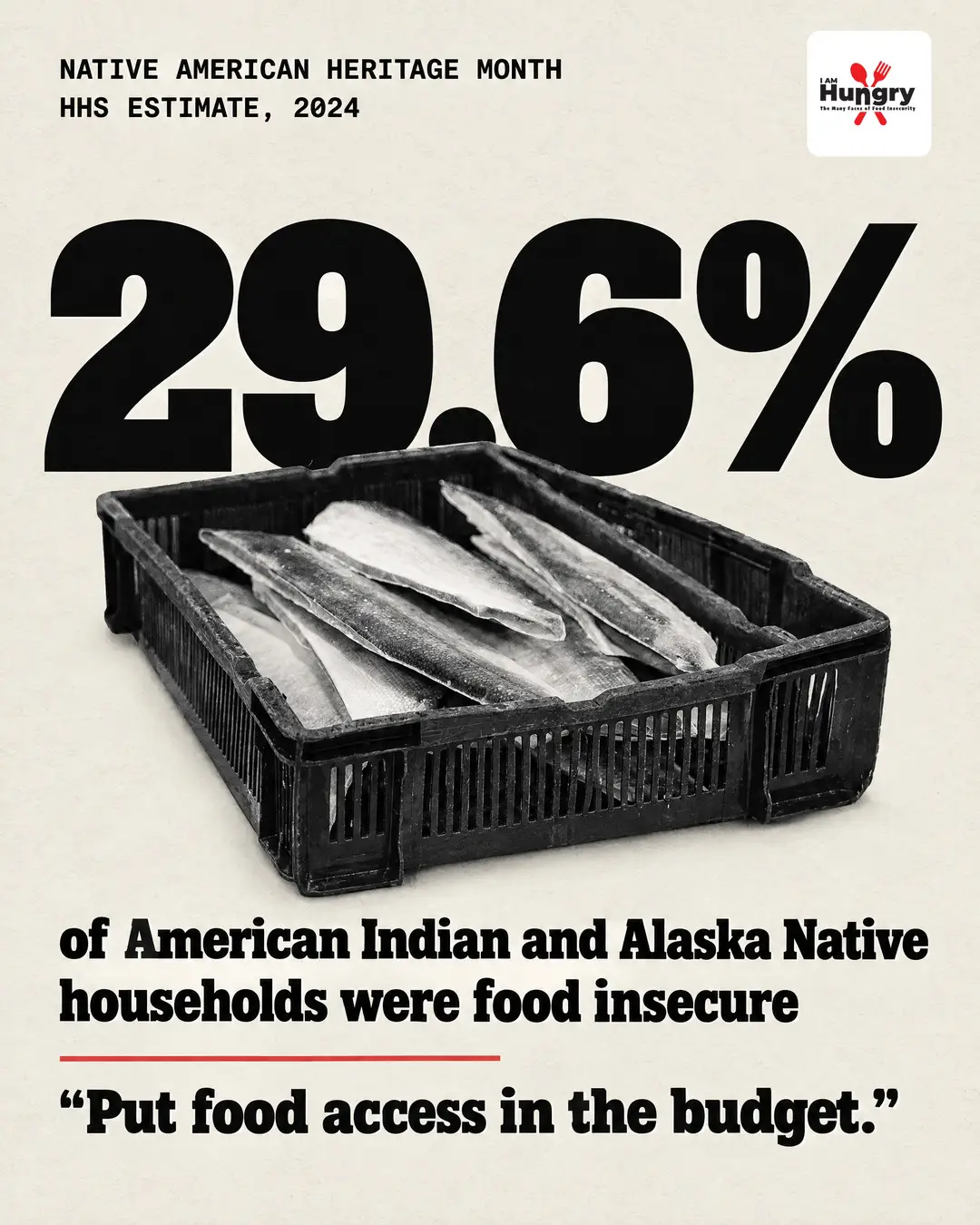
29.6% is the estimate I want on the table for Native American Heritage Month. It comes from HHS’s Healthy People 2030 household food insecurity data, and it deserves a more serious response than advice about making a grocery budget stretch. Before the objection arrives, yes, public food programs exist. The people keeping food moving deserve support. I still want to know what the existence of those programs lets the rest of us stop asking. Who qualifies? Who pays for delivery? Who checks whether the rules actually get food to the people eligible to receive it? Those are the questions I bring to I Am Hungry in Philadelphia. A household can be doing everything asked of it while the public system still fails to make reliable food access possible. I want the camera on that responsibility.
What the household estimate actually measures
The figure needs its full description. In the HHS table, the 2024 estimate is for U.S. households whose reference person identified as American Indian or Alaska Native only. It measures food insecurity over the past twelve months. The national estimate for all households in that same year is 13.7%. The comparison is more than double, using the same measure and period, rather than matching an older Native estimate to a newer national rate. These are national household estimates in the HHS table.
That category includes people of any Hispanic origin; the table separately reports a category excluding Hispanic or Latino reference persons. It also reports multiracial households separately. The estimate has a wide confidence interval. I would not describe it as an exact count, a rate for every Native nation, or a measure of conditions in Philadelphia. It certainly isn’t a count of individual Native people going hungry today.
The HHS methodology for this objective identifies the Current Population Survey Food Security Supplement as its source. It classifies households using reported experiences related to insufficient resources for food. Knowing what a figure counts makes the argument harder to dismiss. It also keeps me from claiming an authority over people’s lives that a survey cannot give me.
Food insecurity is a question about access
There is a reason to keep the language precise. USDA’s explanation of food security measurement distinguishes food insecurity, a household economic and social condition, from hunger, an individual physiological experience. Limited or uncertain access to adequate food is the concern measured here. I don’t need to turn that into a more dramatic claim to take it seriously.
Actually, the precise version makes me ask more of public policy. If access is uncertain, I want to examine what would make it dependable. A household’s food budget has to meet actual prices. A distribution program has to move actual food. Neither question gets answered by assuming that better intentions will close the distance between the two.
The estimate alone cannot tell me how much of the disparity any particular policy caused. I won’t pretend it can. Calling this a systems failure is my judgment about the responsibility to secure food access, supported by the disparity and by the concrete federal machinery involved. It is an argument for examining decisions we can change. It gives no permission to make assumptions about how a Native household shops, cooks or lives.
The federal program makes the decisions visible
The Food Distribution Program on Indian Reservations factsheet gives that machinery a name: FDPIR. USDA purchases and ships food to administering agencies and provides money for administrative costs. Indian Tribal Organizations or state governmental agencies administer the program, including eligibility determinations, food storage and distribution. Participating households receive a monthly food package.
Look at what those responsibilities require. Buying food and moving it are different jobs. Keeping it usable until distribution is another job. So is determining eligibility. I want a public discussion that can stay with those responsibilities long enough to ask whether each has the money and capacity it needs.
This is also why I resist using the existence of a program as the answer to a question about food insecurity. A program tells us there is a public mechanism. We still have to examine its operation and its reach. The national household estimate is not an evaluation of FDPIR participants, and I wouldn’t use it to grade the people administering the program.
My demand is for an honest account of public responsibility. Show what the program is supposed to accomplish, explain which agency owns each step, and make it possible to ask whether the food arrived. Those are practical questions about a food system.
Eligibility is part of the food system
The rules matter before anything reaches a shelf. According to the USDA eligibility explanation, FDPIR serves income eligible households on reservations, along with qualifying American Indian households in approved nearby areas and in Oklahoma. Households cannot participate in both FDPIR and SNAP in the same month. A national Native household statistic therefore cannot be treated as a map of who qualifies for FDPIR.
Now the discussion has something specific to examine. If eligibility is the decision point, ask how the application works. If a household changes programs, ask how the transition works under the participation rules. Don’t treat every question about access as a request for another lesson in personal responsibility.
I am not proposing that Philadelphia copy a reservation program or claiming that the same rules apply to every community. I am asking us to recognize a familiar policy task: decide who is served, fund the service, and examine what happens at the points where eligibility becomes delivery.
A food crate without a person on display
The photograph accompanying this post shows a black crate holding fish fillets. Another crate and the room behind it fall out of focus. There are no people in the frame. It comes from USDA’s Lummi Nation FDPIR photograph, within the agency’s Lummi Nation FDPIR project album. That provenance matters: this is a documented connection to the named federal program.
I want the object to carry a question about the system. How does the food get purchased, stored and distributed? The photograph can make those responsibilities visible without asking a private person to demonstrate need for the camera. It cannot establish whether a particular delivery was late, what any recipient ate, or how well the program performed. There is no reason to attach an invented story to the crate.
The national estimate and this local program photograph also describe different things. Putting them together makes an editorial argument about public responsibility. It does not turn the photographed food into evidence about the households in the survey.
The assignment I bring back to Philadelphia
From Philadelphia, I can acknowledge Native American Heritage Month by giving this policy question the time it needs. I don’t have to speak for Native people, or pretend one statistic describes the experience of every nation. I do have to be clear about what I am asking my own audience to examine.
For I Am Hungry in Philadelphia, that means following the decision behind the food. Who sets the eligibility test? Which budget pays for distribution? What would an administering agency need to show whether access is improving? I want that line of questioning in our civic conversations because responsibility becomes easier to evade when we leave it unnamed.
I also want the distinction between a proposal and a result kept visible. More funding, a revised rule or a better delivery process should be assessed against what it actually changes for access. Announcing an intervention doesn’t establish its effect. Neither does publishing an acknowledgment in November.
Take the program explanation into the next food policy discussion. Read the eligibility language, identify the agency responsible for the step being debated, and ask to see the funding behind it. Put food access in the budget.
Sources and references
- HHS Healthy People 2030: NWS 01 household food insecurity data. The 2024 American Indian or Alaska Native only household estimate and the same year national comparison.
- HHS Healthy People 2030: NWS 01 methodology and measurement.
- USDA Economic Research Service: food security measurement.
- USDA: FDPIR factsheet. Federal purchasing, administrative responsibilities, program eligibility and the restriction on participation alongside SNAP.
- USDA: Lummi Nation FDPIR project photograph, 20230718-USDA-FNS-UNK-0001. Hero photograph by the U.S. Department of Agriculture; no individual photographer credited. Public domain federal work, marked public domain on Flickr. The poster uses a black and white cutout of the foreground crate.
- USDA: Lummi Nation FDPIR project album.
- Creative Commons: Public Domain Mark 1.0. This mark identifies public domain status; it is not a Creative Commons attribution license.