National Museum of the American Indian: A November Trip
A November trip from Philadelphia to the National Museum of the American Indian, with time for its architecture, Native voices and grounds.
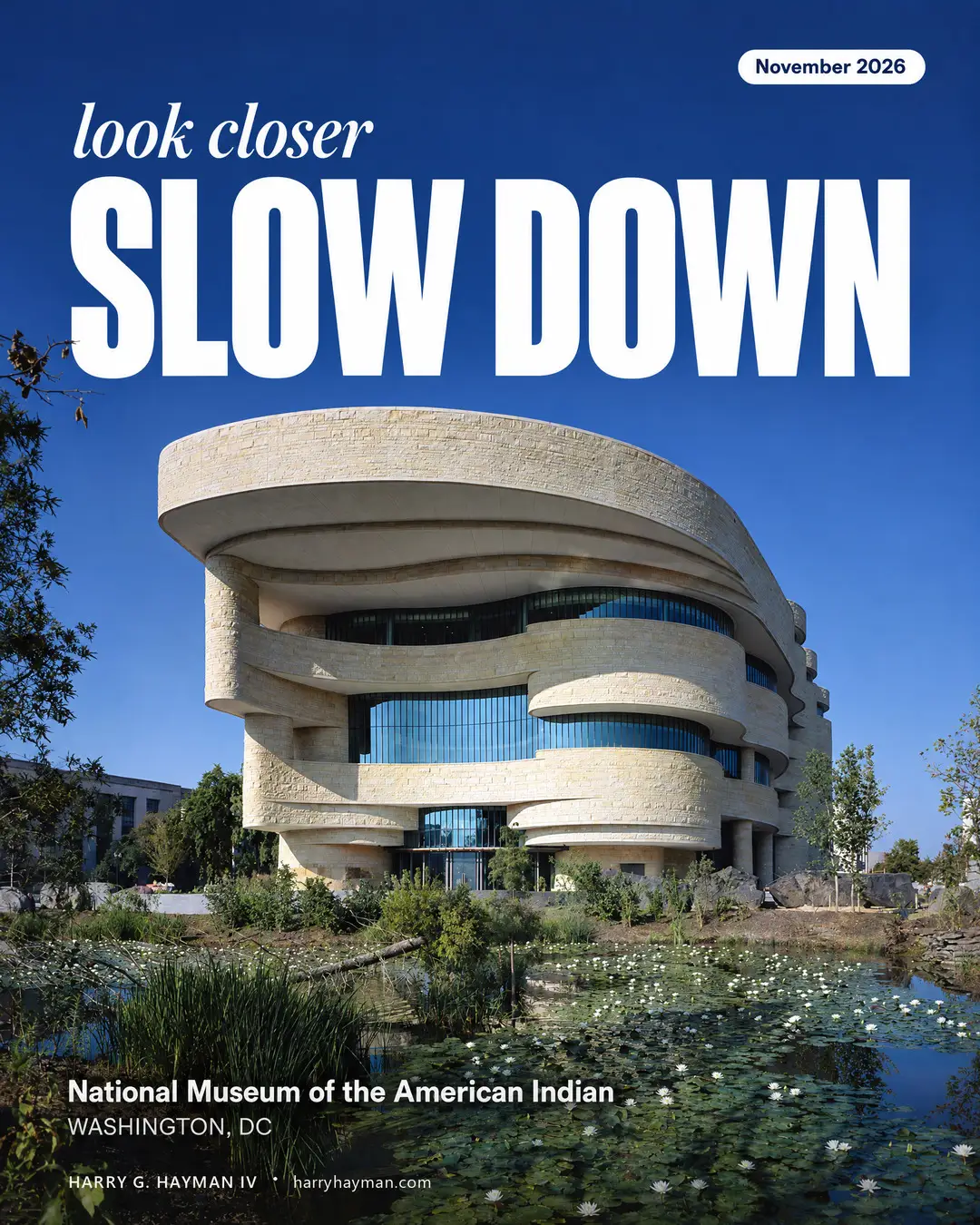
The roofline curves beneath a broad blue sky, with water and plants filling the foreground. In Carol M. Highsmith’s photograph of the National Museum of the American Indian, the building gives your eye plenty to do before you reach a door. That is where I would start a November trip from Philadelphia. Give the outside some time. Yes, I know how quickly a day away fills up, especially when you start adding museums to it. I still want to push back on the idea that seeing more addresses means getting more from a city. For Native American Heritage Month, observed each November, this Smithsonian museum belongs near the center of a day in Washington. The invitation here is for November 2026; the photograph is archival. What draws me is the chance to understand how the place came to be, then carry that curiosity inside.
Who helped shape the building
The Smithsonian’s architecture fact sheet credits Douglas Cardinal, identified there as Blackfoot, as architect and project designer. It also identifies GBQC Architects of Philadelphia and Johnpaul Jones, Cherokee/Choctaw, as design architects. Jones & Jones and SmithGroup were project architects, with further collaborators and consultants. A building like this deserves a little care in the telling. One name on a photograph cannot carry the whole account.
The design team record from Histories of the National Mall describes the contributions of Jones, Donna House, Diné/Oneida, and Ramona Sakiestewa, Hopi, alongside Cardinal and Lou Weller, Caddo. Cardinal supplied the initial architectural concept; Jones led the design architecture group. House and Sakiestewa were design consultants. These were people making decisions about a real place, with different responsibilities. I want their names in mind when I look at the result.
The Smithsonian documents extensive consultation with Native peoples. The east facing entrance and the Potomac gathering space were among the features shaped by that process. Its Kasota limestone exterior suggests rock worn by wind and water, according to the same architecture record. Those are documented design intentions, rather than a meaning I am assigning to every Native nation.
Who gets involved early enough to change the building? That is a question I would bring home to Philadelphia. By the time a visitor sees a finished wall, the meetings are invisible. Reading the design credits gives some of that work a place beside the stone.
Give the ground some attention
The water in Highsmith’s photograph keeps drawing my eye down from the roof. Looking only at the upper curves would crop out much of what makes this particular view interesting. The museum’s June 2015 fact sheet describes the building within grounds that include wetlands and large boulders. The setting belongs in the account of the museum, alongside the architecture.
I like a travel photograph that makes me reconsider where the subject begins. Is it the wall? The reflection? The plants between the camera and the entrance? Here, leaving those things in the frame changes the way I look at the building. You can follow the curve of the stone and then notice the water below it. There is room for both.
On a visit, I would want to read what the museum says about the grounds before deciding what they mean to me. A planted area can be beautiful and still ask more of a visitor than admiration. That extra step takes a little patience, especially when the building itself is such an easy thing to photograph.
It also changes the pace of arrival. I would leave enough time to stop outside, look at the relationship between the building and the ground, and find out who made those choices. There is no need to arrive with a finished interpretation. Having a question ready seems a better use of the approach to the door.
Leave room for the meal
Food belongs in this visit too. The museum’s Mitsitam Native Foods Cafe fact sheet describes a cafe organized around different geographic regions and Native culinary traditions of the Americas. It traces the name Mitsitam, meaning let’s eat, to the Piscataway and Delaware languages. That document dates to March 2009; it explains the cafe’s approach, rather than promising what will be on a tray this November.
That regional distinction interests me. A cafe can give you a reason to ask where an ingredient comes from or which community a description refers to. I would want to read the information offered with the food, then ask a question if I did not understand it. There is pleasure in that kind of lunch, with enough time left to stay curious.
I would also check the current offering before building the day around a particular dish. An old menu is a record of a kitchen at a moment in time. It cannot tell me exactly what a visitor will be served now. The reason to include a meal here is the opportunity to keep paying attention to place while eating, with the same care brought to the galleries.
Let lunch have its own place in the day. Sit down. Leave a little space for a conversation about something you have just read, including the part you still do not understand.
Keep the present in view
The Native Knowledge 360 framework, produced by the museum in collaboration with Native communities and educators, makes an essential distinction: there is no single American Indian culture or language. It also addresses contemporary Native lives. That gives me a useful way to check my own attention before a museum visit.
Am I reading the name of a nation carefully, or letting a broad category stand in for it? Am I noticing who is explaining something? Am I allowing the present into what I think I know? These questions require more than a photograph and a quick impression. They ask me to read a little longer, sometimes to go back over a sentence.
The Washington tourism bureau’s museum listing describes architecture, grounds and exhibitions developed through consultation with American Indian, Alaska Native and Native Hawaiian tribes and communities. I take that as an invitation to look for specific voices throughout the visit. The museum’s name is broad. The people and nations behind its work deserve more precise attention.
I do not expect one day to settle everything I should learn. That would be an unreasonable burden to put on a museum, and a convenient excuse to stop reading afterward. A visit can give me a better question, a name I should remember, or a subject to return to when I am home. Those are useful things to bring back on a train.
A Philadelphia trip with time left in it
Amtrak’s Northeast Regional timetable connects Philadelphia’s William H. Gray III 30th Street Station with Washington Union Station. That makes this a nearby rail trip to consider from Philadelphia. I would check the service for the chosen day and make the return reservation with enough room to enjoy the museum. A short journey can still deserve an unhurried day at the other end.
Before somebody says there are plenty of other things to see in Washington, yes, of course. There will be choices. I would rather make those choices before leaving than spend the afternoon calculating how quickly I can get through a room. Give the museum a proper part of the day and let another address wait.
The tourism bureau places the museum on the National Mall, near the Capitol, and lists free admission. That gives the day a clear destination. What I want to leave open is how much time a question might need once I get there. A return train sets one boundary; an overfilled itinerary adds several more.
For me, the Philadelphia connection goes beyond getting there. Learning how another city presents a cultural institution can change the questions I ask of buildings at home. Whose knowledge shaped the entrance? Who is named? What did I hurry past because I had already decided where the important part began?
There is room for pleasure in a visit that asks those questions. Look at the curves. Enjoy the sky above them. Read the names behind the design, and let the people explaining their own histories have your attention. For this November trip, leave some space in the day before you buy the return ticket.
Sources and references
- Smithsonian architecture fact sheet, September 2005: design credits, Native consultation, east facing entrance and Kasota limestone.
- Histories of the National Mall design team record: named contributors and their roles.
- National Museum of the American Indian fact sheet, June 2015: museum setting, wetlands and boulders. Used for enduring features, not current staffing, exhibitions or hours.
- Mitsitam Native Foods Cafe fact sheet, March 2009: regional approach and the name’s meaning. Historical context, not a current menu.
- Native Knowledge 360 framework: cultural diversity and contemporary Native lives.
- Washington tourism bureau museum listing: location, consultation and admission.
- Amtrak Northeast Regional timetable: rail connection between Philadelphia and Washington. Consult the service for the travel date.
- Indian Affairs on National Native American Heritage Month: November observance.
- Carol M. Highsmith photograph, Library of Congress record 2011630892, via Wikimedia Commons: public domain. Credit: Carol M. Highsmith Archive, Library of Congress, Prints and Photographs Division. The full original Library of Congress TIFF was converted to JPEG without cropping or retouching; the Commons derivative has different dimensions.
- Library of Congress rights information for the Highsmith archive: public domain provenance and reuse information.