Mildred Bailey, a Coeur d'Alene Voice in Jazz History
Mildred Bailey and her Coeur d'Alene heritage belong in jazz history. A Philadelphia perspective on the singer behind the archive portrait.
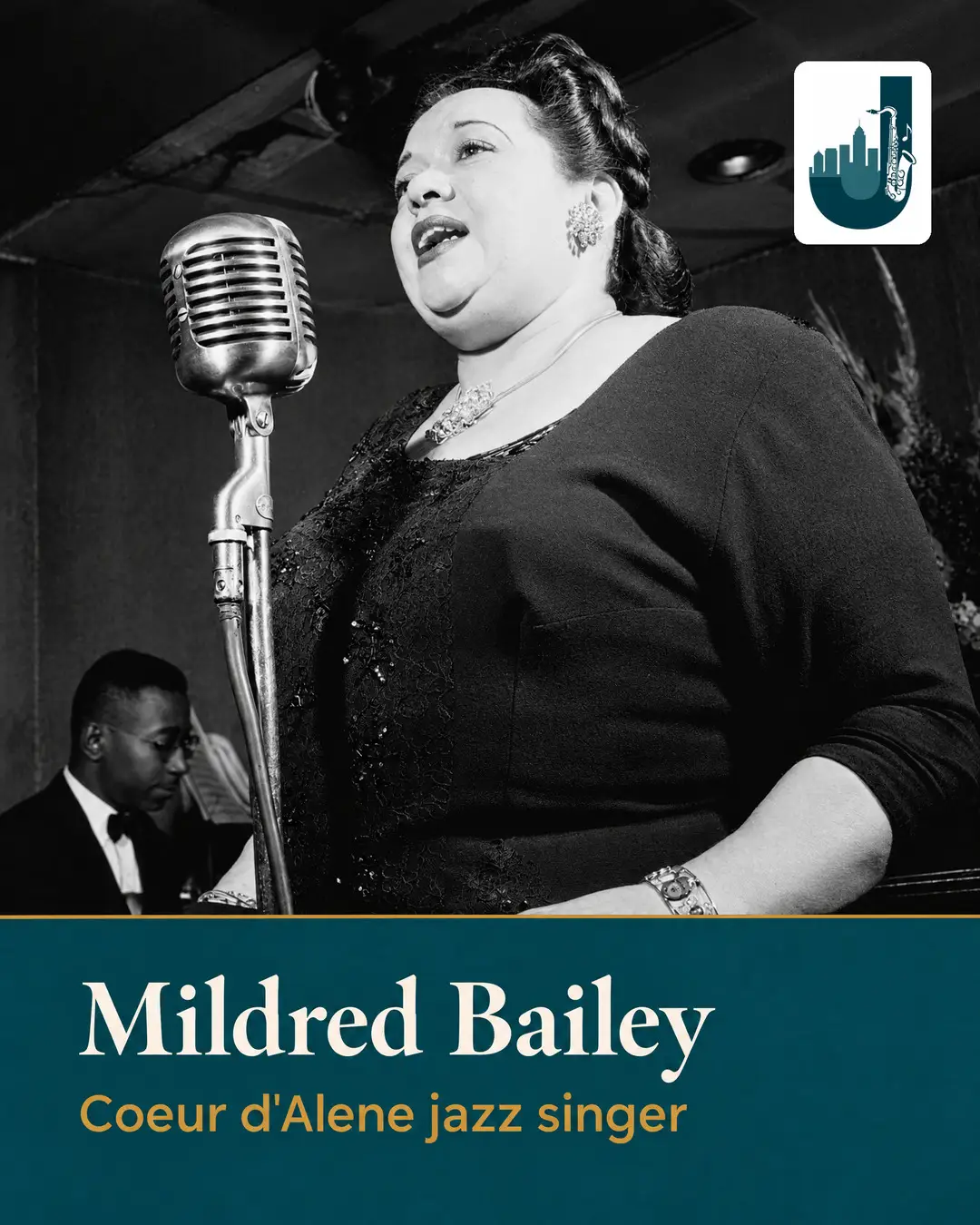
The microphone catches the light before anything else does. Beside it, a singer in a dark dress lifts her face, her mouth open in the middle of a phrase. The archive identifies her as Mildred Bailey, photographed by William P. Gottlieb in New York around April 1947. I’m Harry Hayman, writing from Philadelphia, and this Native American Heritage Month I want to begin with the person at that microphone. A portrait invites us to look. What happens after that depends on how carefully we tell the story attached to the face. For Philadelphia Jazz Experience, Bailey offers a place to begin listening, and a reason to read the credits a little more closely. Her name should lead us toward the music and toward the people who remember where she came from.

The musician behind the microphone
Bailey was a Coeur d’Alene jazz singer. The Coeur d’Alene Tribe’s account of its radio station, KWIS, identifies her as a tribal member. That is where I want to start: with the tribe naming one of its own. Her heritage belongs in a straightforward introduction, beside her profession, without a guessing game about what someone might see in a photograph.
Music was part of her family life. Russell’s biography describes her mother playing piano and teaching Mildred to play, while her father played fiddle. I like beginning with people making music at home. Before the radio microphone and the professional billing, there was someone teaching someone else. That is a concrete part of an artist’s story, and it makes me want to know what happened when she took that knowledge into a working band.
In Kim Wheeler’s account for the National Museum of the American Indian’s magazine, Bailey’s mother is identified as Coeur d’Alene, and the singer’s Native heritage is described as a part of her life that was not consistently acknowledged in jazz narratives. Wheeler also notes that Bailey did not hide that identity. I want to be careful with that distinction. An audience’s incomplete account of a person is different from the account that person gave of herself.
Before the portrait, a place with the band
The photograph belongs to a career already well underway. Sue Russell’s biography for Jazz.com places Bailey’s debut with Paul Whiteman’s band in 1929, on its radio program, singing Moanin’ Low. It also describes her recording Rockin’ Chair with Whiteman’s band in 1932, the song that became her signature. Those are useful listening directions: a band, a song and a period to look for.
Bailey was among the first women to front a major big band. Jim Kershner’s reporting for The Spokesman Review describes her early position with Whiteman and the role played by her brother, Al Rinker, and Bing Crosby in getting the bandleader to hear her. The engagement put her voice into a band with a national radio audience. I want a reader to picture that working role: a singer taking her place in front of the orchestra.
There is a lovely turn in that relationship with Crosby. Kershner recounts that Bailey had helped him and Rinker get their first audition after they arrived in Hollywood in 1925. Their later effort to introduce her to Whiteman followed help she had already given them. I find that exchange more interesting than a simple discovery story. Bailey was already a working musician with connections she could share. The people around her were part of a career she was actively building.
Mr. and Mrs. Swing
Another part of the story is her work with Red Norvo. In its celebration of women photographed by Gottlieb, the Library of Congress identifies Norvo as a vibraphonist and bandleader and recalls the name the couple shared: Mr. and Mrs. Swing. The same account places Bailey’s success with popular songs and early jazz in the late twenties and thirties. It is a useful reminder of how much musical history sits behind a short billing.
Russell describes Bailey recording with Norvo’s group for Brunswick from 1936 to 1939, with arrangements often written by Eddie Sauter. That gives the listener another name to follow alongside the singer and bandleader. A recording brings together several kinds of work. I want to hear the singer clearly, then pay attention to the musical setting around her and the decisions that leave room for a voice.
Try listening once for the words, then again for what happens around them. Where does the band answer? Where does the singer let a phrase finish? I would rather leave those questions open for a listener than prescribe what everyone ought to hear. A photograph cannot give us Bailey’s phrasing, or let us hear how she fits a lyric into the time available. It can hold our attention long enough to make us want those things.
The people keeping her story in circulation
The attention to Bailey’s heritage did not begin with this post. In Jessica Robinson’s 2012 reporting for Boise State Public Radio, the Coeur d’Alene Tribe was campaigning for wider recognition of the singer and her Native identity. Robinson describes Bailey’s childhood on the family’s farm on the reservation in Idaho and the tribe’s effort to bring that background into public view. The reporting gives a reader somewhere to go beyond a short commemorative caption.
There are also people presenting that history through performance. Elizabeth Miller’s reporting in American Indian magazine describes a reenactment at the Coeur d’Alene Tribe’s casino resort that tells Bailey’s story. Miller explains that cultural programming there is developed in conversation with the tribe’s cultural department and tribal members. I appreciate being able to point readers toward an account in which the community is involved in deciding how its history is shared.
The International Jazz Day listing for the Music Conservatory of Coeur d’Alene’s Bailey presentation offers another example. It names director and producer Dr. Gary Edwards as the presenter of a program about Bailey and the tribal casino’s tribute show. These are different ways of making a biography available: reporting, performance and a conversation about the work behind the performance. I want a reader to have access to those people and institutions as well as the archive image.
What I want to carry into Philadelphia listening
For me, the local connection is an approach to jazz education. Jazz Philadelphia’s history timeline describes the city’s long history of Black popular music and its place in the early development of jazz. That history is the context in which I want Philadelphia Jazz Experience readers to meet Bailey. We can acknowledge her Coeur d’Alene identity while keeping the music’s Black history clearly in view.
I would put the photograph next to a recording and a short biography. Let someone hear the song before loading the conversation with conclusions. Then give them the names of the people who made it, and the sources that establish the singer’s background. A listener should be able to follow the evidence without needing to take my word for it.
There is a practical question here for anyone introducing an artist to an audience: what will a person be able to do after reading? In this case, I want them to be able to recognize Bailey, identify her as a Coeur d’Alene musician, and find her work. That is a reasonable beginning for a heritage month post. The listening can continue long after the month ends.
The portrait is useful for that purpose because we can share it with a clear record of its maker and rights. The Commons file record identifies Gottlieb and records the public domain dedication; the Library of Congress account linked above independently confirms that his photographs entered the public domain. The archive’s venue identification is tentative, so I have kept the location to New York. The person at the microphone is the point. Put Rockin’ Chair on next, and give Mildred Bailey the time of a song.
Sources and references
- Mildred Bailey portrait file record, Gottlieb 00391, Wikimedia Commons. Photograph by William P. Gottlieb, around April 1947, New York. Public domain under Gottlieb’s dedication. The hero uses the matching original negative scan from the Library of Congress. Credit: William P. Gottlieb/Ira and Leonore S. Gershwin Fund Collection, Music Division, Library of Congress.
- Coeur d’Alene Tribe, KWIS 88.3. Tribal identification of Bailey as a member; used for identity, not its brief career chronology.
- Kim Wheeler, A Radical Revival, American Indian magazine. Bailey’s Coeur d’Alene heritage and its treatment in accounts of jazz.
- Sue Russell, Mildred Bailey biography, Jazz.com. Whiteman debut, radio performance and Rockin’ Chair.
- Jim Kershner, Coeur d’Alene Tribe celebrates jazz great’s reservation roots, The Spokesman Review. Whiteman engagement and Bailey’s place among early women big band vocalists. Also the career source cited in the social captions.
- Library of Congress, William P. Gottlieb’s Celebration of Women. Bailey, Norvo, their billing and the photographer’s public domain dedication.
- Jessica Robinson, Tribe Seeks To Correct Jazz History On Native Singer’s Heritage, Boise State Public Radio. Childhood on the reservation and the tribe’s recognition campaign.
- Elizabeth Miller, Exploring Native Lands, American Indian magazine. Bailey’s story in the tribe’s cultural programming.
- International Jazz Day, Music Conservatory of Coeur d’Alene presentation on Mildred Bailey. Listed presenter and subject of the educational program.
- Jazz Philadelphia, Timeline. Philadelphia’s Black musical history and early jazz context.
About the Author
Harry Hayman is a Philadelphia-based entrepreneur, music producer, and cultural advocate. Through his work with the Feed Philly Coalition, he explores and documents the creative, culinary, and civic life of a city he believes is one of the most inspired places in America.