Lenape Place Names on Philadelphia's Everyday Map
A closer look at Philadelphia names with Lenape roots, from Wissahickon to Passyunk, and a careful way to learn the history behind familiar places.
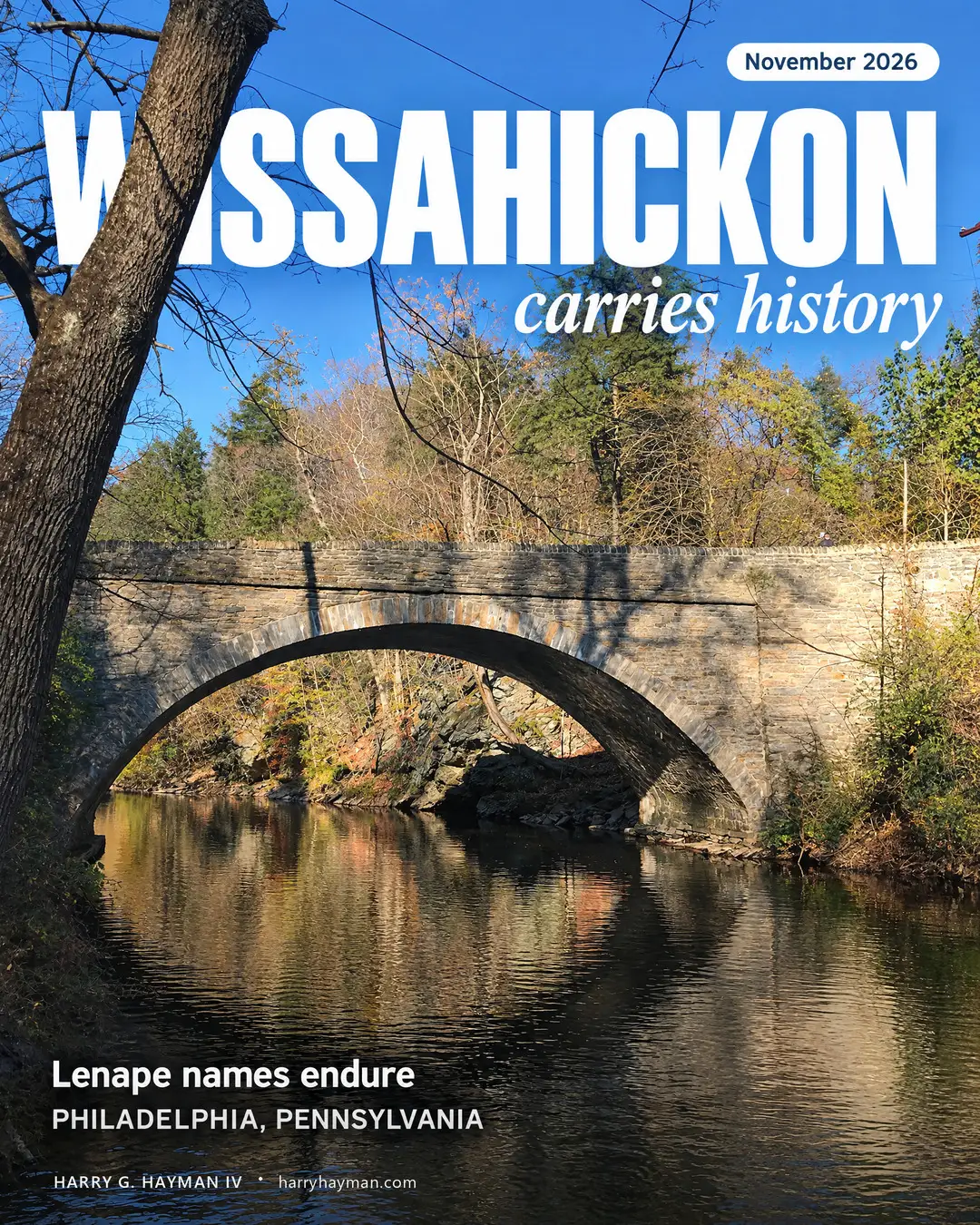
Valley Green Bridge curves over the water, a tree trunk rises close to the camera, and the creek holds the reflection of the stone arch. That is the view in the photograph accompanying this post. I like the way it gives the eye somewhere to settle before asking us to think about a familiar word: Wissahickon. For Native American Heritage Month, I want to spend some time with the names on our own Philadelphia map. SEPTA identifies Wissahickon, Manayunk, Passyunk, Moyamensing, Shackamaxon, Tacony and Pennypack among the names that reflect the city’s Lenape language heritage. A name can become so familiar that we stop asking about it. We know where we mean. We make the plan, give the directions and carry on. There is room for another question before we go.

The creek in the name
Wissahickon Trails explains that Wissahickon derives from the Lenape word wisameckham, which it translates as “catfish stream.” That is an attributed explanation, and I want to keep the attribution beside it. The word suddenly has a connection to the water that a simple location label does not give me.
In the bridge photograph, the creek is plainly visible. There is blue sky above the trees, a dark arch underneath the stonework and water extending toward the bottom of the frame. You can enjoy the picture without knowing anything about the name. Learning its origin adds another reason to look.
I am interested in that small change of attention. A person can arrive knowing which way to turn and leave curious about a word they have used for years. There is no need to manufacture a grand revelation. A creek name is enough to begin with. When I pass along the “catfish stream” explanation, I want to pass along where I found it too. That gives the next reader a way to follow the question beyond this photograph.
Manayunk, before the dinner plans
Manayunk’s neighborhood history traces the name to the Lenape word manaiung and gives the English meaning as “place to drink.” It also records the adoption of the name at a town meeting on May 4, 1824, when the place had been known as Flat Rock. The name familiar to us today came through an act of choosing and adapting an earlier word.
I like putting that history beside an ordinary invitation to meet in Manayunk. The invitation can stay exactly as it is. We can still work out a time, decide where to eat and find each other. But there is now another piece of context to bring along.
The temptation is to make the translation into a joke about an evening out and stop there. I would rather leave room for the older connection the neighborhood history describes. Learning a name asks very little of a busy day. It asks us to pause long enough to hear a familiar destination differently, and to remember that the word reached us through people whose history deserves attention of its own.
Passyunk and Moyamensing deserve a closer look
Restorative Practices at Penn’s land acknowledgement identifies Passyunk as a Lenape name, giving Packsegonk as its source and “in the valley” as the meaning. I would introduce that as Penn’s explanation. A short caption cannot settle every question about language, spelling and historical use, and I do not want its confidence to outrun its source.
Moyamensing offers a useful reason to slow down. Robert S. Grumet’s New York State Museum gazetteer discusses a proposed Southern Unami derivation and traces forms of the name through earlier records. It also identifies Moyamensing Avenue as a place where the name continues in Philadelphia. I am leaving the proposed meaning open here rather than presenting it as a settled translation.
Both names belong in a conversation about the map. They do not need identical explanations to earn their place in it. I want to be able to say what a source supports, show where it says it, and leave a question open when that is the honest answer. That approach makes local history easier to share responsibly. A friend can follow the reference, compare another account and keep learning after the conversation ends.
Shackamaxon, Tacony and Pennypack
PhillyHistory’s account of Lenape places along the Delaware describes Shackamaxon as a Lenape settlement associated with the areas now called Kensington, Fishtown and Port Richmond. Its discussion of the name offers competing derivations, associated with eels or with the making of chiefs. Those alternatives are the point to retain: a familiar spelling does not guarantee one agreed English meaning.
For Tacony and Pennypack, I am keeping the claim narrower. SEPTA includes both among Philadelphia’s names with Lenape language heritage. They can be recognized on that basis without assigning each a translation in this post. The New York State Museum gazetteer also records several possible linguistic connections in its Pennypack entry. Choosing the tidiest one would conceal the uncertainty the reference actually contains.
This is where a map can be a good companion to a conversation. Put the names beside one another and notice how many questions they make possible. Which word names water? Which has been attached to a settlement? How did the spelling we use reach a street sign? I would rather take one of those questions seriously than collect a row of confident answers that cannot survive a second look. A name near home is a manageable place to start.
There are voices beyond the street sign
The Delaware Tribe of Indians describes its Lenape language work and the recordings used in its Talking Dictionary. The Lenape Talking Dictionary identifies itself as the tribe’s official dictionary and offers words, audio, lessons and stories. These are resources to approach on their own terms, with attention to the people doing the teaching.
I want a post about place names to lead somewhere beyond a list of old words. Hearing a speaker and reading a neighborhood explanation are different ways of learning. Both require attention to the source, and neither makes me an authority on someone else’s language. The dictionary is a place to listen and learn; it is not a reason for me to invent a translation of a Philadelphia name.
That feels like a useful next step after the map. Keep the local name in view, then follow the link to the language work the tribe is sharing. There is no requirement to master everything in an afternoon. Taking the time to listen is already a more thoughtful use of our curiosity.
A neighborhood habit for November
For this month’s Harry Hayman Philadelphia post, my invitation is small enough to fit into an ordinary day. Choose one familiar place name. Open a source about it. Read carefully enough to distinguish a documented use from a proposed meaning, then bring that distinction into the next conversation.
If two explanations disagree, keep both references. There is no need to turn a walk into a test or to correct a friend with more certainty than the evidence allows. A simple “this is the explanation I found” leaves room for a better source and another conversation. I would welcome both.
The place itself still gets to be the place. There is water under the bridge, time to spend with someone you like and a name worth asking about. Start with the one you were already going to use when you gave the directions.
About the Author
Harry Hayman is a Philadelphia-based entrepreneur, music producer, and cultural advocate. Through his work with the Feed Philly Coalition, he explores and documents the creative, culinary, and civic life of a city he believes is one of the most inspired places in America.
Sources and references
- SEPTA: Indigenous Peoples’ Day and Lenape place names
- Wissahickon Trails: the creek name and Lenape heritage
- Manayunk: Then and Now, neighborhood naming history
- Restorative Practices at Penn: land acknowledgement and Passyunk
- New York State Museum: Robert S. Grumet, Beyond Manhattan, a gazetteer of Delaware Indian place names
- PhillyHistory: Lenape places along the Delaware
- Delaware Tribe of Indians: Lenape language preservation and learning resources
- Lenape Talking Dictionary: the official dictionary of the Delaware Tribe
- Photograph: Greenhorse0828, Wissahickon Creek, Valley Green Bridge, via Wikimedia Commons. The downloaded photograph is an unchanged JPEG rendition of the original. The companion poster is an adaptation that adds typography and may crop the photograph; any such adaptation is offered under the same license.
- Photo and adapted poster license: Creative Commons Attribution ShareAlike 4.0. Credit Greenhorse0828, link the original and this license, and identify the final typography and any crop as changes. No endorsement is implied.