The Lenape and Philadelphia: Native American Heritage Month
Native American Heritage Month in Philadelphia begins with the Lenape, their living communities, the Penn wampum belt and a place to listen.
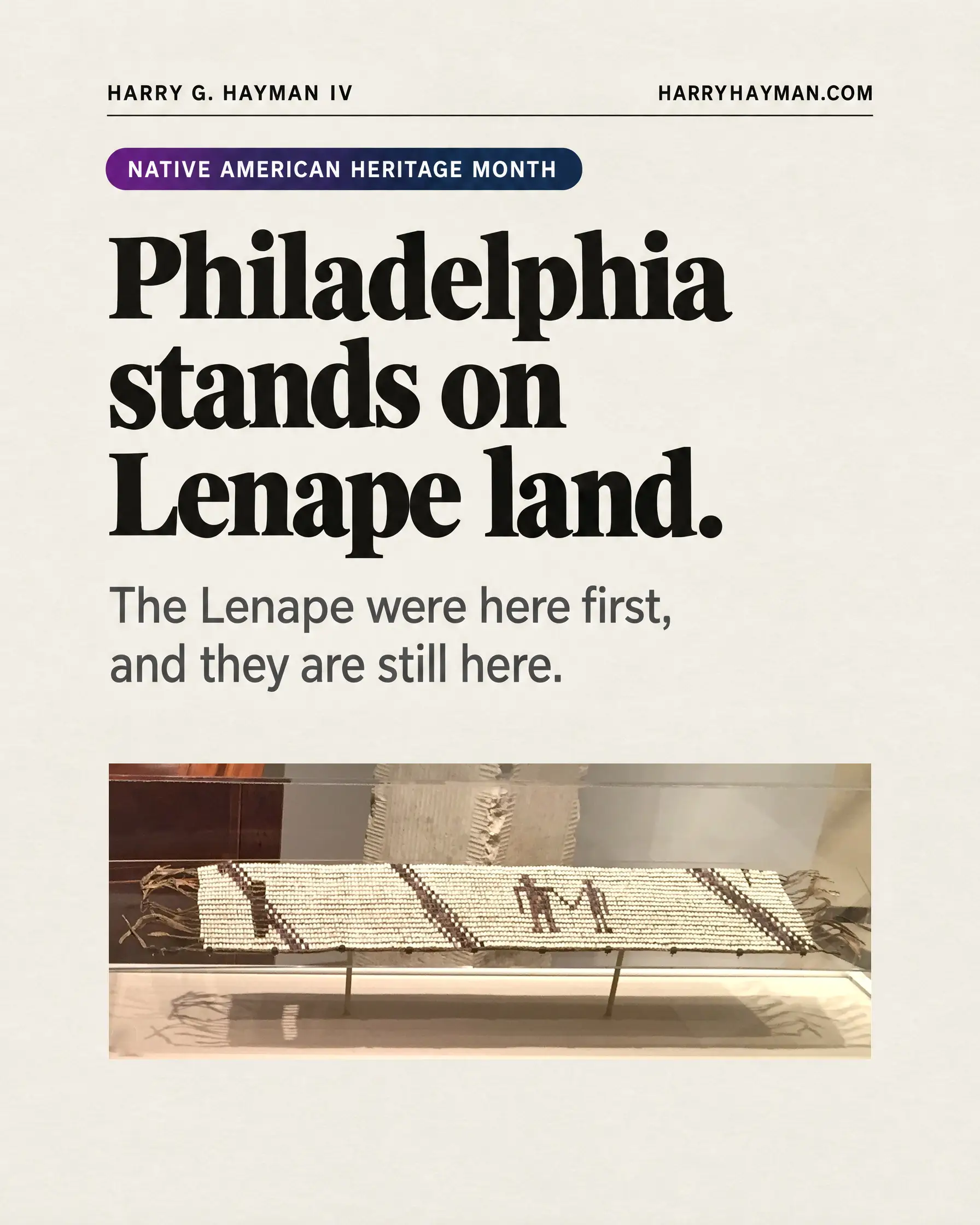
Two figures hold hands in the middle of the belt. White shell beads run across it, interrupted by purple diagonal bands. In the photograph used for this post, the small figures are easy to find even before you know the story attached to them. I want that image to make us pause over how we introduce Philadelphia. I love welcoming people here. But a welcome carries some responsibility for knowing the place, including whose history gets a name and whose gets pushed into a sentence about long ago. Philadelphia stands on Lenape land. The Lenape were here before the city, and Lenape nations are here today. Native American Heritage Month gives me a reason to hold those facts together instead of stopping after the first one.

What November asks of Philadelphia
Before the objection arrives: yes, the dates are old. A month devoted to heritage naturally sends us toward the archive. I want to go there, too. I just don’t want to close the archive and leave an entire people inside it.
The national observance has a specific legislative history. The Library of Congress account explains that Congress passed a joint resolution in 1990 authorizing and requesting a presidential proclamation designating November 1990 as National American Indian Heritage Month. President George H. W. Bush issued Proclamation 6230. The national heritage month website records similar annual proclamations, under varying names, since 1994. The calendar gives us a shared time to pay attention. It doesn’t put a deadline on the learning.
I think about this through the work of a host. You can know how to get someone to a restaurant, what to recommend, how to make an evening comfortable, and still have questions about the ground under the building. Those questions belong in the welcome. I don’t need to pretend that I can answer all of them. I do need to make room for people who can tell their own histories, without turning their lives into background for mine.
The belt, and the limits of its story
The photograph shows the Penn wampum belt, often called the Peace Treaty Belt. By tradition, it was given by the Lenape to William Penn in connection with the treaty at Shackamaxon in 1682. Drexel’s recent account of the belt describes it as said to have been given to mark that treaty. The traditional account gives the object a place in the city’s memory; it leaves questions for anyone trying to establish exactly what happened.
Delaware Nation’s history of Penn’s dealings with the Lenape notes that no paper documents from that agreement survive. I can’t turn a traditional association into a witnessed scene under an elm. The image is strong enough without supplying dialogue, promises or a precise encounter that the evidence cannot establish.
There is also a difference between where an object was once held and who cares for it now. The Atwater Kent Collection at Drexel includes the belt in its Historical Society of Pennsylvania collection. Its account records the transfer of stewardship from HSP to the Philadelphia History Museum under a 1999 agreement. Drexel’s exhibition announcement identifies the belt with the Atwater Kent Collection at Drexel. I wouldn’t send someone to HSP on the assumption that the belt is on display there.
The hands at the center make me think about a relationship that needs attention from both sides. I can respond to that image as someone who lives here while leaving the interpretation of the belt to people with the knowledge to explain it.
A city map with Lenape names
Lenapehoking is the Lenape homeland, including the ground Philadelphia occupies, as the city’s own land and life acknowledgment recognizes. The Delaware Nation history describes a homeland encompassing eastern Pennsylvania, New Jersey, Delaware and parts of New York, Connecticut and Maryland. A city boundary is a small frame for that history.
Even the familiar names can slow me down. A Pennypack watershed conservation plan hosted by the Philadelphia Water Department identifies Wissahickon, Pennypack and Poquessing as names with origins in the Lenape language. A name can become so familiar that I stop hearing it as a word from another language. I want to catch that habit. Knowing that a name has a language behind it is already a reason to ask a better question about the place.
Tamanend has a name, too. The National Park Service identifies him as a Lenni Lenape leader who met with and signed treaties with early Pennsylvanians. That is a person engaged in diplomacy, with decisions to make. I want to hold onto that specificity when I talk about Philadelphia’s beginnings. It is easy to mention a founder and leave the people across the negotiating table unnamed. I would rather spend another minute getting the names into the conversation.
The Lenape nations speaking now
The present tense has addresses and institutions behind it. Delaware Nation names contemporary Lenape nations in Oklahoma, Wisconsin and Ontario, including Delaware Nation, the Delaware Tribe of Indians and the Stockbridge Munsee Community. Its history explains the forced removals that scattered Lenape communities. It also identifies the Walking Purchase of 1737 as a fraudulent dispossession. A photograph of clasped hands cannot carry the whole account of what followed.
Closer to Philadelphia, the Nanticoke Lenni-Lenape’s own history describes its community in New Jersey and its work serving Native people in the Delaware Valley. I want readers to have that source in the community’s own words. A regional community and a nation whose government is now far from its homeland each deserve to be read with attention to their particular history. I wouldn’t flatten them into a single organization, or treat distance from Philadelphia as distance from a connection to this land.
The Delaware Tribe of Indians’ Lenape language resources point to its official dictionary and lessons. Those are useful words on a screen today, made available through language preservation work. I’m grateful for the people doing that work. There is a big difference between being able to recognize a name on a sign and being able to hear the language it comes from. I have no authority to speak for the Lenape. I can make sure a reader has a way to reach people speaking for themselves.
A gallery with living voices
For a concrete place to begin in Philadelphia, there is Penn Museum’s Native North America Gallery. The museum says it developed the gallery with eight Indigenous consulting curators. Its Northeast section addresses the Lenape, and its curator roster includes Jeremy Johnson, Cultural Education Director for the Delaware Tribe of Indians. Those are people helping decide how the history reaches the visitor.
The same gallery page presents I Am More Than Fluff, a 2022 work by Holly Wilson of Delaware Nation, alongside its account of the exhibition. A contemporary artist has a name and a work with a date attached. For me, that is a useful interruption to the habit of looking for Native people only in the oldest part of a museum.
I want to be careful with the invitation. A visit doesn’t make someone an expert. It gives us a place to spend time with the material and the perspectives of people who helped shape its presentation. The questions can remain open when we leave. I would like to come back to a city conversation where the next person knows the gallery’s name, knows one artist’s name, and has another question ready.
If you are deciding what to do with Native American Heritage Month, put a visit on your calendar. Visit the Native North America Gallery at Penn Museum, and give the Lenape section some time.
Sources and references
- City of Philadelphia: Farm Philly land and life acknowledgment
- Library of Congress: heritage month history and overview
- National Native American Heritage Month: about the observance
- Delaware Nation: history, homeland, forced removals and living nations
- Drexel University Libraries: the belt in the Pennsylvania founding exhibition
- Atwater Kent Collection at Drexel: special collections and the HSP transfer
- Drexel University: the exhibition and the belt’s collection attribution
- Philadelphia Water Department: Pennypack Creek conservation plan, cultural history, page 2-15
- National Park Service: Tamanend
- Nanticoke Lenni-Lenape: our tribal history
- Delaware Tribe of Indians: Lenape language and official dictionary
- Penn Museum: Native North America Gallery, artists and consulting curators
- Worldhistoryguru67: The Peace Treaty Belt, Wikimedia Commons. Photograph by Worldhistoryguru67, own work, used in the accompanying poster; reproduced within the designed page layout.
- Creative Commons: Attribution ShareAlike 4.0 International license. The belt photograph is licensed CC BY-SA 4.0.