Owamni and the Business Decisions Behind Indigenous Sourcing
Owamni offers Philadelphia hospitality operators a lesson in sourcing, supplier relationships and making restaurant values part of daily work.
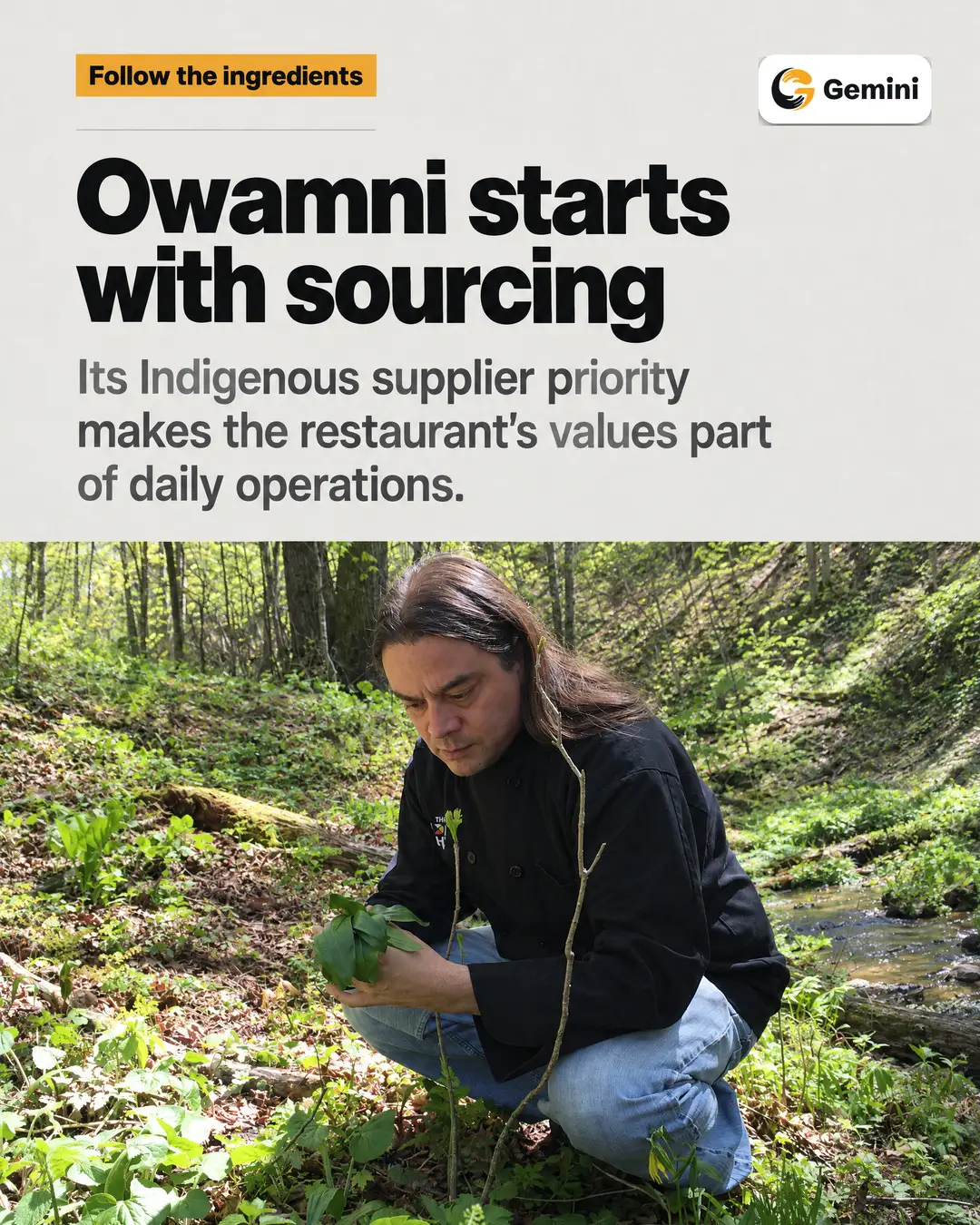
Sean Sherman is crouched beside a stream, looking down at the plants in his hands. The photograph of Sherman foraging wild ramps is a useful place to start thinking about a restaurant. Before the dining room, before the menu language, there is an ingredient and somebody who knows it. I’m looking at this from Philadelphia during Native American Heritage Month, following the decisions behind Owamni in Minneapolis. What interests me is the documented work: which ingredients the restaurant chooses, which producers it prioritizes and how the organizations around it support that work. Follow those decisions in order and you get an operator lesson with something concrete to act on back home.

Start with the ingredient rule
Owamni’s current restaurant site describes a clear boundary: it excludes colonial ingredients including beef, pork, chicken, dairy, wheat flour and cane sugar. It gives priority to purchasing from Indigenous producers. Those are separate decisions, and I want to keep both in view. One defines what the kitchen cooks with; the other identifies whose businesses it seeks to buy from.
I read that as a purchasing specification. Put yourself at the point of approving a substitute. A delivery is unavailable, somebody has offered an alternative and service is approaching. Does the replacement meet the ingredient rule? Does it meet the purchasing priority? A statement of values becomes useful to the person placing the order when it helps answer that ordinary question.
The distinction between priority and exclusivity matters. The restaurant says Indigenous producers first. I won’t turn that into a claim that every purchase comes from an Indigenous business. Specific wording makes the policy something an operator can understand and a guest can evaluate without having to guess what was promised.
For me, this is where Owamni starts with sourcing. Its Indigenous supplier priority makes the restaurant’s values part of daily operations. The next step in my reading is to find the people and institutions doing that work.
Keep the founders in the picture
Sean Sherman’s own biography identifies him as Oglala Lakota and describes his research into Indigenous ingredients and relationships with tribal producers. MPR News’s report on Owamni’s award names Sherman and Dana Thompson as its co owners and records that the restaurant opened in 2021. Both belong in an account of how this restaurant began.
The recognition is precise too. The James Beard Foundation’s 2022 winners list names Owamni, Minneapolis, as Best New Restaurant. That is a restaurant award in a particular year. It gives me a documented reason to call the restaurant celebrated, without making an unsupported statement about its sales or the return on any particular supplier relationship.
I can admire that result and still keep the credit where it belongs. Sherman, Thompson, their colleagues and the Indigenous producers brought knowledge and work to this restaurant. Their food traditions aren’t a theme for another business to borrow. The useful assignment for an outside operator is to examine the integrity of our own purchasing decisions, while learning from the people who made these decisions in their own context.
Follow the restaurant into NATIFS
The organisational story goes beyond the founding partnership. In its September 2023 acquisition announcement, North American Traditional Indigenous Food Systems, or NATIFS, announced that it had acquired Owamni. The announcement explains the restaurant’s intended role in creating jobs, training people, increasing demand for Indigenous producers and supporting programming with restaurant revenue.
That helps me understand the business design. A restaurant creates a place to use ingredients and train people through actual service. Under this arrangement, its relationship to the broader mission includes ownership and the use of revenue. I would assess those choices separately from the publicity surrounding an award. A financial structure has to do its work after the announcement has passed.
NATIFS’ description of the Indigenous Food Lab identifies an education and training center whose scope includes food identification, gathering, cultivation, preparation and starting and running a culinary business. Its vision for the wider network connects professional kitchens, teaching and access to products from Indigenous purveyors. These are defined functions, rather than different names for the restaurant.
Then there is the Indigenous Food Lab Market, an online shop owned and operated by NATIFS that broadens access to Native made products. Reading these descriptions together, I see several ways to support food enterprises: education, a restaurant buying ingredients and a market reaching customers. I wouldn’t assume they have identical buying rules. Each has its own role.
Read the current business, too
There is a current chapter to include in a November 2026 post. The restaurant’s June 2026 announcement introduces Indígena by Owamni at the Guthrie Theater in Minneapolis. It describes the restaurant as NATIFS’ commercial arm and outlines dining before theater performances and drinks and bar food after them. The current site continues to state its Indigenous purchasing priority and ingredient exclusions.
I find the connection between the operating principle and the new setting worth watching. Serving someone before a performance creates a timing requirement. Serving someone afterward creates another occasion to visit. Those service choices can be evaluated alongside sourcing: what can the kitchen prepare within the available time, and what does a producer need to know about demand?
That is my reading of the operating questions, rather than a report from inside the kitchen. I don’t have the restaurant’s purchasing ledger or margins. The award, the ownership structure and the new location don’t establish that every sourcing decision saves money or guarantees profit. They do give us a specific business to study, with stated priorities that survive beyond one menu or dining room.
Bring one order sheet back to Philadelphia
For a hospitality operator in Philadelphia, I’d begin with one ingredient. Choose something you buy regularly and write down the promise you make about it. Perhaps the promise concerns the producer, the place it comes from or a method of production. Make it specific enough that the person receiving a delivery could check it.
Then follow the transaction. I would ask who places the order, what notice the supplier needs, what volume the kitchen can reasonably commit to and when payment arrives. These are proposed questions for our own businesses. They aren’t claims about Owamni’s private contracts. They help turn admiration into work a purchasing manager and chef can do together.
Next, decide who can approve a replacement. If the usual ingredient isn’t available, should the dish change, should the menu description change or should another approved producer receive the order? Write the answer before a busy service. Otherwise, the person under pressure has to invent a policy while also trying to get dinner out.
I’d give the service team the same information. A server should be able to name the producer accurately and explain the ingredient without embellishing the story. That is how I think sourcing can build a brand and a business: purchasing, preparation and the guest’s experience begin to support the same promise. It remains a management task, with costs and tradeoffs to check.
During Native American Heritage Month, I want the attention here to stay with the expertise of Sherman, Thompson, the Owamni teams and Indigenous producers. The practical invitation is to take their work seriously enough to study the decisions. Bring your next order sheet, choose one ingredient and follow the payment all the way to the person supplying it.
About the Author
Harry Hayman is a Philadelphia-based entrepreneur, music producer, and cultural advocate. Through his work with the Feed Philly Coalition, he explores and documents the creative, culinary, and civic life of a city he believes is one of the most inspired places in America.
Sources and references
- Owamni’s current restaurant site, purchasing philosophy and ingredient exclusions.
- Sean Sherman’s official biography and Oglala Lakota identity.
- MPR News, Owamni’s 2022 award, founding partners and 2021 opening.
- James Beard Foundation, the 2022 award winners.
- Owamni, NATIFS acquisition announcement, September 15, 2023.
- NATIFS, Indigenous Food Lab education and training scope.
- NATIFS, vision for Indigenous food infrastructure.
- Indigenous Food Lab Market, official shop and ownership.
- Indígena by Owamni, June 18, 2026 announcement of the Guthrie location.
- Hero photograph: Sean Sherman foraging wild ramps, by DThompson1313, via Wikimedia Commons. Original photograph dated May 4, 2016; supplied without modifications. It predates Owamni and does not show its dining room.
- Photograph licence: Creative Commons Attribution ShareAlike 4.0 International. Credit DThompson1313, link the licence and identify any subsequent crop or adaptation; applicable adapted material is shared under the same licence.