Kansas City's 248 free orchards and the stewards who keep them alive
I want Philadelphia to look at how Kansas City's free orchards keep producing, and put support for the people caring for trees into the budget.
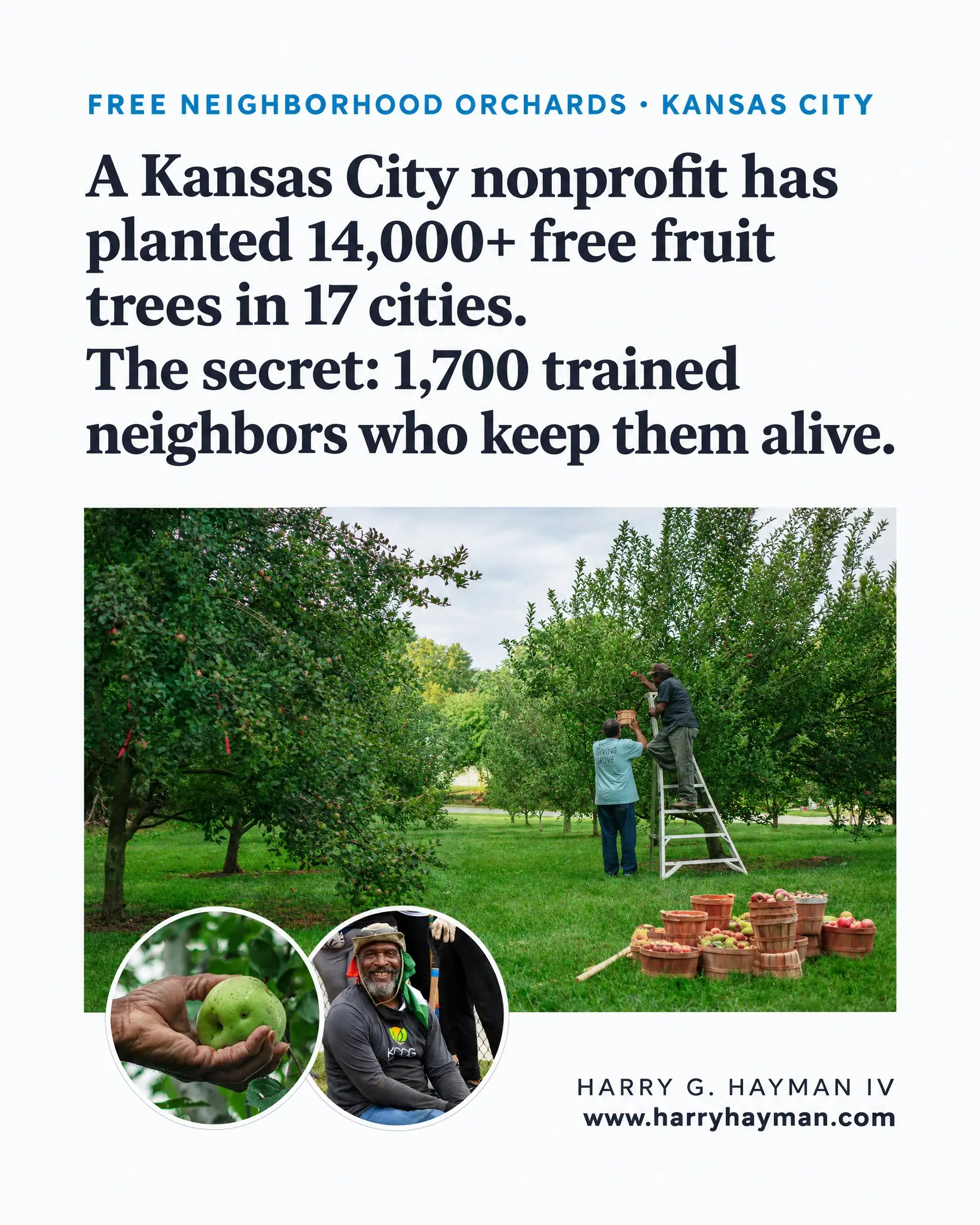
Who’s pruning the trees in year three? That’s where I want the conversation about vacant lots to begin. Anyone can put a sapling in the ground for a photo op. The harder promise is to keep coming back when planting day is long over, the original volunteer has moved away and the branches still need attention. I want Philadelphia to make that promise with its eyes open.
Kansas City’s Giving Grove gives us something practical to look at. The story has fruit trees, a shuttered school and free food for anyone walking by. But what gets me excited is the commitment behind the trees: neighbors who learn how to care for an orchard, with people they can call when they need help. We can buy a tree. We also have to decide how we will support the person responsible for keeping it alive.
A schoolyard before a national network
The beginning matters because this wasn’t a finished national program dropped into a neighborhood. According to KCUR’s reporting on The Giving Grove, it was a concept 14 years ago. The first trees went into Hale Cook Elementary in Waldo 13 years ago, when the district had shuttered the school. It has since reopened.
I keep coming back to that schoolyard. A place whose school doors had closed became a place to start growing food. We don’t have to invent a grand story around it. The actual choice is interesting enough: put something useful in the ground, then organize the care that lets it stay useful.
Working with Kansas City Community Gardens, the Kansas City program reached 248 free orchards with almost 4,600 fruit, nut and berry trees, the same KCUR report explains. Across the wider network, it counted 847 orchards, more than 14,000 trees and 17 cities. The fruit is free for anyone who walks by.
That last part changes how I think about the land. A tree can be part of the food available to a neighborhood. For that to mean anything over time, somebody has to know how to care for it. The permission to pick the fruit is only part of the promise.
The person with the pruning knowledge
Founder Kevin Birzer put the original commitment plainly in the KCUR report: “So our thought from day one was we would provide that expertise, the knowledge of how to grow the trees, how to select the trees.”
There’s a budget decision hiding in that sentence. If expertise is something you promise, you have to keep making it available. You can’t treat it as a speech delivered at the planting and assume the neighborhood has everything it needs afterward.
KCUR describes about 1,700 volunteer orchard stewards, with training, workshops and help a phone call away. The support includes soil, grants, pruning and succession plans when a steward moves away. I like that they name the handoff. Moving is a normal part of life. An orchard plan ought to make room for it instead of treating the departure of a volunteer as some unforeseeable disaster.
The Giving Grove is the place to start for the organization itself. For anyone considering the practical work, I’d also point to its planting and maintenance resources. Read those before making promises about a lot. I’d want the people proposing an orchard to spend as much attention on its care as they spend choosing where to plant.
Not just a planting crew. Not just a bag of tools. Not just an enthusiastic neighbor expected to figure everything out alone. I want a named person who can ask for help, a way to get that help and a plan for who learns the job next. That’s the part I’d put in front of a funder.
An invitation and a continuing budget
Another detail in the KCUR account deserves attention: The Giving Grove only helps where it is invited. St. Louis was its first expansion city, nine years ago; the network now reaches from Seattle to Atlanta. Growth still starts with an invitation.
GOOD. I’d want a neighborhood to want the orchard before anyone starts congratulating themselves for bringing it there. There’s a difference between seeing an empty lot and understanding what the people around it want to do with it. An invitation gives that conversation a place to begin.
For readers considering how to organize the work, the organization’s program and approach are worth reading alongside the reporting. My interest is in the relationship that continues after the planting. Who listens when the steward has a problem? Who helps when the person doing the work changes? Those are questions I’d bring to the planning meeting.
KCUR puts the annual cost to staff and supply new orchards at a little more than $1 million. Much of the funding comes through 1% for the Planet, alongside corporations and individual donors. I read that as a reminder that free fruit still requires funded work. Somebody pays for the support that makes the harvest possible.
I wouldn’t divide that figure by the orchard count and call the answer a Philadelphia price. It isn’t a local proposal or a quote for caring for an existing site. What it gives us is a reason to ask for a continuing budget, with the people and responsibilities spelled out, before we celebrate the trees.
Count what keeps producing
The figure I want beside every planting photograph is the one KCUR reports about continued production: more than four out of five Giving Grove orchards planted remain in production. That tells us something a planting total cannot. The work has continued at those sites.
The NPR report carried by NHPR describes almost 850 orchards producing more than 2.5 million pounds of fruit and nuts a year. I would keep the reporting’s language intact: almost 850 there, 847 in the KCUR account. These are descriptions of the network, not a promise about what a proposed Philadelphia lot will produce.
I also wouldn’t use those totals to claim that training alone explains every orchard that lasts. The reporting describes a support model and a result. That’s enough to justify looking closely at how the model works without pretending we have an experiment that isolates every cause.
Still, continued production is a useful demand to make of a food project. If we say a lot is going to feed people, I want us to come back and ask whether it does. A photo can show that a tree was planted. A harvest tells us something else. We need to care about what happens after the picture.
Philadelphia already has people doing this work
We’re not starting from zero. The Philadelphia Orchard Project’s website lists 58 orchards planted, 72 supported and 1,731 trees planted in its November 2026 counters. Those are different measures. I want us to notice the word supported as carefully as we notice planted.
Kansas City’s example gives me a way to ask about sustained support here. It doesn’t give me a reason to dismiss work already happening in Philadelphia or assume our local orchard partners lack expertise. I’d start by asking those partners what would make their existing work easier to carry forward. Where would steady funding help? What support do their stewards want? What happens when someone needs to step away?
A vacant lot that feeds a block every August is infrastructure. That’s how I want us to budget for the possibility: with care, responsibility and continuity attached. Fund the stewards, not just the saplings. That means treating the time spent teaching, answering the phone and planning a handoff as part of the orchard itself.
For a land bank, I’d want the care plan in the conversation about the lot. For a school board, I’d want to know who carries the work forward when the people involved change. For a neighborhood group, I’d want a willing steward to have somewhere to turn when enthusiasm runs into a question they can’t answer.
The next planting proposal can answer those questions before anyone picks up a shovel. Put the steward’s support in the budget. Make the handoff somebody’s responsibility. If you sit on a land bank, a school board or a neighborhood group, ask who will prune the trees in year three before you plant a single one.
Sources and references
- KCUR: A Kansas City nonprofit turned vacant lots into free fruit orchards.
- NPR via NHPR: Group that plants fruit trees in vacant lots grows to cities nationwide.
- Philadelphia Orchard Project.
- The Giving Grove planting and maintenance resources.
- The Giving Grove program and approach.
- Photographs: The Giving Grove. The poster at the top of this page is a designed graphic built from these photographs.