After Kroger Left, Southeast Raleigh Broke Ground on a Grocery Store It Owns
Southeast Raleigh is building a grocery store its neighbors own. I look at what Philadelphia can learn, including why ownership still needs sales.
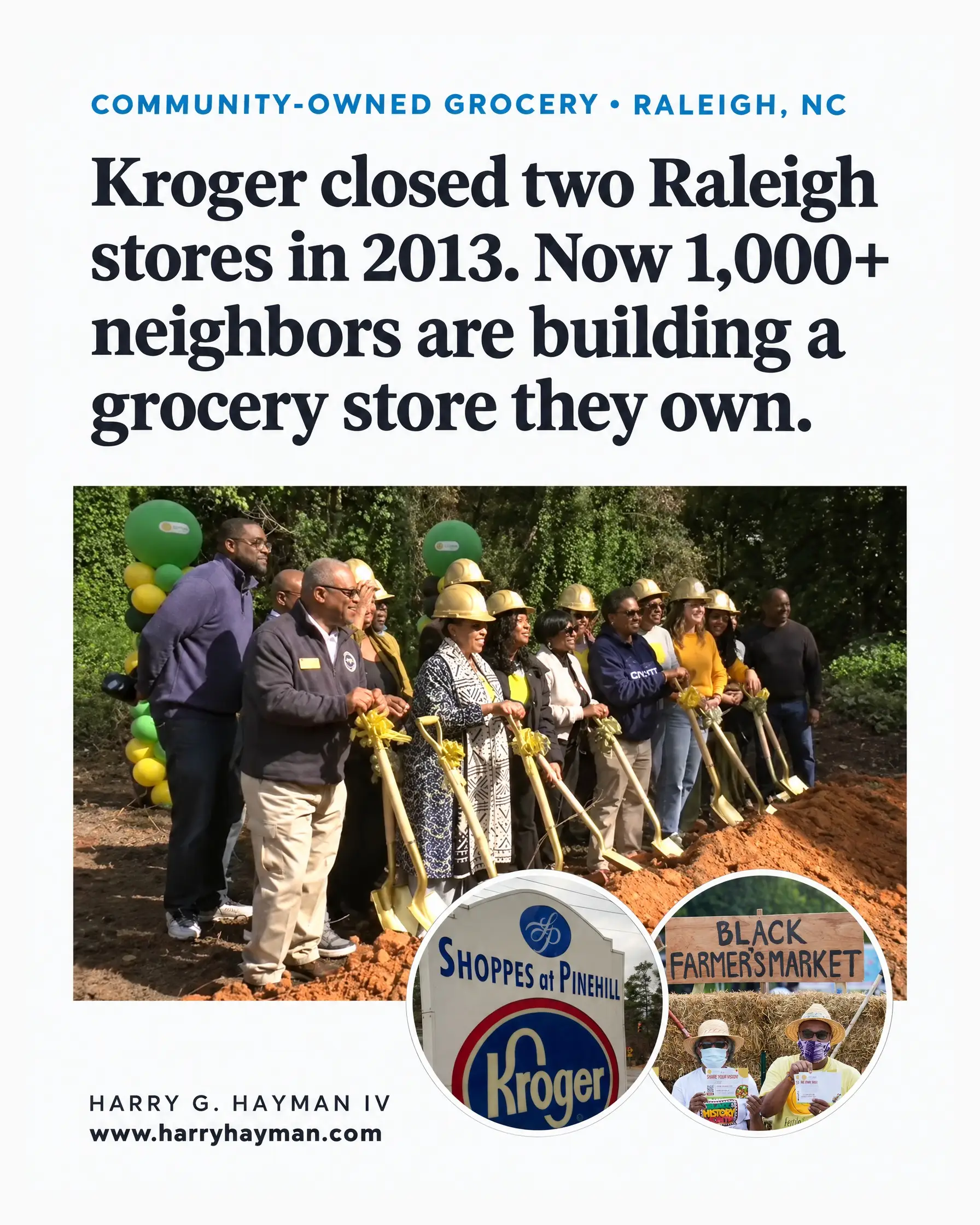
Your grocery store is leaving, and you find out from the newspaper. I keep coming back to that part of the Southeast Raleigh story. The people who depended on those aisles weren’t the people deciding whether the doors would stay open. Now neighbors are building a store they own through Fertile Ground Food Cooperative, and I want Philadelphia to look closely at how that works.
I also want us to keep Kensington Community Food Co-op’s closure in the conversation. A grocery store can belong to its community and still close. If we skip that because the groundbreaking photographs look good, we’re asking people to risk their money on half a story. There’s something worth copying in Raleigh. Let’s be honest about the work it requires.
Finding out after the decision
Raleigh Public Record’s account of the Kroger announcement names the stores at 1610 Martin Luther King Jr. Boulevard and 4111 New Bern Avenue. Kroger said both had been unprofitable. Residents hadn’t been notified before The News & Observer reported the closures. WUNC reports that the stores closed in 2013.
I don’t need to turn Kroger’s employees or managers into villains to see the problem here. A business has to cover its costs. Nobody gets to wish that away. But a neighborhood still needs groceries when a company decides its local stores don’t earn enough. The company’s decision and the residents’ need operate on different clocks, and the residents don’t get to stop eating while another plan comes together.
That’s the part I want us to question. How much say do people have over a place they depend on? When the answer is that they’ll hear about its closure through the press, I think it’s reasonable to start looking for a different ownership arrangement. Southeast Raleigh has been doing that work.
What a member-owner actually gets
Fertile Ground Food Cooperative lists 1,044 member-owners and a goal of 2,000 before the store opens. The arrangement gives a member one share and one vote on major decisions. WUNC describes the Black-led store, open to anyone, and its development from an earlier cooperative cafe plan into a grocery store residents control.
I like being able to explain the arrangement without a sales pitch. Buy a share, become an owner, have a say. The ownership and any returns to members stay with that local membership. That’s the appeal of keeping the store’s profits local. It doesn’t mean there’s already a profit to distribute, or that every good intention becomes money in a member’s pocket.
A share and a shopping basket do different jobs. The share helps establish the ownership. The basket brings in sales. If I were considering this for a Philadelphia neighborhood, I’d want both conversations happening together, with no embarrassment about asking people where they actually plan to buy their groceries.
Wanting a store nearby is understandable. Becoming an owner asks for a commitment. Shopping there regularly asks for another. I wouldn’t treat those answers as interchangeable, and I wouldn’t call a membership list a sales forecast. I’d want to hear what would make a neighbor come back with a grocery list after the excitement of joining wears off.
A building people can use beyond the grocery trip
ABC11 reported the groundbreaking on October 24, 2026. Its account traces the idea to neighbors talking about healthier food more than a decade ago. Architect Andre Johnson explained the plan this way: “The building is designed to both be a grocery store, but also a community center.”
WUNC places the site beside the JD Lewis Multipurpose Center and describes plans for a community garden, gathering spaces, and fresh food from Black farmers and regional growers. It also reports more than $5 million raised. I see a plan that connects the grocery trip to local growers and gives neighbors a place to spend time together.
The gathering space catches my attention because it gives people another reason to use the building. But I’d still ask how that space will be run and paid for. Who handles it when something breaks? What will it cost to keep it clean? Those are questions I’d bring to any proposal, not problems I’m claiming Fertile Ground has failed to address.
I’m excited by a building people can make part of their ordinary lives. I also want the cost of keeping it useful in the budget from the beginning. The garden and the groceries both deserve that kind of care. Putting them in the same plan means thinking through how each will keep working.
Philadelphia already knows co-ops can close
The Philadelphia Inquirer’s account of Kensington Community Food Co-op’s opening describes an 11-year effort before the doors opened in April 2019. The Food Co-op Initiative told the paper that opening a cooperative typically takes at least five to seven years. Then came the Inquirer’s report of Kensington’s permanent closure, after years of sagging sales.
So, co-ops fail. Fair. I won’t wave that away as an inconvenient detail. People put effort and hope into getting Kensington open. Its closure belongs in any serious Philadelphia conversation about community grocery ownership.
What I won’t accept is using that closure to end the conversation. A chain closing a store doesn’t make all chain groceries impossible. A cooperative closing doesn’t settle the question for every cooperative either. It does tell us to ask harder questions before we encourage neighbors to buy shares.
I’d want a proposal to explain what happens when sales come in below expectations. How long can it operate? Which costs can change, and which bills keep arriving? Who has the authority to make a difficult decision? I don’t know Fertile Ground’s answers to all of that. These are the questions I’d take into a room where people are considering putting their own money into a store.
The slow part deserves attention
WUNC reports that Fertile Ground’s slower timeline is deliberate: prevent debt, help the store stay afloat, and bring profitability to members sooner. That reasoning interests me more than a promise to move fast. It gives the long wait a business purpose, while leaving the actual outcome to be earned.
I want a neighborhood grocery to have enough room in its finances to survive ordinary trouble. Equipment needs attention. Orders don’t always sell as expected. Those are operating questions I’d put in a budget, rather than treating every dollar raised as money available for the building.
Going slowly has a cost, too. People waiting for a store still need food now. I wouldn’t ask them to be endlessly patient or pretend a cautious construction plan meets an immediate household need. The challenge is to protect the store’s future without losing sight of the people waiting for it.
And slow doesn’t automatically mean sound. I’d judge the pace by what it accomplishes: less debt, clearer commitments, better preparation for paying the bills. A long timeline needs an explanation. Here, the reported explanation is about keeping the business afloat. I want to watch whether that preparation holds up when the owners become regular customers.
What I’d ask a Philadelphia neighborhood to do now
I’d start with a conversation about shopping, before choosing a building. Ask neighbors what they buy, what they can afford, and what would make them use the proposed store every week. Listen when someone says the plan doesn’t fit their household. That answer helps more before money is committed.
Then I’d put the membership question beside it. Who would buy a share? Who would shop? Some people may want ownership without changing their grocery routine. Others may need the store without being ready to become owners. I’d want a plan that understands those differences and can explain how it expects to pay its bills.
Raleigh has done the long work of organizing toward a store residents control. Philadelphia has a local closure that should make us careful with promises. I want us to learn from both, with enough optimism to organize and enough respect for people’s money to test the plan.
If your neighborhood is a closure away from a food desert, don’t wait for the newspaper story. Count the neighbors willing to buy a share. Count the neighbors willing to shop every week. Those counts decide whether you’ve got a business to build. Get them now.
Sources and references
- Raleigh Public Record: neighbors respond to the Kroger closure announcement.
- WUNC: Fertile Ground’s grocery plans, ownership and approach to debt.
- ABC11 WTVD: Fertile Ground Food Cooperative breaks ground.
- Fertile Ground Food Cooperative: membership and store information.
- The Philadelphia Inquirer: the long effort to open Kensington Community Food Co-op.
- The Philadelphia Inquirer: Kensington Community Food Co-op’s permanent closure.
- Photographs: groundbreaking, ABC11 WTVD; Kroger sign, Raleigh Public Record; farmers market, Fertile Ground Food Cooperative. The poster at the top of this page is a designed graphic built from these photographs.