Portland Spent $724 Million While Its Homeless Count Rose
Portland spent $724 million while its homeless count rose. I want Philadelphia to ask what that spending buys and whose housing lasts.
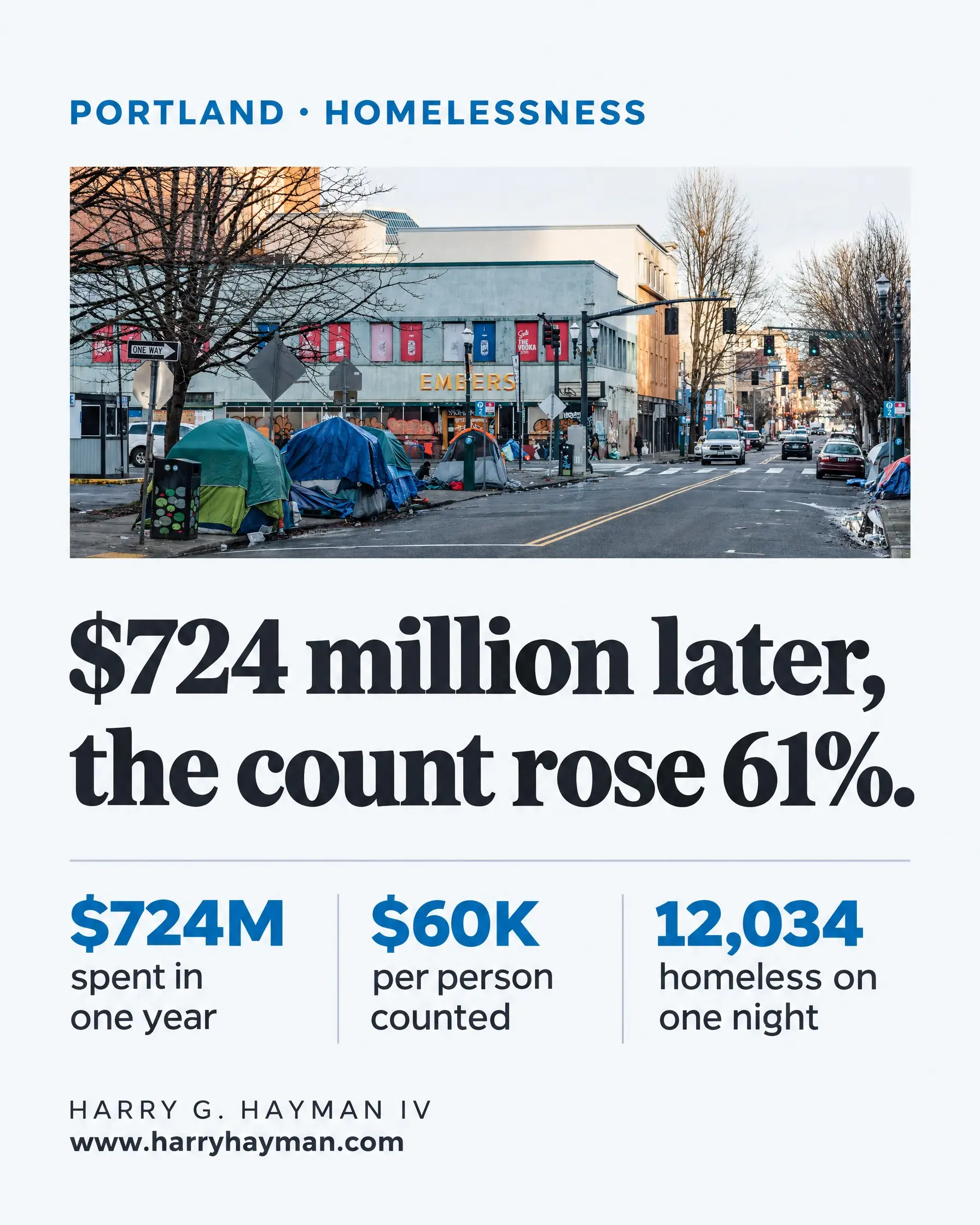
Portland’s region spent an estimated $724 million on homelessness in fiscal 2024. The latest regional count still found 12,034 people homeless on one night, up 61% from 2023. That gets my attention. A region can spend an enormous amount and still have more people counted without homes. Divide the spending by that later count and it comes to about $60,000 for every person counted. I want to know what the money bought. Someone sleeping outside deserves an answer that reaches further than the size of a budget, and so does the public paying for it. Here in Philadelphia, I want us asking that question while we can still use the answer to decide what comes next.
A huge budget and a rising count
The spending estimate covers Clackamas, Multnomah and Washington counties from July 2023 through June 2024. ECOnorthwest describes the resources as aimed at preventing or resolving literal homelessness or the near term risk of losing housing. This is a regional total for a fiscal year. The later count took place on January 22, 2025. I want those dates beside the figures because we should know exactly what we’re putting next to each other.
The 2023 regional Point in Time report records 7,482 people. By the later count, the number was 12,034. Part of that jump came from a new data set included for Multnomah County, but the count increased in every county. Meanwhile, Multnomah County reports nearly 5,500 people moved into homes and left homelessness during fiscal 2023 to 2024. Those people are no longer in the homeless count. So the about $60,000 figure is a ratio, not a bill for an individual’s care.
There. That’s the context. It doesn’t make the spending small or the increase comfortable. I can accept that the figures measure different things and still expect a region spending that much to explain its results. The people doing the work should be able to show what happened, and the people waiting for help should be able to understand the answer.
So the money was wasted? I don’t know that from these figures. So spend less? That doesn’t follow from them either. Before deciding which work to expand, change or stop, I’d want the housing results and their costs in front of me. Otherwise we’re arguing over a total without knowing which parts are getting people home.
What went out the kitchen pass?
I come at this through hospitality. You judge a kitchen by what goes out the pass, not by the food budget divided by the number of chairs. The budget matters. Of course it does. But I’d also want to know whether the meal reached the table and whether it was any good. A spending total gets me to the next question; it doesn’t answer it.
With homelessness, I want to follow the work to a person getting housed, then check whether that housing held. Someone entering shelter and someone moving into a permanent home are different results. Both deserve to be counted accurately. If we put them under the same broad heading and stop there, we lose information we need to make a useful decision.
The researchers who added up Portland’s spending are asking for more useful measures too. ECOnorthwest says continued progress depends on deeper data integration, “better cost-per-outcome metrics,” and more durable reporting frameworks. That phrase about outcomes is where I’d spend the meeting. Tell me what result we’re buying, which costs belong to it, and how we checked that it lasted.
For example, I’d ask a budget presenter to separate the cost of helping someone move into a home from the cost of helping them remain there. Explain what is included in each calculation. If the same person received several kinds of help, explain how the reporting follows that person without turning each service into a separate success story.
I’d also ask how prevention is being measured. If part of the budget is meant to keep someone from losing housing, show me how that result is checked. I want to understand the work before comparing its costs with a different service. Putting a clear purpose beside each part of the spending would help us ask a more useful follow up question.
That’s a proposal for how I’d ask the question, not a claim about how Portland’s agencies currently report. I want the answer in plain language, with the dates and definitions attached. An honest unknown is useful if somebody is responsible for finding it. A large total presented as proof of effort leaves me with nowhere to go next.
Houston gives me something concrete to examine
Houston’s regional system, The Way Home, offers a result worth studying. The Coalition for the Homeless of Houston/Harris County reported more than 32,000 people placed in permanent housing since 2012. The same release reported more than a 60% reduction in homelessness since 2011. Permanent housing placements, alongside a count tracked over time. Now I have something I can examine.
I like that the housing result is stated plainly. A person got into a permanent home. That’s closer to the purpose of the spending than the spending total itself. The regional system gives Philadelphia a named place to learn from, rather than leaving us with a broad demand to do better and no example of what better might look like.
Those figures still don’t tell me what each lasting housing outcome cost. They also cover different periods, so I would keep the dates attached rather than imply a direct calculation between them. I’d want to understand how people moved through the system and what happened after placement. The encouraging result is the beginning of that inquiry.
And here’s the part I want kept in the conversation: Houston’s 2025 count found unsheltered homelessness up 15.8% from 2024, partly because of reduced shelter capacity. The coalition connects street homelessness to sufficient shelter capacity and the flow into permanent housing. Its earlier progress doesn’t make that setback disappear.
I respect the willingness to put the harder result on the page. If we learn only from a city’s best year, we’re learning from an incomplete account. I want to see where the system made progress and where it needed attention, then ask what changed. A place with a record of getting people housed can still need to change what it does next.
Philadelphia, keep following the person
Here at home, the City of Philadelphia’s 2026 count found 711 people unsheltered, down 39% from 1,178. Good. Fewer people counted outside is news I want to hear. Keep going. I also want to know what happened after a person left the street, because that’s where the work can become harder to see from a count alone.
I’m asking for follow through. If someone got a home, were they still housed a year later? If that housing broke down, what did we learn? I want that information beside the count so we can see both the immediate change and whether the help lasted. Those questions are a request for evidence, not a description of what Philadelphia does or doesn’t publish today.
I’d want anyone presenting a budget to make it possible to follow the connection from the money to the outcome. Define who is included, say which spending period applies, and explain how continued housing was checked. If the answer covers only part of the work, say which part. That lets a reader judge the result without pretending the number tells us everything.
There is room to be hopeful here. Houston’s housing placements give us work to study. Philadelphia’s lower unsheltered count gives us reason to keep pressing. I want that hope attached to a result we can keep checking, including when the next report brings news we’d rather not hear.
When anyone puts a homelessness budget in front of you, ask how many people left the street, how many were still housed a year later, and what each of those outcomes cost. Ask for the dates and the method beside the answer. Keep that question on the table until someone can walk you through it.
Sources and references
- ECOnorthwest’s Portland region spending report: Spending estimate, fiscal period, regional scope and recommendations on outcome measures.
- Regional Point in Time count report: The 2023 regional count.
- Portland State University’s regional count release: The 2025 count, increase across counties and data change.
- Multnomah County’s housing and shelter report: People moved into homes during the fiscal year.
- Houston’s regional housing results: The Way Home’s permanent housing placements and reduction in homelessness.
- Houston’s 2025 count: The unsheltered increase and reduced shelter capacity.
- Philadelphia’s 2026 count report: Unsheltered count and decline.
- Photograph: Portland streets, Loren Kerns, December 27, 2020, licensed CC BY 2.0. The poster at the top of this page is a designed graphic built from this photograph.