Farmers Own the Founding Farmers in King of Prussia
Founding Farmers in King of Prussia is majority owned by family farmers. Here is how that works and what Philadelphia could learn from it.
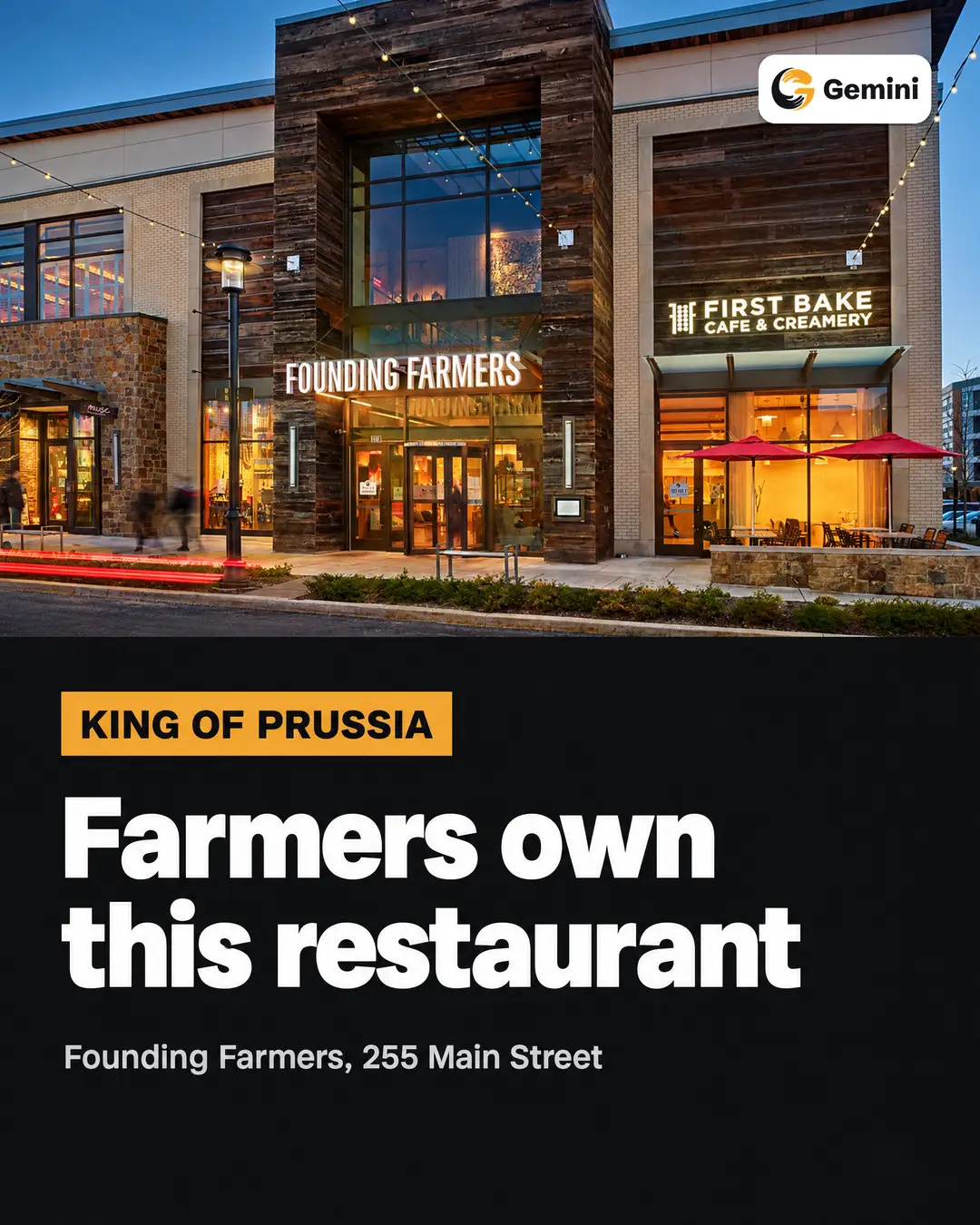
There is a restaurant at 255 Main Street in King of Prussia that most people drive past thinking of it as another good place to eat in a shopping district. Founding Farmers calls itself a full-service restaurant and bar open every day, and it is, but the part that holds my attention is on a different page of its website. The company says it is majority owned by American family farmers, including the more than 70,000 members of the North Dakota Farmers Union. That is a farm organization in a state more than a thousand miles from the Schuylkill, and its members are among the family farmers who majority-own a restaurant just outside Philadelphia. I run into a lot of ideas about how to give farmers more of the food economy. This one is already open, and I want to walk through how it is built because the structure is the lesson.
Who owns it, and who runs it
Founding Farmers states its ownership plainly: it is majority owned by American family farmers, including the members of the North Dakota Farmers Union and family farmers from the Minnesota and Wisconsin farmers unions. The union’s own restaurants page adds detail: North Dakota Farmers Union and Agraria LLC members, along with the Farmers Restaurant Group and partner investors, own the restaurants in Washington, D.C., Maryland, Virginia and Pennsylvania.
What the farmers do not do is run the kitchen. The company says it is led by restaurateurs Michael Vucurevich and Dan Simons, in partnership with Matt Perdue, a farmer and the president of the North Dakota Farmers Union, and the members who own the restaurants. That division is the part I would underline. Farmers supply capital, product and a mission. Professional operators supply the craft of running a seven-day restaurant. Neither side pretends to do the other’s job.
I should be careful about what is and is not public. Neither the company nor the union publishes the ownership split, the profits or any dividend paid to members, so I will not guess at them. The union says the model “has increased on-farm income for those who supply the restaurants,” but it does not put a number on that, and neither will I.
Why farmers decided to own a restaurant
The union’s stated reason is on its restaurants page: the idea was that farmers could secure a greater share of the food dollar by taking advantage of opportunities at the top of the production food chain rather than the bottom. In plainer words, they decided that selling ingredients to someone else’s restaurant was the weaker position and that owning part of the restaurant was the stronger one.
The federal numbers help explain the instinct, though I want to handle them with care. The USDA Economic Research Service reports that in 2024, farmers received 7.1 cents of each dollar Americans spent on food away from home, down from 7.5 cents the year before. In the same release, the foodservice industry group accounts for 65.8 cents of that dollar, 44.2 cents of it labor. Those two figures come from two different breakdowns of the same dollar, so they belong side by side and not added together. They do show where the value is added. It is mostly in the restaurant, and a farmer who only grows the food is not there.
Owning the restaurant puts farmers in that room. It does not make the work cheaper, since the labor is real, and I do not read the model as a trick to capture margin from diners, who pay ordinary restaurant prices. I read it as a decision about where capital goes.
How it grew
According to the union, the venture launched in 2006 with a single storefront, and eight restaurants now serve 50,000 people a week with food sourced from family farms and ranches, farmer-owned cooperatives and farmer-owned processing plants. The company says it opened its first restaurant in 2008 on Pennsylvania Avenue a few blocks from the White House. The two sources date the beginning differently, so I am writing it the way both can be true: launched in 2006, first Founding Farmers in 2008. The eighth restaurant opened in Alexandria, Virginia, in March 2025.
Pennsylvania came in the middle of that run. Philadelphia Magazine reported in 2016 that the group was bringing its next restaurant to the King of Prussia Town Center, and the Inquirer wrote about it at its opening in 2017 as a restaurant backed by farmers and farm groups.
What the farmers’ ownership does and does not mean on the plate
The company says it buys directly from farmers where it can, and that includes two of its own 18-wheelers running from American family farms and suppliers in North Dakota, picking up food and supplies along the way to Washington, D.C. That is a concrete supply chain choice and I find it interesting.
It is not proof that the menu in King of Prussia is mostly North Dakota product, and I will not suggest it. The share of food bought from owner-farmers is not published. Ownership and sourcing are two separate questions. A restaurant can have farmer owners and a buyer who purchases from many places, and the reverse is also possible. What Founding Farmers has shown is the first part: farmers can hold the equity in a restaurant group, and that group can reach eight dining rooms and a weekly audience of 50,000.
It is also a for-profit company. I am holding it up as a model to study and not as an endorsement of any particular dinner.
What a Philadelphia version would need
Here is where my work comes in. At Gemini Strategic Consultants we work on food systems and hospitality, and the question I keep asking is who would play the North Dakota Farmers Union’s role closer to home. If Pennsylvania farmers wanted to hold equity in a restaurant in Philadelphia, I count four parties that would need to sit at one table.
The first is a farmer group willing to pool equity. The raw material exists in the region: Lancaster Farm Fresh Cooperative describes itself as an organic farmers’ co-op of over 100 small farms. I am not suggesting it is planning anything like this, only that a co-op of that size shows that farmers here already organize themselves. The second is an experienced operator, because farmers own but do not cook, which is the arrangement Farmers Restaurant Group represents. The third is patient capital, for example a CDFI loan or a foundation program-related investment, to cover the gap between what farmers can contribute and what a restaurant costs to open. The fourth is a landlord who wants a farmer-owned tenant.
Diners pay ordinary menu prices. The gain goes to the farmer-owners, through a share of the margin the restaurant side earns. Founding Farmers lists no Philadelphia city location today, so the nearest example of this model sits in King of Prussia, a short drive from Center City.
The question I would put to the table
The question for anyone who works on a regional food economy is a practical one: who pools the farmer capital? North Dakota had an organization with 70,000 member families and a history that goes back to 1927, when the union was founded. Pennsylvania has its own farm groups and co-ops, and I do not know which of them would take the lead, or whether any would want to. That is the conversation worth having with them, and it is one I would welcome.
If you run a farm cooperative, a hospitality group or a fund that backs regional food businesses, the point I would pass along is simple. Selling to restaurants and owning part of one are different positions on the same dollar, and one group of farmers has been working in the second position for almost twenty years.
Sources and references
- Founding Farmers, About
- Founding Farmers, King of Prussia location
- North Dakota Farmers Union, Restaurants
- USDA Economic Research Service, Food Dollar summary findings
- Philadelphia Magazine, Farmer-Owned Restaurant Coming to the KOP Town Center
- The Inquirer, Founding Farmers keeps farming legacy alive at King of Prussia Town Center
- Lancaster Farm Fresh Cooperative
- Gemini Strategic Consultants