The Old UArts Dorm Becomes 45 Artist Homes, With Affordability in the Deed
Philadelphia's former UArts dorm in the Furness building is becoming 45 artist homes, and the affordability is written into the deed, not a budget.
Rent is the first fee every artist pays, long before anyone pays them for the work. I keep coming back to that when I think about the old University of the Arts campus on Broad Street. So when I read that the former UArts dorm, the red brick Furness building at the Village of Industry & Art, is becoming 45 homes for artists, with the affordability written into the deed, I stopped scrolling. I did not stop because it is a feel good story. I stopped because it is a mechanism, and mechanisms are what I care about. A promise that lives in a press release or a budget line can be renegotiated. A promise in a deed travels with the building. That is the idea I want to look at here, carefully, with the claims attributed to the people making them.
What is actually being built
On August 12, 2026, the Philadelphia firm Scout announced a $2.5 million grant from the John S. and James L. Knight Foundation to create 45 permanent affordable artist housing and residency units at the Village of Industry & Art, which the release calls “a major adaptive reuse project on Philadelphia’s Avenue of the Arts.” The homes go in the Furness building, which the release says was designed by Frank Furness and “anchors the 15th Street side of the project.”
The split matters. According to the same release, 35 of the units are long term rentals for working artists earning 60 to 80 percent of Area Median Income, and 10 are furnished short term residences for visiting artists and artist residencies. PhillyVoice put real numbers on that threshold: in Philadelphia in 2025 it was $51,563 to $68,750 for a one person household and $73,613 to $98,150 for a family of four. Those are the incomes the housing is meant to serve, which tells me something about who “working artist” means here. Not a trust fund. Someone with a day job in the arts and a studio practice squeezed around it.
The homes are not open yet, and I want to be exact about that. Reporting on the timeline differs a little: PhillyVoice quotes a project spokesperson saying completion is expected by the middle of next year, while Hyperallergic reported the units arriving by fall 2027. I will say due in 2027 and leave it there. The village’s own Artist Residences page says opportunities, including paths to long term live and work housing and applications for the residency program, “will be announced in late 2026 / early 2027.” There is no application date yet, so I am not going to invent one.
The deed is the idea
Here is the sentence in the release that made me read it twice. Artist housing was always central to the vision, it says, and that intention “is now a lasting commitment, written into the building’s deed, to ensure that affordable, artist-centered residences at the Village of Industry & Art are a permanent part of Center City” Philadelphia’s cultural and residential life.
Why does that matter to me more than the grant? Because grants end. A subsidy that depends on a yearly decision is a subsidy that has to win the same argument every year, in front of whoever is in the room that year. A restriction recorded on the property is a different kind of commitment, since it attaches to the building rather than to the owner. Lindsey Scannapieco, Scout’s managing partner, put the intent in her own words in the release: “This isn’t a temporary use, this is a permanent investment in desperately needed civic infrastructure for the cultural and artistic workers of Philadelphia.”
I am an outsider to the legal details, and I will say so. I have not read the deed, and the release does not publish its terms, so I cannot tell you how the restriction is enforced or for how long. What I can tell you is what Scout and Knight have said it is, and that they chose to say it in those words. If you work in housing law and can explain how deed restrictions like this hold up over decades, I would honestly like to hear it.
First, and largest, in their words
The release makes two claims I want to attribute carefully. It says the project “marks a first for Philadelphia in the heart of Center City - and the largest allocation of artist affordable housing ever developed in the city.” That is Scout and Knight’s description of their own project. I have not independently audited every artist housing project in the city, so I am repeating it as their claim and not as mine.
Knight’s side of the announcement framed it as economics as much as art. Kristina Newman-Scott, Knight’s vice president of arts, said that creating affordable places for artists to live and work is “an investment in Philadelphia’s long-term vitality.” John Churchill, Knight’s Philadelphia director, called the project “a story of resilience for Philadelphia’s $3.4 billion creative economy.” The grant also pays for programming. The release says artist led programs and partnerships with academic and cultural institutions will give residents access to paid opportunities for teaching, commissioning and public presentation, aimed at measurable gains in income and professional networks. Housing plus paid work is a better pairing than housing alone, and I think it is the part most people will skim past.
Where these buildings came from
To see why this matters, you have to remember how fast the old campus disappeared. The village’s history timeline is blunt: the University of the Arts abruptly announced bankruptcy in June 2024 and closed within two weeks. Philadelphia Magazine later counted what was left behind, nine properties totaling roughly 760,000 square feet, concentrated along the Avenue of the Arts.
I want to be careful with this part. I am not interested in assigning blame to the people who ran or worked at UArts. Students, faculty and staff lost something they did not choose to lose, and many of them are still hurting. What I am looking at is the system. When a university closes in two weeks, nothing in how our cities work asks what happens to the studios, the kilns, the dorm rooms and the community around them. The buildings go through bankruptcy and the market decides. Whatever comes next is luck.
Scout’s version of what comes next started with a purchase. PhillyVoice reports that in February 2025 the firm bought Furness Hall and nearby Hamilton Hall for $12.25 million. Scout is best known for turning a former South Philadelphia school into the Bok Building, and the village is, in the release’s words, “inspired by Scout’s Bok Building model.” Together the two buildings span more than 110,000 square feet across 1.9 acres. The village now calls the Broad Street building Haviland Hall, and says on its own site that it is the oldest on Broad Street, older than City Hall by 77 years, a line I am attributing to them. It also dates Furness Hall to 1875.
Who is already inside
Housing is only one half of this. The village already has tenants, and the community directory is the part I find most encouraging. BlackStar Projects, the nonprofit behind the BlackStar Film Festival, is there. So are Monument Lab and Design Philadelphia, along with the Stained Glass Project and more than 45 local artists, makers and small retailers.
The detail that got me, though, is smaller. The directory describes The Ceramics Dept, run by two former UArts ceramics alumni, Molly Bernstein and Liz Colyar, who are “revitalizing their former classroom into a community space for classes, workshops, memberships, and more.” Think about that for a second. Two people who learned a craft in a room come back and reopen the room. That is what continuity looks like when a system fails gently instead of completely, and it is the strongest argument I know for keeping artists near each other.
The civic backdrop, kept plain
The timing is not an accident, and I want to keep the context factual. On November 3, about 84 percent of Philadelphia voters, in unofficial results, approved making Creative Philadelphia a permanent office in the Home Rule Charter. Billy Penn notes that the change does not guarantee more money, since budgets still get set each year, and that results were awaiting certification when it reported. It also reports that the city cut the Philadelphia Cultural Fund from $5 million to $3.5 million in its latest budget, citing the Committee of Seventy.
I am not putting those facts next to the Furness building to score a point against anyone. They describe two different kinds of protection. A charter office protects a function of government, and a yearly budget decides what it can fund. A deed protects a specific place. I find it useful to see both in the same week, because it shows how many different layers an arts ecosystem actually needs.
There is another small piece of evidence that these buildings can keep serving the arts. Philadelphia Magazine reports that Music Theatre Philly has signed a 10 year lease on the former UArts Arts Bank, with options to extend and a right of first refusal if the landlord sells.
The what if I cannot shake
UArts left nine properties behind. Most of them will become whatever the market decides. A few, like the Furness building and the Arts Bank, are going back to arts use, and in the Furness case the promise is recorded in the property itself. So here is my question, thinking out loud: what if every institutional building Philadelphia loses came with an artist clause? Not as a demand placed on any one buyer, but as something the city and its funders design in from the start, the way you would design in a fire exit.
I do not know whether that scales. I do not know what it costs, who enforces it, or what it does to a building’s sale price. What I do know is that Scout and Knight have now shown one version of it, with a dollar figure, a unit count and a deed. If you make things for a living, the next move is simple: watch the village’s Artist Residences page for the application announcement, and read the release yourself.
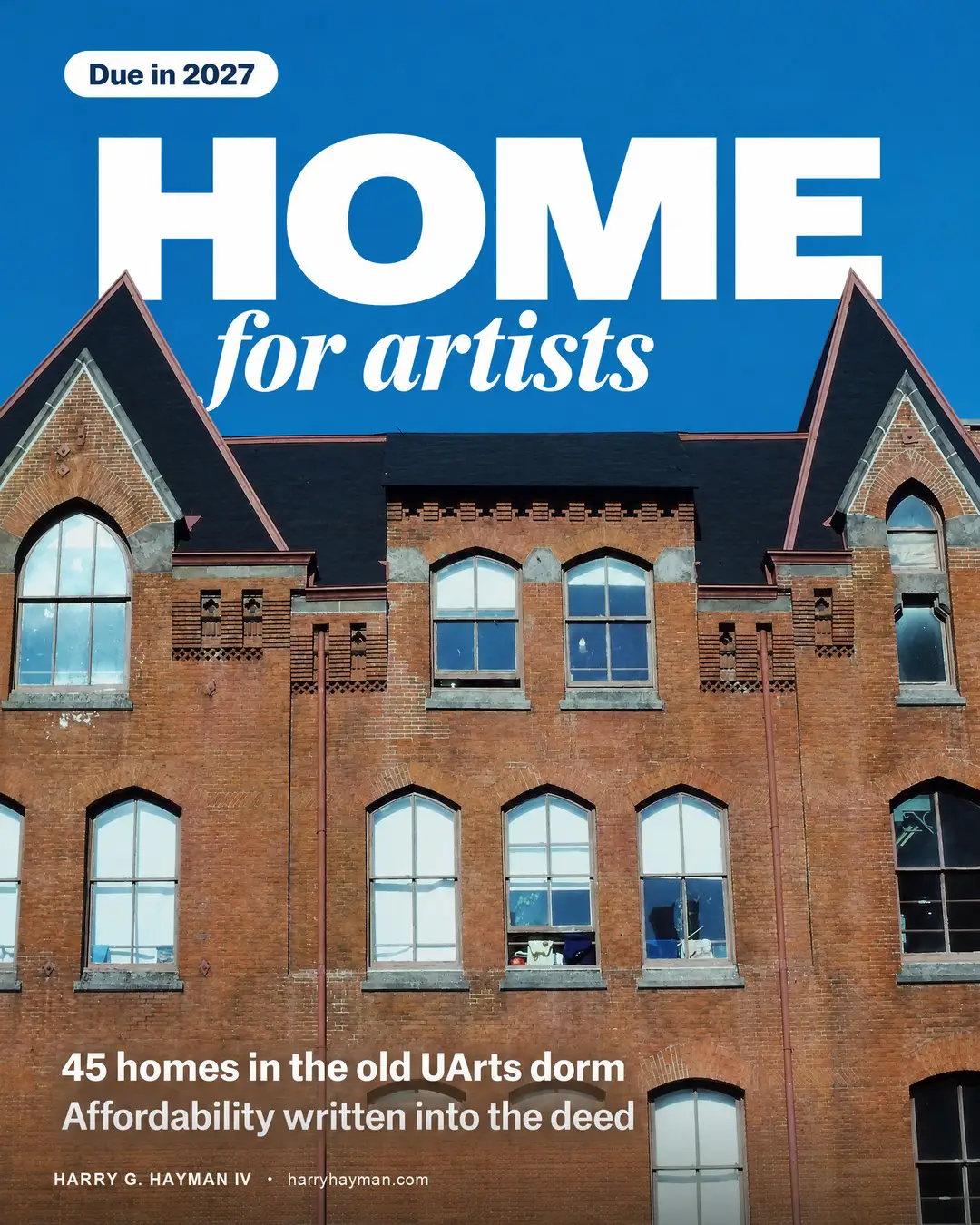
The photograph behind the poster is a 1990 view of the Furness building; the poster at the top of this page is a designed graphic built from it. Photograph by Bmzuckerman, via Wikimedia Commons, licensed CC BY 4.0. Changes: the image was extended with additional sky, cropped and set with type.
Sources and references
- Scout and Knight Foundation press release, August 12, 2026
- PhillyVoice: Furness Hall to become affordable housing for artists
- Hyperallergic: Former Philly UArts building to become affordable housing for artists
- Village of Industry & Art: Artist Residences
- Village of Industry & Art: About and site history
- Village of Industry & Art: Community directory
- Billy Penn: Philadelphia 2026 ballot questions pass
- Philadelphia Magazine: Former UArts building Arts Bank gets a second act
- Photograph by Bmzuckerman, Wikimedia Commons, CC BY 4.0
- Creative Commons Attribution 4.0 International license
