Farm Zero Grows Greens on the 18th Floor of a Chicago Tower
A law firm left an office floor in the Chicago Loop and a farm moved in. What Farm Zero shows Philadelphia about the empty floors of Center City.
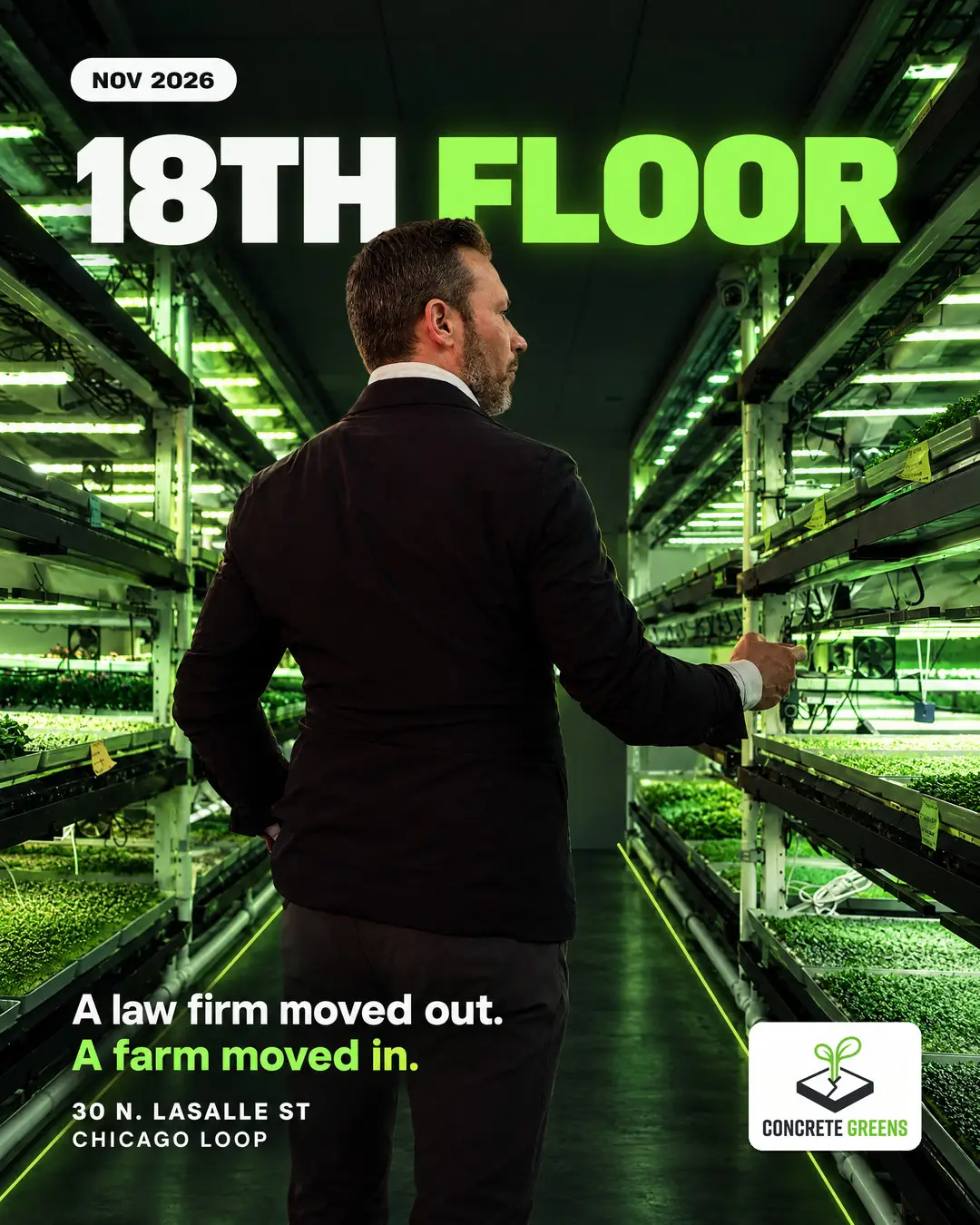
Picture the elevator. You press 18 in a Loop office tower, the doors open, and instead of a reception desk and a wall of law books you get racks of pea shoots under glowing bars of light. That is the picture I cannot shake from the ABC7 Chicago report on Farm Zero, which says it plainly: “a law firm used to occupy the space.” Now it is a farm. It sits on the 18th floor of 30 N. LaSalle St., and according to the Chicago Tribune, it was built after a special-use permit from the city’s Department of Planning and Development. I have been reading everything I can find about it, because Center City Philadelphia has the same raw material and I want to know what the Chicago version teaches us.
What is actually on the 18th floor
Farm Zero is led by founder Russell Steinberg. The Tribune reports that it moved into 30 N. LaSalle in June 2024 and built a farm of 1,000 square feet. Sizes differ between outlets, so I will say “about 1,000 square feet” and attribute it: WBEZ’s What’s That Building? column gives the same figure, while other coverage describes a smaller footprint. Whatever the exact number, it is a room, not a warehouse.
The Tribune says the farm runs almost like a production line, with five people overseeing operations. WBEZ describes the setup as a climate and light controlled enclosure on a former office floor, with plants in trays under artificial light and growing cycles written on Post-it notes. A 100-gallon tank circulates water through the shelves. Steinberg told WBEZ that everybody he talks to worries about flooding, which is a very office tower question to ask about a farm.
What grows there is mostly small and fast: microgreens, leafy greens, herbs and edible flowers, with pea shoots among the crops the Tribune mentions. Small and fast matters. A crop that turns over in days can be sold in days.
The buyers are downtown
This is the part that changed how I think about the idea. According to the Tribune, products are typically delivered within 48 hours to partner restaurants, companies and healthcare programs across downtown Chicago. The chef at Blue Plate, a catering company, told the paper the company buys between 30 and 60 pounds of produce every week, including microgreens, lettuces and pea shoots.
Steinberg also told the Tribune that Farm Zero sells to the University of Chicago Medicine and the University of Illinois College of Medicine for their healthcare programs, and provides workplace dining services for organizations such as Jump Trading, Tempus AI and Uber, along with restaurants like Bazaar Meat and NoMI. Those are his statements to the reporter, and I am repeating them as his statements. Even so, the shape is clear: a caterer, two medical institutions and company cafeterias, all within a short ride of the farm.
NPR’s Morning Edition covered Farm Zero again on November 3, 2026, describing a company that uses empty downtown office space to grow edible greens and deliver them to restaurants, caterers, other office buildings and people who live in nearby high-rises. So it is still operating, and still selling.
The landlord is part of the model
Here is the detail I find most useful for Philadelphia. WBEZ reports that developer Lee Golub lent the 18th floor space. The Tribune quotes Golub on the building’s side of the ledger: “The amount of water we use versus a typical tenant is probably less because we recycle it, and it gets to be about 92 to 94% reusable.” Reading that, I do not hear a landlord tolerating a strange tenant. I hear one comparing a farm to the tenant it replaced.
The Tribune also reports that the farm uses the building’s existing infrastructure, and that is the point: a floor in a working tower already comes with power, air handling and water. The buyers are blocks away. Nobody had to find a field or truck greens in from three states away. The building is also in the middle of its own change: WBEZ reported in 2025 that the bottom 18 floors of 30 N. LaSalle would be turned into 349 apartments, with the rest remaining offices and amenities. A farm on the 18th floor is part of a tower that is deciding what it wants to be.
Does it pay? The founder’s numbers
I want to be careful here, because indoor farming has a history of numbers that did not survive contact with a balance sheet. The Tribune reports that Steinberg said Farm Zero is close to approaching its break-even point on the first farm, and that the company expects to reach around $300,000 in revenue. Those are the founder’s statements, not audited figures, and I am not treating them as proof.
What I will say is that the claim is modest. It is not a promise to feed a city. It describes one small room that is nearly paying for itself. The Tribune adds that construction on a farm seven to 10 times larger at 125 S. Wacker Drive was due to begin in July, with a further location planned at 401 S. State St. by summer 2027. I could not confirm that the Wacker farm has finished, so I will watch that one rather than report it as done.
Center City has the same raw material
Now to Philadelphia. The Philadelphia Inquirer, reporting on the Center City District’s State of Center City 2026 report, put Center City’s office vacancy at about 20%. In that same Inquirer story, 2 million square feet of office space has been removed from supply to be converted into residential, and 1,000 new apartments are slated in the West Market office district alone. Of the 57 available spaces offering a whole floor or more, only 10 are in high-rises.
That last number is the one I keep returning to. Chicago’s farm lives on a floor of a high-rise, and in the Inquirer’s count only 10 of the 57 whole floor spaces on offer in Center City are in high-rises. I do not know which conversion, if any, would suit a farm. I am not claiming that Philadelphia has the buyers, or that it has a zoning path for 1,000 square feet of food production. Chicago needed a special-use permit, and I do not know what the same room would need here.
Those are questions, and I would rather ask them out loud than pretend to have the answers.
What I would do with this
My aim at Concrete Greens is specific: local food grown year-round that complements traditional farms, covers its own costs and sends surplus to neighbors facing food insecurity. Farm Zero is a different company with its own model, and I am not borrowing its claims. What I am borrowing is the order of the story. A floor was left. A landlord lent it. Buyers were already nearby. Then the farm.
So here is my ask, and it is aimed at the people who decide what happens to Center City’s conversions. Pick one building. Give one floor to food. Find out what permit it needs and who the first three buyers would be. If a developer reading this has a floor that apartments cannot use, I would like to hear about it.
About the Author
Harry Hayman is a Philadelphia-based entrepreneur, music producer, and cultural advocate. Through his work with the Feed Philly Coalition, he explores and documents the creative, culinary, and civic life of a city he believes is one of the most inspired places in America.
Sources and references
- Chicago Tribune: vertical farms in the Chicago Loop (June 9, 2026).
- ABC7 Chicago: vertical farm in a downtown office building, Chicago Loop (March 4, 2026).
- WBEZ: What’s That Building? FarmZero (June 3, 2025).
- NPR Morning Edition: Chicago entrepreneur turns empty downtown office space into vertical gardens (November 3, 2026).
- Philadelphia Inquirer: Center City job growth and the economy (April 29, 2026).
- Center City District: State of Center City 2026.
- Farm Zero: official site.
- Hero image: photograph of Russell Steinberg by John J. Kim for the Chicago Tribune, May 12, 2026. The poster at the top of this page is a designed graphic built from that editorial photograph, regraded to a night palette with type added. All rights remain with the Chicago Tribune and the photographer.