Committee of Seventy: Philadelphia's Nonpartisan Civic Group Since 1904
I joined the Committee of Seventy, Philadelphia's nonpartisan civic organization founded in 1904. Here is what it does and what joining means.
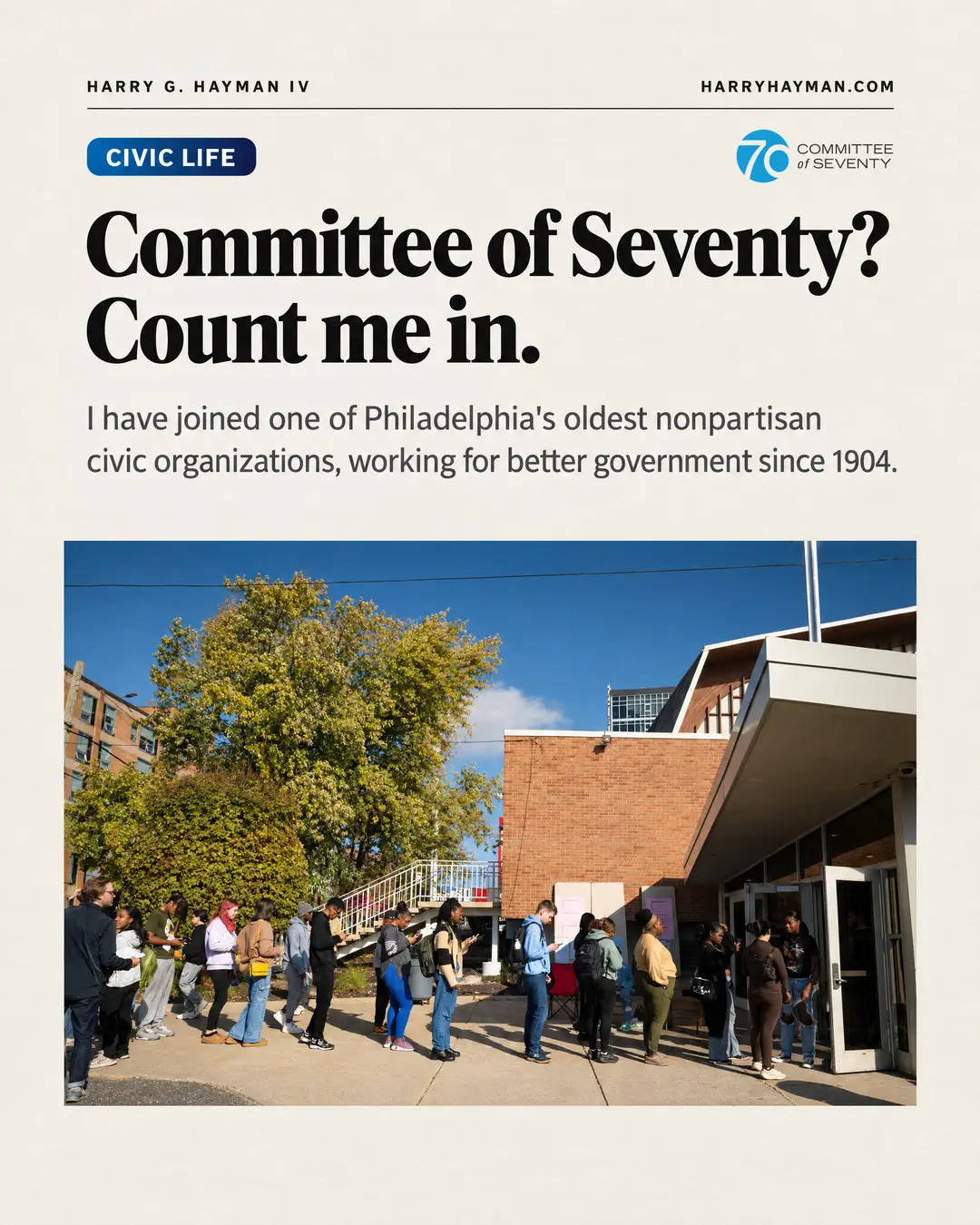
Remember the first week of college, when you walked the activities fair and every table had a clipboard and every club sounded like the one you were meant to join? I had that feeling this month. I’m Harry Hayman, and I have joined the Committee of Seventy, the nonpartisan civic organization that has been working on Philadelphia’s elections and government since 1904. I would love to say I arrived with a plan. What I had was enthusiasm, a long list of things I care about and, apparently, a clipboard. This is the longer version of my post: what the Committee is, how it started, what it does now, what joining means on its own website, and why someone who spends an awful lot of time on food, hospitality and economic development cares how a city’s government works.
What the Committee of Seventy Is
The Committee of Seventy, which also goes by Seventy and C70, is a nonpartisan, nonprofit civic organization in Philadelphia that works toward government people can trust. Its offices are on South Broad Street, and its about page puts the mission in one sentence: it is “a nonpartisan civic leadership organization that advances representative, ethical and effective government in Philadelphia and Pennsylvania through citizen engagement and public policy advocacy.” The same page says Seventy “does not endorse candidates or represent any special interests,” and its vision, in its own words, is “better government citizens can trust.”
Local reporting describes it the same way. When Billy Penn’s Davis Cuffe wrote about the group in June 2025, he called it “a nonpartisan, nonprofit organization that advocates for improvements in local and state government.” I keep coming back to the word trust in that vision. Every project I touch depends on it, and it is slow to build and quick to lose.
How It Started in 1904
Seventy’s history page gives the origin story. On November 14, 1904, a group of business and civic leaders, among them names still familiar today such as Strawbridge and Fels, met at the Philadelphia Bourse to do something about the state of city government. Two months later, the page says, the Committee of Seventy was up and running. Wikipedia’s entry on the Committee fills in the steps between: an initial Committee of Seven formed in December 1904 and grew in January 1905 into the Committee of Seventy.
The founding statement had four goals, and Seventy still keeps them on its page about the original mission statement. Two of them could hang in a civics classroom today: protect the ballot, and gather and share accurate, nonpartisan information on the city’s affairs. The founding principle fits on a bookmark: “To keep watch and ward over the public interests.”
The name is a Bible reference. According to Wikipedia, which quotes the organization’s own explanation, Exodus “tells of seventy elders who were appointed to assist Moses in the governance of the people.” I like that a reform group born in a Philadelphia room in 1904 borrowed its name from a very old idea: nobody governs alone.
What Seventy Does Today
If you only click one thing, make it the Interactive Voter Guide. On its voter guide page, Seventy describes a guide that lets you research your ballot, see how candidates answered the Committee’s own questionnaire, and find election information for all 67 Pennsylvania counties. The same page notes that Pennsylvanians go to the polls on Tuesday, November 3, 2026. Seventy’s impact report page says that in 2024 tens of thousands of voters used the guide to research candidates, make a plan to vote, build sample ballots, find polling places and check their registration.
That page also reports on the people who staff polling places. Seventy says more than 8,500 poll workers were trained with its support in 2024. It also says it hosted 52 training sessions with the League of Women Voters of Pennsylvania and helped every Philadelphia polling place reach full staffing on Election Day. The Committee publishes poll worker resources, offered in partnership with the League, for anyone who wants to staff a polling place.
For younger people there is WeVote Next, which offers civic education programs from kindergarten through college, designed to give students real experience with government and civic participation. For everyone else there is How Philly Works, a guide to city government. Billy Penn reported that Seventy added Spanish and Chinese editions in 2025, with explanatory sections on City Council and the budget, the school district and other elected officials, and the Committee’s page now lists French as well. Seventy’s president and CEO, Lauren Cristella, told Billy Penn that when people cannot find the answers in a language they understand, “our entire system of government becomes a locked door.” I could not have described the problem better.
Then there is Philadelphia Documenters, now housed at Seventy. It trains everyday residents to attend public meetings of local government, take accurate notes and submit them for editing and publication, on a national model developed by City Bureau. The page describes the role as neutral eyes and ears for the public. I love that idea, because the same page points out that local government makes decisions every day about schools, housing, streets and safety, and that those public meetings often go unobserved and unrecorded.
What Joining Means
On Seventy’s own website, joining means becoming a member. The Become a Member page says members are “joining a vital part of the movement to strengthen democracy” and helping power the Committee’s mission. Among the benefits it lists are invitations to events that include policy briefings with experts, members only events for conversation and exchanging ideas, opportunities to volunteer at civic education events, and recognition in the Impact Report, which honors all members every other year.
I want to be plain about what I am and am not doing. I joined as myself, and everything on this page is me speaking for me. I am not here to tell anyone how to vote, and I am glad the group says it does not endorse candidates. What I said in my post is what I mean: I want to learn more, meet people who care about these issues, and hopefully contribute something useful along the way. I don’t know yet where I will be most useful, and I’m fine with that.
Why Government That Works Matters to Everything Else I Do
A lot of my time goes into projects that involve food, hospitality, economic development, arts, education and community organizations. The longer I do that work, the clearer it gets that all of it rests on the same three things: a government that actually functions, institutions people can trust, and residents who understand how decisions get made. You can have the greatest ideas in the world, but if the systems around them don’t work, good luck getting anything done.
I think of civic life as plumbing. Nobody applauds it, and nothing else in the building works without it. I believe civic engagement is a contact sport, and the Committee gives people a way to get in the game. Its Five Habits of Active Citizenship, which the page calls a checklist, are to be a voter, invite diverse perspectives, choose your news wisely, learn how it works, and act. None of them asks you to pick a side. They ask for attention, practiced often enough to become a habit.
The year suits it, too. The National Park Service describes Independence Hall as the building where the Declaration of Independence and the Constitution were debated and signed, and 2026 is the 250th anniversary of that Declaration. A group devoted to the everyday practice of democracy belongs in this city in this year.
Anything Can Happen Day
On the day I wrote my post, I woke up thinking about something I used to say all the time: “Today is anything can happen day.” And who gets to decide what happens? I do. I realize that may be a frightening prospect for some of you, and I’m sorry about that. Actually, no I’m not.
So what is next? I have absolutely no idea, and that is a big part of the fun. The same week I joined Seventy, I also joined the Sunday Breakfast Club, which by its own admission does not meet on Sundays or for breakfast. Guitar lessons are on the list too, because why not.
If a clipboard is already in your hand, Seventy lists places to start: learn the five habits, read the poll worker resources, or become a Philadelphia Documenter and sit in on a public meeting. I love Philadelphia, and after all these years I’m still excited about the possibilities here. There is a lot that needs fixing, plenty worth protecting, and no shortage of interesting people trying to make things better. I want to be part of those conversations, and more importantly, I want to be part of getting things done.
So thank you to the Committee of Seventy. I’m looking forward to getting involved. Now, seriously, somebody hide the clipboard before I join another six organizations before dinner.
Sources and references
- Committee of Seventy
- Committee of Seventy: About Us
- Billy Penn: New Spanish and Chinese How Philly Works guides aim to break language barriers for voters (June 2025)
- Committee of Seventy: Our History
- Wikipedia: Committee of Seventy
- Committee of Seventy: Original Mission Statement
- Committee of Seventy: Interactive Voter Guide
- Committee of Seventy: Voter Guide
- Committee of Seventy: Our Impact
- Committee of Seventy: Become a Poll Worker
- Committee of Seventy: WeVote Next
- Committee of Seventy: How Philly Works
- Committee of Seventy: Philadelphia Documenters
- City Bureau
- Committee of Seventy: Become a Member
- Committee of Seventy: The Five Habits of Active Citizenship
- National Park Service: Independence Hall
- Sunday Breakfast Club