The Dead Milkmen at Laurel Hill Cemetery: Punk Among the Tombstones
I watched The Dead Milkmen play a punk set among the tombstones at Laurel Hill East in Philadelphia, a cemetery founded in 1836 for the living.
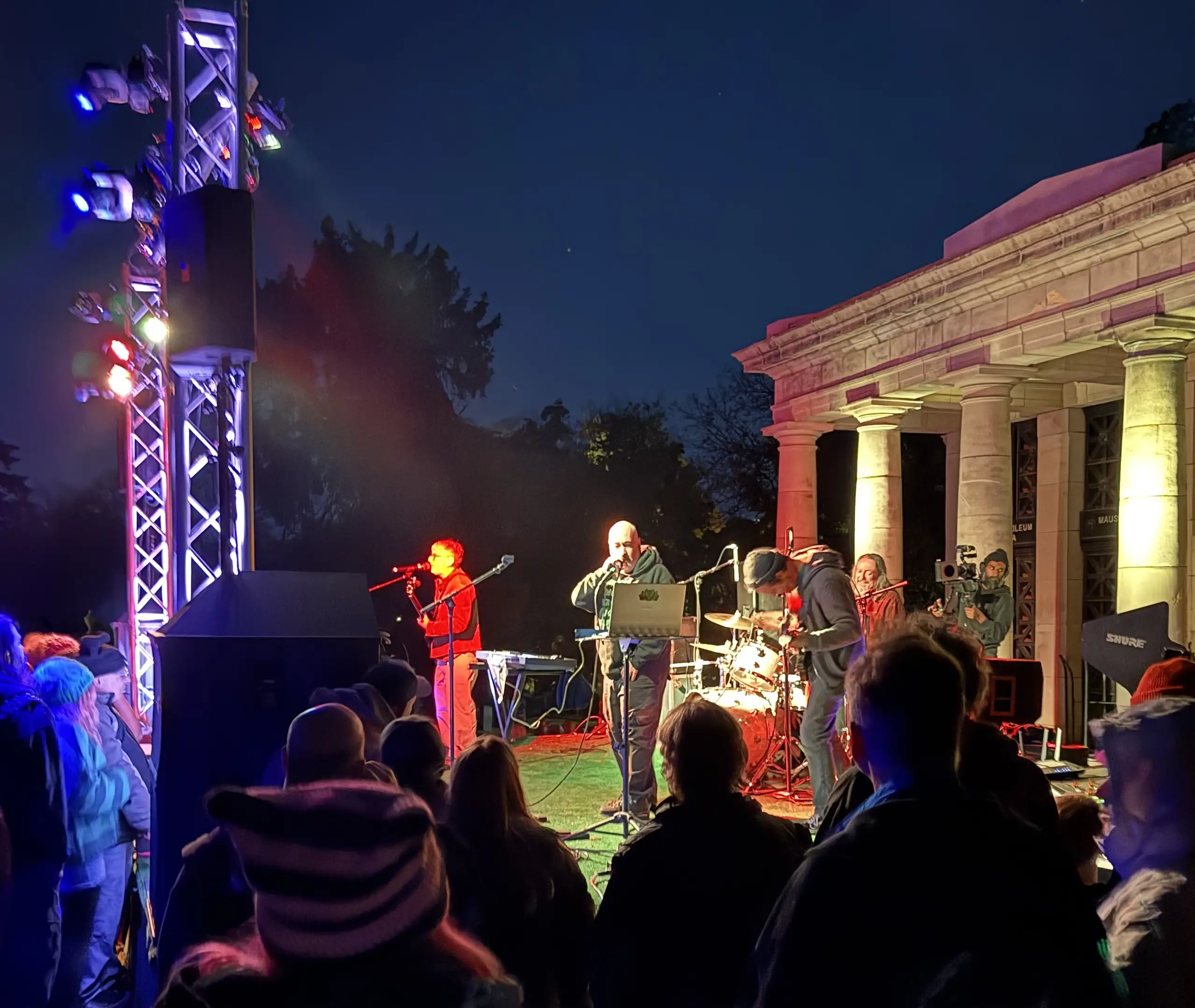
On Saturday night, October 17, I stood among nineteenth century mausoleums, under old trees, on a hillside overlooking the Schuylkill River, and watched The Dead Milkmen play a punk set in a cemetery. I’m Harry Hayman, and in my post about that night I said it twice, because it earns it: only in Philadelphia. I have been seeing this band since the 1980s, which is hard for me to believe too, and I tell anybody who will listen that they are one of the great Philadelphia bands. Putting them in the middle of Laurel Hill made perfect sense. This is the longer version of that post: what the cemetery promised about the show, who the band is, what Laurel Hill was built to be in 1836, and why the night felt personal.
A Saturday Night Among the Tombstones
The cemetery’s own event page is titled NEW DATE: The Dead Milkmen at Laurel Hill. It lists the show for Saturday, October 17, 2026, at 7:30 pm at Laurel Hill East, and says it was rescheduled to that Saturday because of inclement weather. The pitch is two short lines. THEY HAVE RETURNED! Come see the legendary Philadelphia punk rock band amongst the tombstones at Laurel Hill East. That sentence alone deserves to be framed.
A quick note on the word East. Laurel Hill is two cemeteries. The original sits at 3822 Ridge Avenue in East Falls, as the National Park Service’s register record shows, and that is where I stood. According to the cemetery’s history page, the growth of Fairmount Park in the 1860s boxed it in, so in 1869 the founder, John Jay Smith, bought land across the Schuylkill in Lower Merion Township to expand, which became Laurel Hill West.
The post carries ten of my photos. The first shows the band on a lit stage on the lawn in front of a columned mausoleum, a lighting rig to one side and a crowd in the foreground. The next two move in on the stage. Then the pictures turn to the place: the state historical marker, the gatehouse after dark, mausoleums lit in purple and green, an illuminated tomb, and two statues. You cannot separate this band from this ground.
The Band That Never Tried to Be Anybody Else
The Dead Milkmen formed in Philadelphia in 1983. Wikipedia’s entry on the band gives the original lineup as Rodney Linderman, who goes by Rodney Anonymous, Joe Genaro, Dave Schulthise and Dean Sabatino, and says they set themselves apart in the early 1980s hardcore scene with a jangly punk sound and sardonic humor delivered in thick Philadelphia accents. The 1985 debut album, Big Lizard in My Backyard, and the song Bitchin’ Camaro brought college radio attention, and Punk Rock Girl, from the 1988 album Beelzebubba, reached MTV rotation. The band broke up in 1995 and reunited in 2008, with Dan Stevens on bass after Schulthise’s death in 2004.
That is the biography. Mine is shorter. Not polished, far from it, and I mean that as praise. Not precious. Not pretentious. Not trying to be anybody else. Smart, sarcastic, absurd, subversive, funny, loud, and completely their own thing. That is why Philly is great.
They have also been here before, which I should have said in my post. WHYY previewed an earlier Laurel Hill show in September 2014, when Rodney Anonymous was asked whether the band had ever played a concert in a cemetery. His answer was two words: “Legally, no.” Of the decision to play Laurel Hill he said, “It’s either the best or worst decision we’ve ever made.” Instead of a stage, the piece reported, the band would play near the receiving vault, in an area flanked by high metal doors and mausoleums. A May 2015 Suburban Life profile looked back on that September show and said it brought more than 1,000 people to the cemetery, with a mausoleum as the stage. The magazine says the band emailed the director of programs to ask, “Can we do a show there?” and she obliged. So when this year’s page says THEY HAVE RETURNED, it means it.
A Cemetery Built for the Living
My post said Laurel Hill was designed not just as a burial ground but as a sanctuary for the living. The record backs me up, with one caution. The Encyclopedia of Greater Philadelphia’s essay on Laurel Hill, by the historian Thomas H. Keels, says it was founded in 1836 as an alternative to the overcrowded churchyards of a fast growing Philadelphia. The idea came from John Jay Smith, a Quaker editor and horticulturist, who wanted a rural cemetery like Père Lachaise outside Paris. Mount Auburn in Cambridge, Massachusetts, was founded in 1831 as the first in the country, and Laurel Hill was the second. Smith’s push was personal: after construction next to the Friends’ Burial Ground at Arch and Fourth Streets, where nearly 20,000 bodies were crowded into less than half a city block, he could not find his daughter’s grave.
In early 1836 Smith and his associates acquired a 32 acre estate on the east bank of the Schuylkill, rising 100 feet above the river. John Notman, a Scottish immigrant, designed the Roman Doric gatehouse on Ridge Avenue, and the ground plan is usually attributed to him too. TCLF’s profile calls it his first known commission and dates the 1861 addition of the 21 acre Fairy Hill section, which brought the total to 78 acres. That is the figure on the state marker in my fourth photo, which reads in part:
Founded in 1836 and designed by Scottish architect John Notman, this was the nation’s second major rural cemetery. … Overlooking the Schuylkill River, 3.5 miles north of center-city, it had grown by 1861 to 78 acres. This cemetery was designated a National Historic Landmark in 1998.
The cemetery’s history page adds that it was the first cemetery to be honored as a National Historic Landmark.
Now the park line. By 1844, Keels writes, nearly 30,000 people visited Laurel Hill each year to escape the heat and crowds of the city, and he calls it a tourist attraction that provided a prototype for Fairmount Park. The history page says Laurel Hill predated the public park system and in many ways served the same purpose before the idea existed. The dates fit. The Encyclopedia’s Fairmount Park essay says Lemon Hill was dedicated as Fairmount Park in 1855 and that acts of Assembly in 1867 and 1868 created the Fairmount Park Commission. Here is the caution: the same essay says the park did not introduce recreation to Philadelphia, because the Schuylkill and the Wissahickon had been popular destinations since the eighteenth century. So I will not claim Laurel Hill invented the day out. I will say it was the city’s first rural cemetery, and that people really did come to walk, reflect and take in the architecture and sculpture, just as I wrote.
Still Doing Exactly That
Nearly two centuries later, we are still doing exactly that. Keels closes his essay by noting that by the early 2000s thousands of visitors a year were attending concerts, films, ghost hunts, astronomy nights and walking tours at Laurel Hill, using the cemetery for recreation and relaxation just as their nineteenth century counterparts did. A June 2026 Billy Penn guide says it is open 365 days a year to anyone who wants to walk a dog or take a stroll, and that many families think of it as their community park. Its president and CEO, Nancy Goldenberg, told Billy Penn that rural cemeteries were “meant to be places where people could come with their families and enjoy the fresh air and a day out of the pollution of the industrial city,” and that people came “whether they had a loved one buried there or not.”
The place is part cemetery, part sculpture garden, part arboretum, part history lesson, and part living piece of Philadelphia. The arboretum part is literal. The cemetery’s arboretum page describes an accredited arboretum with over 9,000 trees and shrubs representing over 1,000 species and cultivars, and quotes the horticulturist Andrew Jackson Downing, who visited in 1849: “It is a better arboretum than can easily be found elsewhere in the country.”
The sculpture garden is in my photos. One mausoleum has SHIELDS carved over the door and glows purple in the light. Another, MACALESTER, glows green. The history page says a lighting project launched in 2020 highlights significant mausoleums and monuments for travelers on Kelly Drive at night. I cannot tell which lights in my pictures are the cemetery’s and which came with the show.
The history lesson runs deep, and so does the strangeness. Billy Penn lists General George Meade, who led the Union Army at Gettysburg, among the people buried here. It also lists the longtime Phillies broadcaster Harry Kalas, whose grave is marked by a large microphone, sod from Citizens Bank Park and seats from Veterans Stadium, and mentions a headstone for Adrian Balboa that was used in a Rocky movie and remains among the other graves. If that is not Philadelphia, I do not know what is.
My Sister Is Part of This Place
I said in my post that this was personal for me, and I want to say it here as plainly as I did there. My sister was cremated at Laurel Hill. I am not going to add details, because those belong to her and to my family. Billy Penn notes that Laurel Hill is still an active burial site, and that matters to me. The same ground that hosted a punk show is still where families bring the people they miss.
So I stood there listening to the Dead Milkmen, surrounded by thousands of stories, memories, monuments, trees, ghosts, laughter, music and this absolutely insane city I love, and something about it landed. Wikipedia’s entry on the cemetery counts more than 11,000 family lots and more than 33,000 graves, so thousands is, if anything, polite. It was funny and sad. Loud and quiet. Life and death. Memory and music, all occupying the same patch of ground at the same time.
Maybe that is what Laurel Hill has always been about. It was never only about death. It was about continuity: the people who came before us, the people we miss, the people standing next to us, and whatever strange, beautiful noise we get to make while we are still here.
Keep Philadelphia Strange
Near the end of my post I told Philadelphia to keep getting weirder and to keep making noise. Keep changing. Change constantly. Get stranger. Get louder. Put punk bands in cemeteries and turn old places into new experiences. Laurel Hill shows how that works without losing the old thing: a ground laid out in 1836 for families to walk and look and remember, hosting a band that formed in 1983 and never tried to be anybody else.
The part I mean most is the last part. Honor the dead. Celebrate the living. Never, ever become boring, and never, ever forget what made you who you are, because the day a city does that is the day it dies and becomes dead to me.
Long live the Dead Milkmen. Long live Laurel Hill. Long live Philadelphia.
Sources and references
- Laurel Hill Cemetery: NEW DATE: The Dead Milkmen at Laurel Hill
- Laurel Hill Cemetery: History
- Laurel Hill Cemetery: About the Arboretum
- National Park Service NPGallery: Laurel Hill Cemetery National Register record
- The Dead Milkmen (Wikipedia)
- WHYY: Dead Milkmen to entertain living fans at Laurel Hill Cemetery concert
- Suburban Life Magazine: Resurrected (May 2015)
- Encyclopedia of Greater Philadelphia: Laurel Hill Cemetery
- Encyclopedia of Greater Philadelphia: Fairmount Park
- TCLF What’s Out There: Laurel Hill Cemetery
- Billy Penn: More than a cemetery, inside Laurel Hill (June 2026)
- Laurel Hill Cemetery (Wikipedia)